As of October 21, 2026.
The verdict: If you’re eligible, open a First Home Savings Account (FHSA) before Dec 31, 2026 (71 days left). Opening in 2026 gives you $8,000 of contribution room for 2026. Opening in January 2027 gives you none for 2026 — and you reach the $40,000 lifetime limit a full year later.
Who this is for: Canadian residents, 18 or older, who pass the first-time home buyer test and don’t have an FHSA yet.
Your move: Open the account in 2026, even with a small deposit — or no deposit. Then file Schedule 15 with your 2026 tax return so the CRA records the account.
The rule that makes December matter
FHSA room doesn’t build up from the year you turn 18. It doesn’t build up from 2023, when the account launched.
It starts in the year you open your first FHSA. The CRA puts it plainly: your FHSA participation room in the first year you open your FHSA is $8,000.
Open in December 2026 and 2026 counts as your first year. You get the full $8,000 of 2026 room.
Wait until January 2027 and your first year is 2027. There is no 2026 room for you. Not reduced room. None.
That’s the whole deadline. Dec 31, 2026 is the last day to make 2026 your first year.
Who can open one
You have to be a “qualifying individual” on the day you open the account. The CRA’s definition of a qualifying individual means you meet all three tests:
- You’re 18 years of age or older.
- You’re a resident of Canada.
- You’re a first-time home buyer for the purpose of opening an FHSA.
The first-time buyer test is about where you’ve lived, not whether you’ve ever held a mortgage. For opening an account, you count as a first-time buyer if, in the part of the current calendar year before you open the account and in the preceding four calendar years, you didn’t live in a qualifying home as your principal place of residence that you owned or jointly owned — or that your spouse or common-law partner (at the time you open the account) owned or jointly owned.
Owned a home you lived in five or more years ago? You may pass the test again. Own a rental property you’ve never lived in? That alone doesn’t fail it.
You open through an FHSA issuer — a bank, credit union, or a trust or insurance company. You’ll need your social insurance number and your date of birth, plus any documents the issuer needs to confirm you’re a qualifying individual.
One more step people miss: file your tax return for the year you open your first FHSA and complete Schedule 15 — FHSA Contributions, Transfers and Activities — even if you put nothing in. That’s how the CRA knows the account exists.
The math: December 2026 vs January 2027
The annual amount is $8,000. The lifetime FHSA limit is $40,000.
Say you contribute the maximum every year. Here’s the only difference opening date makes:
| Year | Open Dec 2026 — cumulative contributions | Open Jan 2027 — cumulative contributions |
|---|---|---|
| 2026 | $8,000 | $0 — no account, no room |
| 2027 | $16,000 | $8,000 |
| 2028 | $24,000 | $16,000 |
| 2029 | $32,000 | $24,000 |
| 2030 | $40,000 — lifetime limit reached | $32,000 |
| 2031 | $40,000 | $40,000 — lifetime limit reached |
Read the table carefully, because the gap is timing — and timing is the money.
Both savers can reach $40,000. The lifetime limit doesn’t shrink if you open late.
But the December opener gets there in 2030. The January opener gets there in 2031.
At Dec 31, 2030, the gap is exactly $8,000: $40,000 contributed vs $32,000. If you buy a home in 2029 or 2030, that $8,000 of room — plus the tax deduction and tax-free growth that go with it — is room the January opener doesn’t have yet.
A small deposit works the same way
You don’t need $8,000 in December. You need the account open.
The CRA’s own example makes the point: a saver who opens an FHSA and makes no contributions in that year still counts that year as her first year, and files Schedule 15 to record it.
Say you open in December 2026 and deposit $500:
- Your 2026 room is $8,000. You’ve used $500.
- $7,500 of unused room carries forward.
- Your room in 2027 is $15,500: $8,000 of new room plus the $7,500 carried forward.
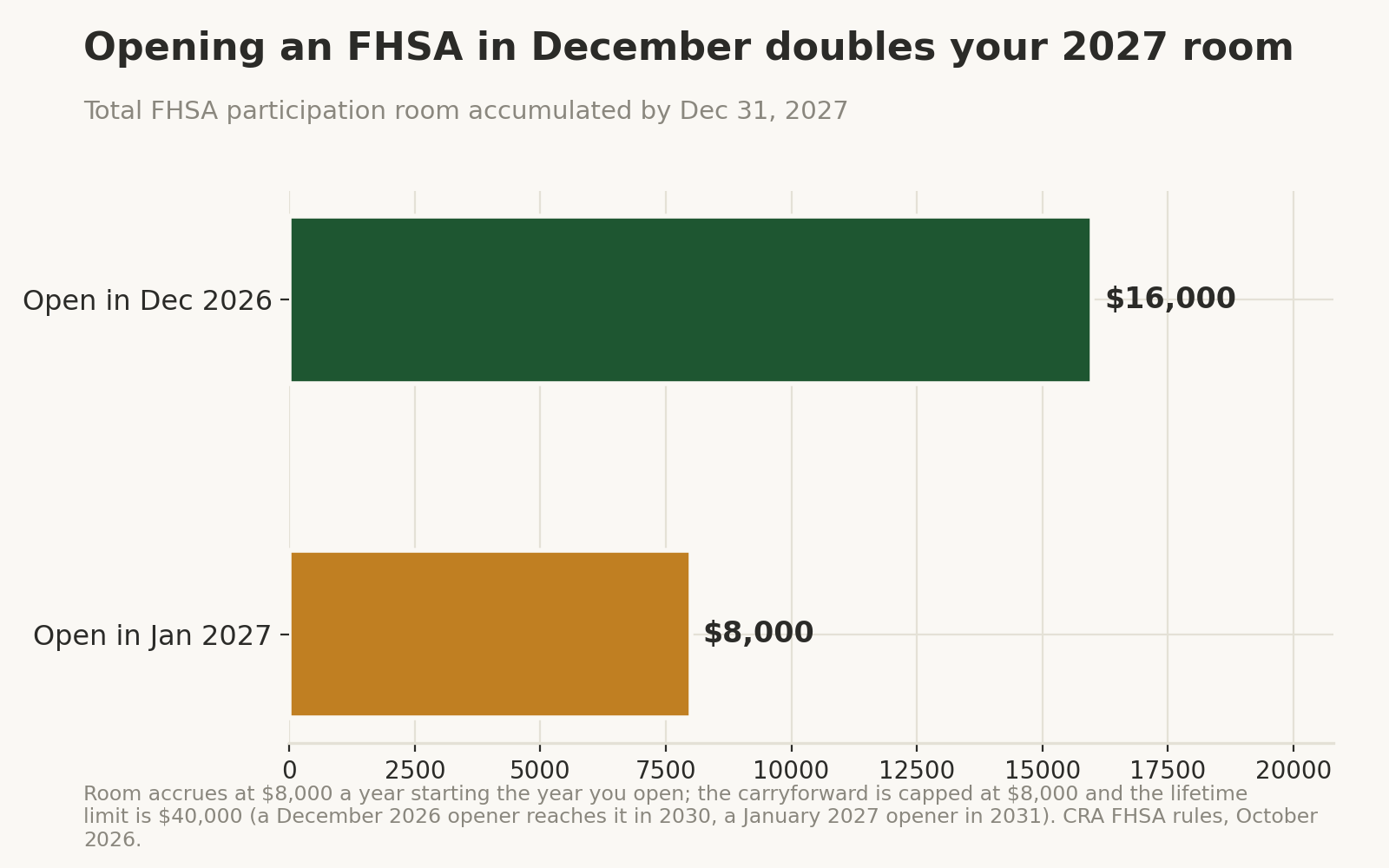
Open in January 2027 instead, deposit the same $500, and your total room for 2027 is $8,000. Through the end of 2027, the December opener has $16,000 of room in total. The January opener has $8,000. The $8,000 gap is there from day one.
The catch inside the carryforward
Unused room carries forward. It doesn’t pile up without limit.
The CRA caps both the FHSA carryforward and the FHSA participation room carryforward at $8,000. So the most you can contribute in any single year is $16,000: $8,000 of new room plus $8,000 carried forward.
Here’s what that means if you open in December 2026 and then contribute nothing:
- 2026 room: $8,000. Contributed: $0.
- 2027 room: $16,000 ($8,000 new + $8,000 carried forward). Contributed: $0.
- 2028 room: $16,000 again — not $24,000. Only $8,000 carries forward at a time.
You don’t lose the $40,000 lifetime limit by skipping years. You lose speed. Each year adds a fresh $8,000 toward the limit, but you can never catch up more than $16,000 in one year.
And don’t overshoot the room you actually have. Amounts contributed above your participation room are an excess FHSA amount, and the tax is 1% of the highest excess amount in the month, for each month the excess stays in the account.
Two different carryforwards — don’t mix them up
The FHSA has two separate carryforwards. One is about room. One is about the deduction.
Room: covered above. Unused participation room carries forward, capped at $8,000 at a time, while you’re still within your participation period.
Deductions: contributions are generally deductible for the year you make them or a future year. The CRA calls what you contributed but didn’t deduct your unused FHSA contributions, and they carry forward — even beyond the closure of your FHSAs.
That split is the planning move. Contribute in a low-income year. Save the deduction for a higher-income year, when it cuts more tax.
The CRA’s worked example, with the years moved to 2026 and 2027:
- You contribute $8,000 in 2026 and claim no deduction for 2026. Your unused FHSA contributions are $8,000.
- You contribute $5,000 in 2027.
- For 2027, you can claim a deduction of up to $13,000: $8,000 carried forward plus $5,000 contributed in 2027.
Two limits still apply. Over your lifetime, the most you can deduct as an FHSA deduction is $40,000. And transfers from your RRSP to your FHSA are not deductible — they were already deducted once, in the RRSP.
Deciding which year to claim in is an income question. See TFSA vs RRSP by income level for how the math flips as income rises.
The calendar-year trap: no first-60-days window
RRSP season trains Canadians to think a January or February contribution can still count for the year before. For the FHSA, it can’t.
The CRA states the FHSA contribution period runs January 1 to December 31 of the same year.
And it states the contrast directly: contributions you make to your FHSAs during the first 60 days of the year cannot be deducted on your return for the previous year, unlike contributions to an RRSP.
Practical version: a contribution on Jan 15, 2027 is a 2027 contribution. It can be deducted for 2027 or a future year. Never for 2026.
If you want a 2026 contribution — or a 2026 first year — the account and the money have to land by Dec 31, 2026.
Using the FHSA with the Home Buyers’ Plan
You don’t have to pick one. The CRA confirms you can withdraw from your RRSP under the Home Buyers’ Plan (HBP) and make a qualifying withdrawal from your FHSA for the same qualifying home, as long as you meet all the conditions at the time of each withdrawal.
The two programs work differently:
- FHSA: up to $40,000 of contributions, plus growth. A qualifying withdrawal is tax-free and you don’t repay it. There’s no minimum number of days contributions must stay in the account before a qualifying withdrawal.
- HBP: a withdrawal from your RRSP to buy or build a qualifying home. The current HBP withdrawal limit is $60,000. HBP withdrawals have to be repaid to your RRSP under the HBP repayment rules — an FHSA withdrawal doesn’t.
Per person, that’s up to $40,000 of FHSA contributions plus up to $60,000 under the HBP — $100,000 of program room toward the same home, before growth.
For an FHSA withdrawal to be a tax-free qualifying withdrawal, all of the CRA’s conditions have to hold at once. In brief: you complete Form RC725, Request to Make a Qualifying Withdrawal from your FHSA, and give it to your issuer; you’re a first-time home buyer for the purpose of a qualifying withdrawal; you have a written agreement to buy or build a qualifying home with the acquisition or completion date before Oct 1 of the year after the withdrawal; you didn’t acquire the home more than 30 days before the withdrawal; you’re a resident of Canada from the first qualifying withdrawal until you acquire the home; and you occupy, or intend to occupy, the home as your principal place of residence within one year after buying or building it.
Miss a condition and the withdrawal is a taxable withdrawal instead. It goes into your income for that year.
The full head-to-head, including repayment schedules and couples, is in FHSA vs RRSP Home Buyers’ Plan for a down payment.
If you don’t buy a home
Opening an FHSA isn’t a promise to buy. If your plans change, the money isn’t trapped and it isn’t wasted.
You can transfer property from your FHSA directly to your RRSP or your RRIF with no immediate tax consequences, as long as it’s a direct transfer and you don’t have an excess FHSA amount. Use Form RC721, Transfer from your FHSA to your FHSA, RRSP or RRIF, through your financial institution.
The key detail: a direct transfer like this generally does not impact your unused RRSP deduction room. The FHSA money lands in your RRSP on top of the room you already have. It doesn’t use any of it up.
Do it the wrong way and you lose that treatment. If you withdraw the money yourself and then contribute it to your RRSP, the withdrawal is taxable income and the deposit counts as a new RRSP contribution that reduces your RRSP room.
The other exit is a straight withdrawal without buying. That’s a taxable withdrawal: it must be included in your income for the year you receive it.
When the account has to close
An FHSA isn’t forever. Your maximum participation period starts when you open your first FHSA and ends on Dec 31 of the year in which the earliest of these events occurs:
- The 15th anniversary of opening your first FHSA.
- You turn 71 years of age.
- The year following your first qualifying withdrawal from your FHSAs.
Open in December 2026 and the 15-year date lands in 2041. Your FHSAs have to be closed by Dec 31, 2041 — earlier if one of the other two events comes first.
That’s the trade inside the December move. You start the $8,000-a-year room clock. You also start the 15-year clock. If your realistic buying window is within 15 years, starting now wins. If buying is a vague idea for 20 years from now, think before you start the second clock.
Before the period ends, you can make a qualifying withdrawal, or move what’s left to your RRSP or RRIF by direct transfer. Don’t leave a balance sitting in an FHSA past the end of the period.
Where this fits in your savings order
This post covers one move: open the account before Dec 31, 2026 so 2026 becomes your first year.
For the full rulebook — investments, excess amounts, life events, couples — read the FHSA complete guide. For where the FHSA sits against your TFSA, RRSP and RESP, read the complete funding order.
The Club take
Who wins: Eligible first-time buyers who haven’t opened an FHSA yet. Opening in 2026 costs you nothing but the account paperwork, and it buys you a first year of $8,000 room that January can’t give back. Even a $500 deposit — or no deposit — starts both the room and the record with the CRA, as long as you file Schedule 15.
Who should skip: Anyone who fails the qualifying individual tests — you’re not permitted to open one. And anyone whose honest buying horizon is well past 15 years: the participation period starts on opening, so a December 2026 account must close by Dec 31, 2041.
The catch: Room carries forward capped at $8,000 at a time, so you can’t stack years of skipped room into one big catch-up contribution — $16,000 is the most you can put in during any one year. Contribute on a calendar-year schedule, not an RRSP-season schedule, and keep the deduction for the year it does you the most good.
FAQ
Can I open an FHSA with no money in it?
Yes. Opening is what starts your first year. The CRA’s example covers a saver who opened an FHSA, made no contributions or RRSP transfers in that year, and still filed Schedule 15 for that year to record the account. Your participation room for that first year is $8,000 whether you deposit in December or not at all.
What if I open in December 2026 and contribute nothing until 2028?
Your 2027 room is $16,000 — $8,000 of new room plus $8,000 carried forward. If you contribute nothing in 2027 either, your 2028 room is still $16,000, not $24,000, because the carryforward is capped at $8,000. Your $40,000 lifetime limit is unchanged. You just need more years to fill it.
Is there an RRSP-style first-60-days deadline for the FHSA?
No. The FHSA contribution period is January 1 to December 31 of the same year. A contribution in the first 60 days of 2027 cannot be deducted on your 2026 return, unlike an RRSP contribution. It counts for 2027, or a future year if you carry the deduction forward.
Can I contribute now and deduct it later, in a higher-income year?
Yes. Contributions are generally deductible for the year of the contribution or a future year. Amounts you contributed but didn’t deduct are your unused FHSA contributions. They carry forward — even beyond the closure of your FHSAs — up to the $40,000 lifetime deduction limit. Transfers from your RRSP to your FHSA are the exception: those are not deductible.
Can I use both the FHSA and the Home Buyers’ Plan on the same home?
Yes. The CRA allows an HBP withdrawal from your RRSP and a qualifying withdrawal from your FHSA for the same qualifying home, if you meet all the conditions at the time of each withdrawal. The HBP limit is currently $60,000. The FHSA side is up to $40,000 of contributions plus growth, tax-free, with no repayment.
What happens to my FHSA if I never buy a home?
Before your maximum participation period ends, you can make a direct transfer from your FHSA to your RRSP or RRIF with no immediate tax consequences and no impact on your unused RRSP deduction room — use Form RC721 through your institution. If you withdraw the money instead, it’s taxable income in the year you receive it. Your FHSAs must be closed by Dec 31 of the year of the earliest of: the 15th anniversary of opening your first FHSA, the year you turn 71, or the year after your first qualifying withdrawal.