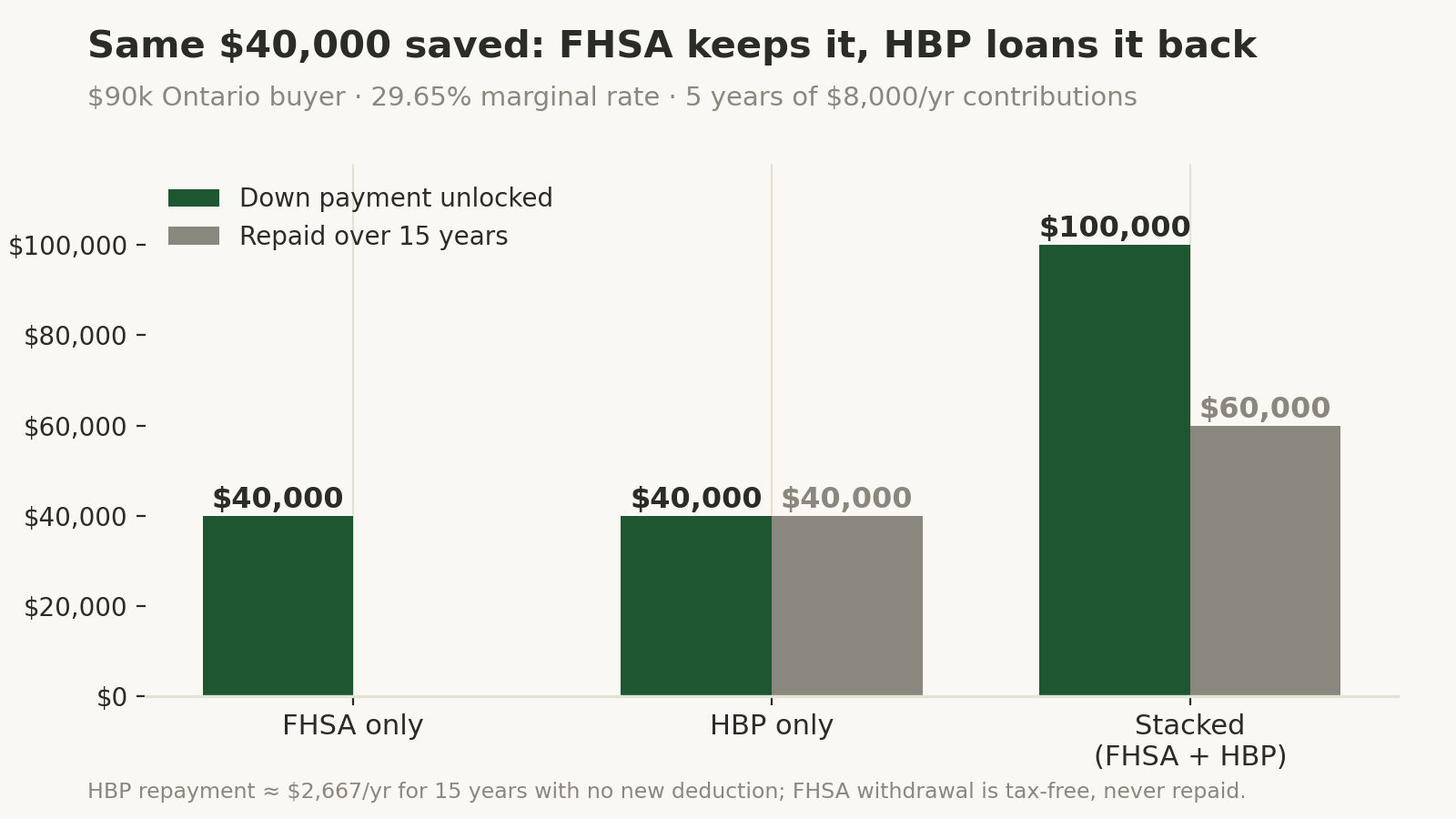
The verdict: For the same dollar saved, the FHSA beats the Home Buyers’ Plan — both give a tax deduction going in, but only the FHSA’s withdrawal is tax-free with nothing to repay, while the HBP must be repaid over 15 years. Stacked, one buyer frees up $100,000 of tax-advantaged down payment; a couple, $200,000 — the FHSA’s $40,000 lifetime cap plus the HBP’s $60,000 max withdrawal per person (CRA; CRA, checked 2026-09-28).
Who this is for: First-time buyers building a down payment.
Your move: Fund the FHSA first (up to the $40,000 lifetime cap (CRA, checked 2026-09-28)), then use the HBP for extra capacity — and open the FHSA early, since room only accrues after you open it.
Contents
- Head-to-Head: FHSA vs HBP
- How the FHSA works (the short version)
- How the HBP works (the short version)
- Worked example: same buyer, same $40,000 saved
- Verdict by buyer profile — ranked by math
- Eligibility: where they differ
- Traps that cost real money
- Bonus: the Home Buyers’ Amount
- FAQ
Head-to-Head: FHSA vs HBP
| FHSA | RRSP Home Buyers’ Plan | |
|---|---|---|
| Annual contribution limit | $8,000/year (CRA, checked 2026-09-28) | No separate HBP contribution limit — uses existing RRSP room (CRA, checked 2026-09-28) |
| Lifetime / total limit | $40,000 lifetime contributions (CRA, checked 2026-09-28) | $60,000 max withdrawal (CRA, checked 2026-09-28) |
| Tax deduction on the way in | Yes, like an RRSP (CRA, checked 2026-09-28) | Yes (the original RRSP contribution was deductible) (TD, checked 2026-09-28) |
| Tax on qualifying withdrawal | $0 — tax-free (CRA, checked 2026-09-28) | $0 at withdrawal if repaid (CRA, checked 2026-09-28) |
| Repayment required? | No (mwadvisors.ca, checked 2026-09-28) | Yes — full amount repaid to your RRSP over 15 years, minimum 1/15 per year (CRA, checked 2026-09-28) |
| Cost of missing repayments | N/A | Missed portion added to taxable income that year, taxed at your marginal rate (TD, checked 2026-09-28) |
| Investment growth | Tax-free, and growth comes out on top of the $40,000 contribution cap (lifemoney.ca, checked 2026-09-28) | Tax-sheltered inside RRSP until withdrawal; repaid amounts re-enter tax-sheltered growth (CRA, checked 2026-09-28) |
| If you don’t buy | Transfer unused FHSA to RRSP/RRIF tax-deferred — transfer doesn’t use any of your RRSP room. The account must be closed by December 31 of the year containing the earliest of: the 15th anniversary of opening, the year you turn 71, or the year after your first qualifying withdrawal (mwadvisors.ca, checked 2026-09-28) | Money stays in RRSP for retirement — nothing is lost |
| Can both be used on the same home? | Yes — a tax-free FHSA withdrawal and an HBP withdrawal can fund the same purchase (CRA, checked 2026-09-28) | Yes (same source) |
Note: the HBP limit used to be $35,000. It was raised to $60,000 on April 16, 2024 (TD, checked 2026-09-28). Any guide still quoting $35,000 is stale.
How the FHSA works (the short version)
The FHSA is the only registered account in Canada that gives you an RRSP-style tax deduction going in and a TFSA-style tax-free withdrawal coming out. For the full account mechanics — carryforward rules, the 15-year window, and qualifying withdrawals — see The FHSA Complete Guide (2026). You must be a first-time home buyer to open one and to make a qualifying withdrawal (CRA, checked 2026-09-28). Key rules:
- $8,000/year in participation room starting the year you open your first FHSA; $40,000 lifetime cap (CRA, checked 2026-09-28). Room only starts accruing when you open the account — opening early, even unfunded, is free optionality.
- Unused room carries forward, but at most $8,000 of carry-forward can be used in a single year, so the max contribution in any one year is $16,000 (openbookplanning.ca, checked 2026-09-28; mwadvisors.ca, checked 2026-09-28).
- Overcontributing is taxed 1% per month on the highest excess amount in the month until the excess is removed or absorbed by new room (Investment Executive, reporting a CRA release, checked 2026-09-28).
CRA’s precise first-time-buyer definition for the FHSA has two versions, and they differ (CRA, checked 2026-09-28):
- To open an FHSA: you are a first-time buyer if you did not, in the current calendar year before the account is opened or in the preceding four calendar years, live in a qualifying home as your principal residence that you owned or jointly owned, or that your spouse/common-law partner (at the time the account is opened) owned or jointly owned.
- To make a qualifying withdrawal: the same 4-year look-back applies, but it counts only homes you owned or jointly owned (a spouse-owned home you lived in does not disqualify you here), with a carve-out for the 30 days immediately before the withdrawal.
How the HBP works (the short version)
The Home Buyers’ Plan lets you withdraw up to $60,000 from your RRSP with no tax at withdrawal, using Form T1036 (CRA, checked 2026-09-28). Withdrawals can span the calendar year of your first withdrawal plus January of the following year (same CRA page). The catch is everything after withdrawal:
- CRA’s 89-day rule: contributions made to your RRSP in the 89 days before an HBP withdrawal may not be deductible — so last-minute contributions effectively lose their deduction and buy you nothing extra (CRA, checked 2026-09-28; TD, checked 2026-09-28).
- Repay the full amount to your RRSP over 15 years, minimum 1/15 per year (e.g., $4,000/year on a $60,000 withdrawal) (CRA, checked 2026-09-28; lifemoney.ca, checked 2026-09-28). Repayment normally starts in the second year after the year of withdrawal. A temporary relief measure pushed the start to the fifth year for first withdrawals made between January 1, 2022 and December 31, 2025 — so it does not apply to first withdrawals made in 2026 or later, which are back on the standard 2-year start (CRA, checked 2026-09-28; CRA, checked 2026-09-28).
- RRSP contributions don’t count as HBP repayments automatically — you must designate them as repayments on Schedule 7 of your return (line 24600), or CRA treats your repayment as $0 and adds the shortfall to your income (CRA, checked 2026-09-28; lifemoney.ca, checked 2026-09-28).
- HBP repayments do not generate a new tax deduction. CRA is explicit: “You cannot claim as a deduction on your income tax and benefit return an amount you designated as a repayment.” They also don’t use up RRSP contribution room (CRA, checked 2026-09-28).
Worked example: same buyer, same $40,000 saved
Meet the buyer: single, Ontario, $90,000 income, first-time buyer, planning to buy in 5 years (2031). Ontario combined marginal rate at $90,000 in 2026 is 29.65% (taxtips.ca, checked 2026-09-28) — used as an estimate; rates change yearly.
Path A — FHSA only. Contributes $8,000/year for 5 years = $40,000 total (CRA, checked 2026-09-28). Tax deduction value: $8,000 × 29.65% ≈ $2,372/year, ≈ $11,860 over 5 years. At purchase, the full $40,000 (plus any tax-free growth on top of the cap, per lifemoney.ca) comes out tax-free. Repayment obligation: $0. Total tax savings kept permanently: ≈ $11,860.
Path B — HBP only. Contributes $8,000/year for 5 years into an RRSP = $40,000 (same ≈ $11,860 of deductions over 5 years). At purchase, withdraws $40,000 under the HBP tax-free. Then repays $40,000 ÷ 15 ≈ $2,667/year for 15 years with no new deduction. Total tax savings kept permanently: ≈ $11,860 on the way in — but the “savings” is a loan, not a gift. Over the 15 repayment years, that buyer must find ≈ $2,667/year in cash flow that an FHSA user keeps free.
The math: identical deduction, but Path B adds a 15-year repayment liability for the same $40,000 of down payment. Path A wins by exactly the cost of that obligation — at 29.65%, missing a single year’s $2,667 repayment would add ≈ $791 to that year’s tax bill.
Path C — stacked (what the math actually recommends). Max the FHSA ($40,000 over 5 years, per CRA) and build the RRSP for an HBP withdrawal (up to $60,000, per CRA). Combined tax-advantaged down payment: $100,000 per person, $200,000 for a couple (lifemoney.ca, checked 2026-09-28; mwadvisors.ca, checked 2026-09-28) — enough for 20% down on a $1,000,000 GTA home without CMHC insurance (lifemoney.ca, checked 2026-09-28). Funding order matters: FHSA first (money never owed back), HBP second (money owed back).
Verdict by buyer profile — ranked by math
1. Buyer with a multi-year runway (2+ years out): FHSA, decisively.
The deduction is identical, the withdrawal is tax-free, and nothing is owed back. Every dollar you route into the FHSA instead of relying on the HBP permanently avoids a 15-year repayment. Fund the FHSA first.
2. Buyer purchasing within the next year with a large existing RRSP: HBP, by necessity.
An FHSA opened last month holds at most $8,000 of room (CRA, checked 2026-09-28); you can’t conjure $40,000 of FHSA room on a 4-month timeline. If you have $60,000 sitting in an RRSP and a closing date, the HBP gives you capital the FHSA can’t match that fast. Accept the repayment schedule as the price of speed.
3. Buyer who needs more than $40,000 from registered accounts: stack both.
The FHSA caps lifetime contributions at $40,000 (CRA, checked 2026-09-28). The HBP reaches $60,000 per person (CRA, checked 2026-09-28). Together: $100,000 per person, $200,000 per couple. This is the power-combo play, and it’s exactly how the government frames it (CRA, checked 2026-09-28).
4. Buyer unsure whether they’ll buy at all: FHSA, with a safety net.
If the purchase never happens, unused FHSA funds transfer to your RRSP/RRIF tax-deferred without using any RRSP room (mwadvisors.ca, checked 2026-09-28). The HBP can’t even be used without a purchase. FHSA first.
5. Buyer choosing “just one account” with no other context: FHSA.
Same deduction, tax-free exit, zero repayment. The only reason the HBP exists in your plan is extra capacity beyond the FHSA’s $40,000 lifetime cap (CRA, checked 2026-09-28) — or a short timeline.
Eligibility: where they differ
Both require first-time-buyer status, but the details differ:
- FHSA: must be a qualifying first-time buyer both when you open the account and when you make the qualifying withdrawal — and CRA’s definitions differ between the two. At opening, a spouse’s/common-law partner’s owned home you lived in disqualifies you; at withdrawal, only homes you owned or jointly owned count (with a 30-day exception before the withdrawal). You must also be 18–71 and a Canadian resident (CRA, checked 2026-09-28).
- HBP: must be considered a first-time home buyer at the time of withdrawal — if, in the four-year period, you did not occupy a home that you, your spouse, or common-law partner owned (TD, checked 2026-09-28). You must also have a written agreement to buy or build a qualifying home, be a Canadian resident, and intend to occupy the home as your principal residence within one year of buying or building it (CRA, checked 2026-09-28).
- Two qualifying buyers (spouses/common-law): each gets their own FHSA ($40,000 each) and their own HBP withdrawal ($60,000 each) — $200,000 combined (CRA, checked 2026-09-28; TD, checked 2026-09-28; mwadvisors.ca, checked 2026-09-28).
Traps that cost real money
- Stale $35,000 HBP figures. The limit is $60,000 since April 16, 2024 (TD, checked 2026-09-28). Guides still quoting $35,000 are costing you planning accuracy.
- The 89-day RRSP seasoning rule. Contributions made to your RRSP in the 89 days before an HBP withdrawal may not be deductible — so last-minute contributions buy you nothing extra. Don’t contribute in February and close in March (CRA, checked 2026-09-28; moneysavings.ca, checked 2026-09-28).
- Undesignated HBP repayments. RRSP contributions do not automatically count as repayments. Skip the Schedule 7 designation and CRA adds the missed 1/15 to your income (CRA, checked 2026-09-28; lifemoney.ca, checked 2026-09-28).
- FHSA overcontributions. 1% per month on the highest excess amount until it’s removed or absorbed by new room (Investment Executive, reporting a CRA release, checked 2026-09-28).
- The repayment years earn you no new tax break. Every HBP repayment dollar goes back into the RRSP — it doesn’t create new contribution room and it doesn’t generate a new deduction (CRA, checked 2026-09-28).
Bonus: the Home Buyers’ Amount
Separate from both programs, eligible first-time buyers can claim up to $10,000 on line 31270 of their tax return. The credit is worth the claim multiplied by the lowest federal tax rate — and that rate changed: Bill C-4 cut it from 15% to 14% for 2026 (Royal Assent March 12, 2026), so a 2026 claim is worth $1,400, not the widely repeated $1,500 (which is the old 15% math) (Dept. of Finance / Canada.ca report, checked 2026-09-28; TurboTax, checked 2026-09-28). Claim it on top of whichever path you take.
FAQ
Can I use the FHSA and the HBP for the same home?
Yes. The government explicitly frames them as combinable (CRA, checked 2026-09-28).
Which should I fund first?
The FHSA — it gives the same deduction with no repayment (mwadvisors.ca, checked 2026-09-28). Use the HBP for capacity beyond the FHSA’s $40,000 lifetime cap.
What happens if I don’t repay the HBP?
Any unpaid portion of the annual minimum (1/15) is added to your taxable income for that year (TD, checked 2026-09-28).
Can the HBP be used more than once?
Yes, if your HBP balance is zero on January 1st of the year of the new withdrawal and you meet all the other eligibility conditions again (CRA, checked 2026-09-28).