The verdict: The FHSA gives you $8,000 a year ($40,000 lifetime) that’s tax-deductible going in and tax-free coming out for a first home — but room only starts accruing after you open the account, and it must close by December 31 of its 15th anniversary year.
Who this is for: Canadians who are — or might become — first-time home buyers.
Your move: If you’re eligible, open an FHSA before December 31, 2026 (even with $0 in it) and file Schedule 15, so the room clock starts ticking.
Canada’s First Home Savings Account is the closest thing to a free lunch in the Canadian tax system. Contributions are tax-deductible like an RRSP, qualifying withdrawals for a first home are tax-free like a TFSA, and growth inside the account isn’t taxed. (canada.ca) The catch: the rules are strict, the account has a hard expiry, and one widely misunderstood detail — room only starts accruing after you open the account — makes timing everything.
This is the complete rulebook, sourced from CRA pages (last reviewed February 2026) and re-checked against the live CRA pages on 2026-09-28.
Contents
- Who qualifies
- Contribution limits: $8,000 a year, $40,000 lifetime
- Carryforward: up to $8,000 — but the clock doesn’t start until you open
- Tax treatment: deductible in, tax-free out
- Qualifying withdrawals: the tax-free exit
- The 15-year window: three deadlines, earliest wins
- If you never buy: the RRSP escape hatch
- Couples: $80,000, not $40,000
- The Club’s FHSA checklist
Who qualifies
To open an FHSA you must be a “qualifying individual,” which means meeting all of these conditions at the time you open the account:
- Canadian resident at the time you open the account. (canada.ca)
- At least 18 years old — and at least the age of majority in your province or territory before an issuer will actually open the account. (canada.ca; wealthsimple.com)
- No older than 71 in the year you open. CRA ends your maximum participation period on December 31 of the year you turn 71, so issuers apply that as an opening-age cap. (canada.ca; canooq.ca)
- A first-time home buyer. The CRA defines this precisely: you qualify if you did not, at any time in the current calendar year before the account is opened or in the preceding 4 calendar years, live as your principal residence in a qualifying home that you owned or jointly owned — or that your spouse or common-law partner (at the time you open the account) owned or jointly owned. (canada.ca)
Three things people get wrong here:
- The lookback includes your partner. If your spouse owned the condo you live in, you are not a first-time buyer for opening purposes — even if you never owned anything yourself. CRA gives an example (Carlos) of exactly this disqualification. (canada.ca)
- It’s about homes you lived in as your principal residence. An owned rental you never lived in doesn’t disqualify you. (Scotiabank’s FHSA Q&A states this directly: if you own a rental property and never lived in it, you can be eligible.) (scotiabank.com)
- The definition differs between opening and withdrawing. CRA explicitly warns that “first-time home buyer” means something slightly different for a qualifying withdrawal (it has a 30-day exception around the withdrawal date and is measured on your own ownership). Recheck eligibility at withdrawal time, not just at opening. (canada.ca)
Note: the FHSA has been available since April 1, 2023. (moneysense.ca)
Contribution limits: $8,000 a year, $40,000 lifetime
Two numbers run the whole account:
- Annual participation room: $8,000 in the year you open your first FHSA. (canada.ca)
- Lifetime limit: $40,000 in total contributions and transfers, across all of your FHSAs. (wealthsimple.com)
| Limit | Amount | Applies to |
|---|---|---|
| Annual participation room | $8,000 | Every year from the year you open your first FHSA |
| Carryforward (unused room) | Up to $8,000 | Carried forward, capped at the lesser of $8,000 and actual unused room |
| Max in a single year | $16,000 | This year’s $8,000 + up to $8,000 carried forward |
| Lifetime limit | $40,000 | All contributions and transfers, across all FHSAs combined |
| Carryforward in the opening year | $0 | Room only exists once the account exists — no backdating |
The lifetime limit of $40,000 applies across all of your accounts combined. You can hold more than one FHSA, but the total you contribute and transfer across all of them in a year cannot exceed your participation room for that year. (canada.ca)
Transfers from your RRSP into your FHSA count against the same room — a $7,500 RRSP transfer plus $500 of cash contributions uses $8,000 of room, not two separate buckets. The transfer is tax-free, but unlike direct contributions it is not deductible (you already got the deduction when the money went into the RRSP). Only the account holder can contribute to their own FHSA, and only the holder can claim the deduction. (canada.ca; wealthsimple.com)
Growth inside the account doesn’t use room. If your $8,000 contribution grows to $8,600 by year-end, that doesn’t create an over-contribution — income earned in the FHSA never counts toward participation room. (canada.ca)
Exceed your room and you face a penalty: an excess FHSA amount is taxed at 1% per month on the highest excess amount for each month it remains, until you fix it (with a designated withdrawal or transfer, or by waiting for new room on January 1). (canada.ca; wealthsimple.com)
Carryforward: up to $8,000 — but the clock doesn’t start until you open
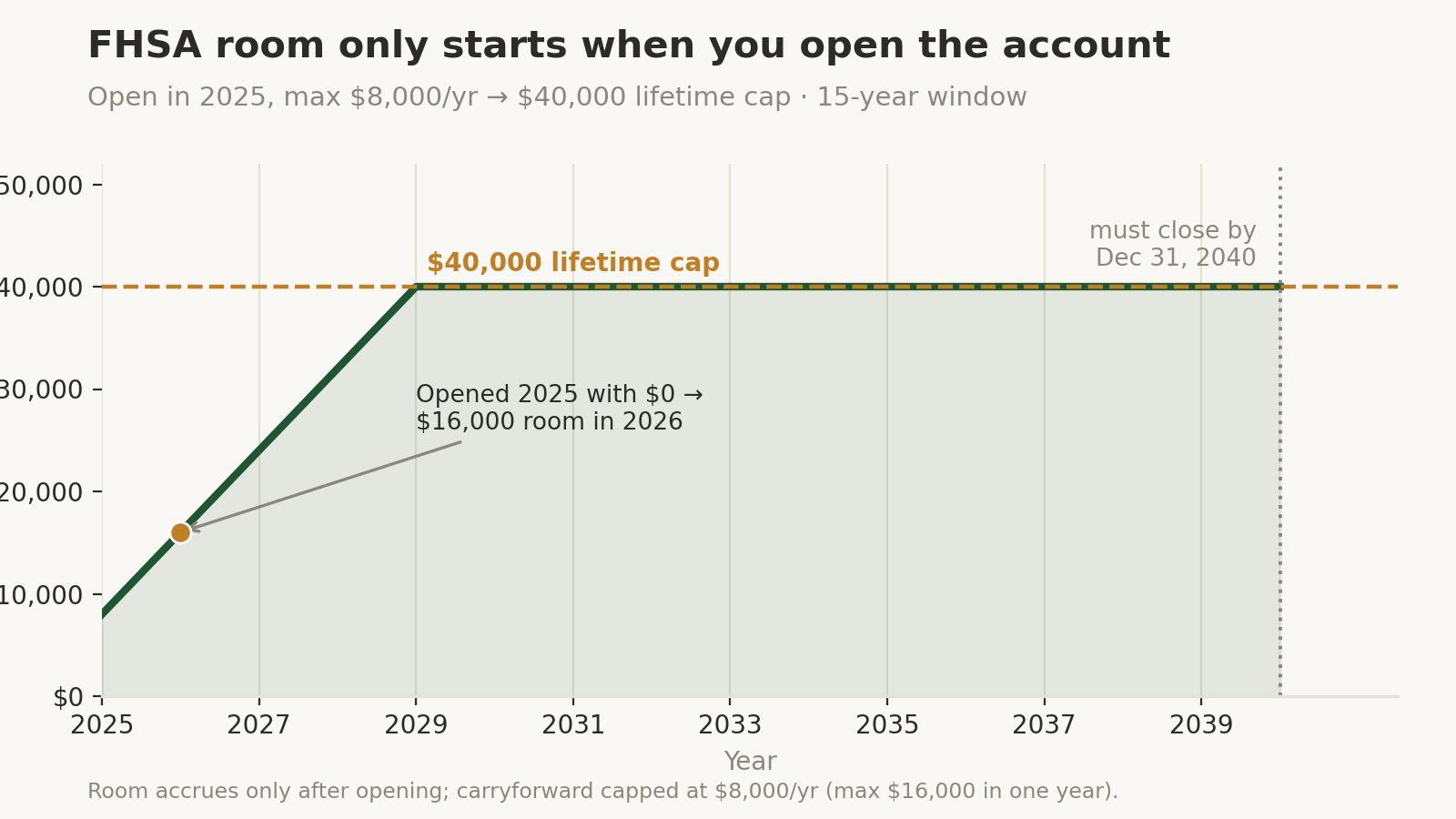
Unused participation room carries forward, but with a hard cap: your carryforward is the lesser of $8,000 and your actual unused room. So the maximum contribution in a single year is $16,000 — this year’s $8,000 plus up to $8,000 carried in. (wealthsimple.com; canada.ca)
Now the critical part most people miss: in the year you open your first FHSA, your carryforward is $0. Room only begins to exist once the account exists — it does not backdate to when you turned 18 or when you became eligible. Wealthsimple’s FAQ states it plainly: carry-forward room only starts building once you have opened an FHSA — it does not accumulate in years before your account exists. (canada.ca; wealthsimple.com)
The CRA’s own example makes the payoff concrete: Wendy opened her first FHSA in June 2025 and contributed nothing that year. When she filed her return and completed Schedule 15, her 2026 participation room statement showed $16,000 — $8,000 of unused 2025 room carried forward plus $8,000 of new 2026 room. The $0-contribution account still banked a full year of room. (canada.ca)
The Club’s take: if you’re eligible, open an FHSA before December 31 even if you contribute $0. Waiting until next year to “start saving properly” costs you $8,000 of room you can never get back. You still must file Schedule 15 (FHSA Contributions, Transfers and Activities) with your return for the year you open it, even with zero activity — that’s what tells the CRA the account exists. (canada.ca; canada.ca)
One caution on the other side of this: opening early also starts the 15-year participation clock (see below). Don’t open a decade before you have any realistic buying plan — but don’t leave free room on the table if buying is on the horizon.
Tax treatment: deductible in, tax-free out
Contributions are generally tax-deductible, like RRSP contributions. You can claim the deduction in the year you contribute or carry the unused deduction forward to a later year — useful if your income (and marginal rate) will be higher next year. CRA’s example: Nagia contributed $8,000 in 2025, claimed nothing, and in 2026 claimed a $13,000 deduction ($8,000 unused + $5,000 new). (wealthsimple.com; canada.ca)
There is no 60-day rule. Unlike an RRSP — where contributions in the first 60 days of the year can be claimed against the prior year — FHSA contributions count only for the calendar year they’re made in. A contribution on February 15, 2026 is a 2026 contribution, full stop. CRA says it directly: contributions made during the first 60 days of the year cannot be deducted on your return for the previous year, unlike RRSP contributions. (canada.ca; wealthsimple.com)
Growth is tax-free, and the issuer reports your activity on a T4FHSA slip, which you report via Schedule 15 on your return. (wealthsimple.com)
Qualifying withdrawals: the tax-free exit
A qualifying withdrawal — money taken out to buy or build your first qualifying home — is tax-free, never repaid, and has no minimum holding period. You can withdraw contributions days after depositing them and still have them qualify. (canada.ca)
To qualify, you must meet all of CRA’s conditions:
- Being a first-time home buyer for withdrawal purposes — you didn’t live as your principal residence in a qualifying home you owned or jointly owned at any point in the current year before the withdrawal (except the 30 days immediately before it) or in the previous 4 years
- Being a Canadian resident from the time of your first qualifying withdrawal until the earlier of acquiring the qualifying home or your death
- Having a written agreement to buy or build a qualifying home, with the acquisition or construction completion date before October 1 of the year following the withdrawal
- Not having acquired the qualifying home more than 30 days before the withdrawal
- Intending to occupy it as your principal residence within 1 year of buying or building
- Completing Form RC725 (Request to Make a Qualifying Withdrawal from your FHSA) and giving it to your issuer before the withdrawal
(canada.ca; canada.ca)
Three things worth knowing:
- Qualifying withdrawals are never added back as room. Unlike a TFSA, room you use doesn’t come back — once you withdraw and close, it’s gone. (wealthsimple.com)
- You cannot undo one. If your purchase falls through after a qualifying withdrawal, you can’t cancel it. Re-contributing the money counts as a new contribution — it uses room and is not deductible. (canada.ca)
- Non-qualifying withdrawals are taxable. Take money out for anything else and it’s added to your income for the year (with withholding tax, like an early RRSP withdrawal). (canada.ca)
Stacking with the RRSP Home Buyers’ Plan: yes, you can make a qualifying FHSA withdrawal and an HBP withdrawal from your RRSP for the same home, as long as you meet both sets of conditions. (canada.ca) A full FHSA-vs-HBP comparison is a separate guide — see the batch’s dedicated piece — but the headline difference is that FHSA withdrawals are never repaid while HBP withdrawals are repaid over 15 years. (wealthsimple.com)
The 15-year window: three deadlines, earliest wins
An FHSA cannot stay open forever. Your maximum participation period ends on December 31 of the year in which the earliest of these occurs:
- The 15th anniversary of opening your first FHSA
- The year you turn 71
- The year following your first qualifying withdrawal
CRA’s example: Anthony opened in 2025, contributed to the $40,000 lifetime limit by 2029, and without a qualifying withdrawal must close the account by December 31, 2040 — 15 years after opening. (canada.ca)
After a qualifying withdrawal, close all your FHSAs by December 31 of the following year. (canada.ca)
If you never buy: the RRSP escape hatch
This is what makes the FHSA close to risk-free. If you reach the end of your participation period without buying a home, you can make a direct transfer of the balance to your RRSP or RRIF — tax-free, with no impact on your unused RRSP deduction room. You must use a direct institution-to-institution transfer (CRA suggests Form RC721); if you withdraw the cash yourself and re-contribute, it becomes a taxable withdrawal plus a new RRSP contribution that eats RRSP room. (canada.ca)
The alternative — withdrawing the money outright — is simply taxable income. And if you miss the closing deadline entirely, the whole balance becomes a taxable withdrawal at your full marginal rate. (rooftopwealth.ca)
Either way: the FHSA is never worse than an RRSP in the worst case. You got the deduction going in, growth was sheltered, and the money lands in your RRSP with no extra RRSP room consumed.
Couples: $80,000, not $40,000
FHSA room belongs to the individual — you cannot contribute to your partner’s FHSA and claim the deduction yourself. But if both partners are eligible, each gets their own $40,000 lifetime limit, for a combined $80,000 (plus growth) toward the same first home. CRA gives a worked example: Kara and Stephen each withdrew $40,500 and $41,000 tax-free for a joint purchase. (canada.ca; wealthsimple.com)
The Club’s FHSA checklist
- Check eligibility now — resident, 18+, and the 4-year lookback (remember: your spouse’s owned home counts for opening).
- Open before December 31 of the year you’re eligible — even with $0. Room you don’t start is room you never get.
- File Schedule 15 with your return in the year you open, even with no contributions.
- Contribute what you can each year (up to $8,000 of room; max $16,000 with carryforward). Track room on your CRA notice of assessment.
- Time your deduction — claim it in a high-income year if you can wait.
- Invest inside the account — cash, GICs, ETFs all qualify; growth is tax-free and doesn’t use room.
- When buying, confirm the withdrawal conditions (RC725, written agreement, 30-day rule) — and consider stacking an HBP withdrawal.
- If you don’t buy, direct-transfer to your RRSP/RRIF before the 15-year deadline.