Numbers checked: September 28, 2026.
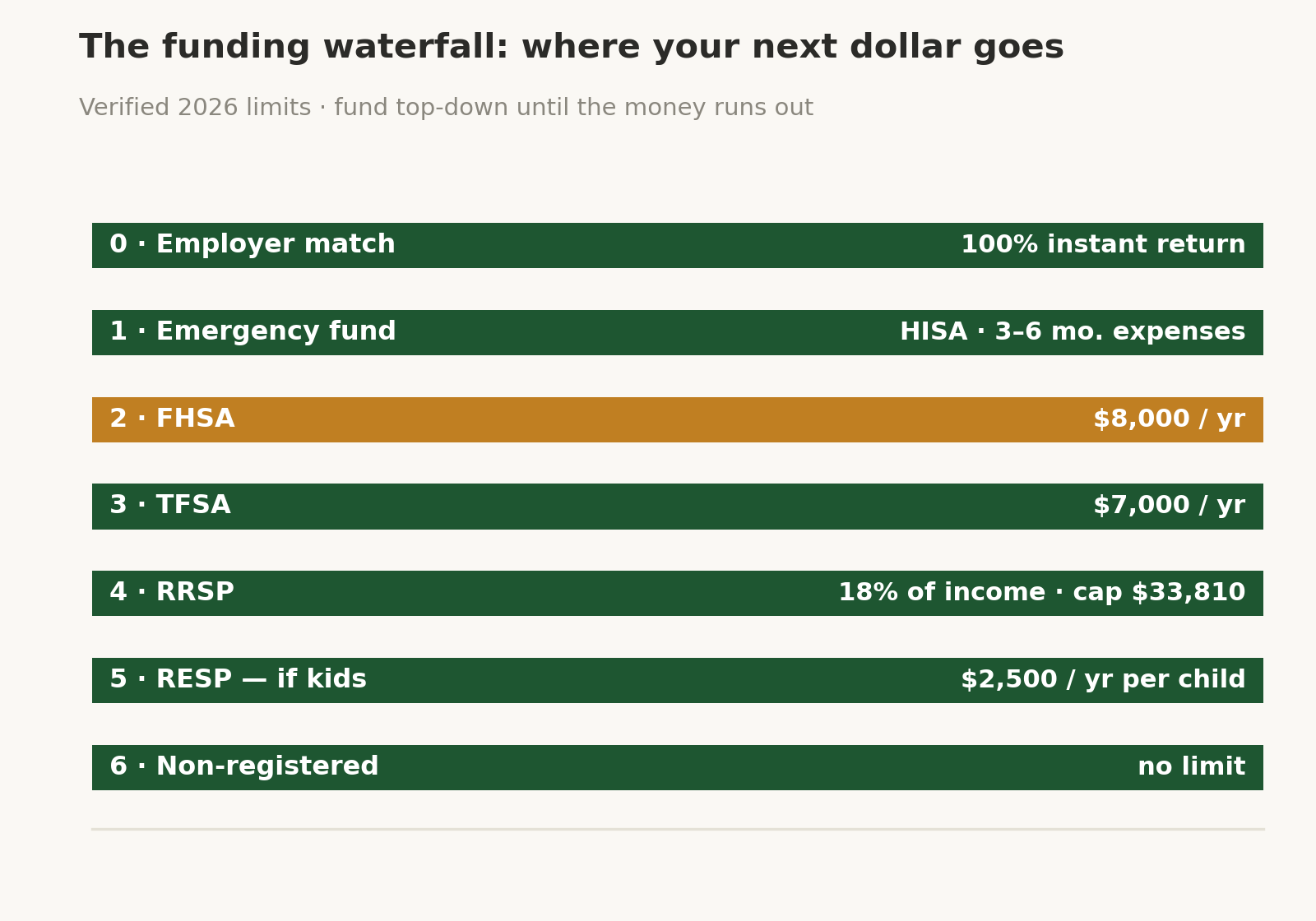
The verdict: Fund in this order: capture any employer match (an instant 100% return), then park 3–6 months of essential expenses in a high-interest savings account emergency fund, then max the FHSA ($8,000/yr — deductible going in, tax-free coming out) if you’re a first-time buyer, then the TFSA ($7,000/yr for 2026, $109,000 cumulative if eligible since 2009), then the RRSP (18% of income, capped at $33,810 for 2026) — the RRSP only pulls ahead when your tax rate today beats your rate in retirement. Parents then add the RESP ($2,500/child/yr captures the full $500 CESG match), and anything left goes to non-registered investing.
Who this is for: Any Canadian deciding where their next savings dollar goes — including parents who keep hearing “TFSA vs RRSP” while their real question is what to do with everything else.
Your move: Open an FHSA the moment you’re eligible — even with a $0 balance — to start the room clock, fill the emergency fund in a steady-rate HISA, then work the waterfall in order and check your actual room before every contribution.
Contents
- Step 1 in full: the HISA emergency fund
- The 2026 numbers: FHSA vs TFSA vs RRSP, side by side
- The order of operations: the waterfall
- Step 5 in full: the RESP and the $7,200 free-money cap
- The core math: why “it depends on your tax rate”
- When each account wins
- The gotchas (check your room before you contribute)
- The decision, in one paragraph
The most-asked question in Canadian personal finance is some version of “TFSA or RRSP?” — but the honest answer stopped being a two-account coin flip years ago. A first-time buyer now has a third registered account. Every household needs a cash cushion before touching any of them. And parents have a fourth: the only account in the country where the government hands you a guaranteed 20% return just for contributing.
So this isn’t really a TFSA-vs-RRSP article. It’s the complete funding order for 2026: where every dollar goes, in what sequence, and why. The three-account comparison table below is still the core of the piece — but it sits inside a wider order of operations that starts with cash in a savings account and ends with the RESP and taxable investing.
Step 1 in full: the HISA emergency fund
Before a dollar touches a registered account, the emergency fund comes first — 3–6 months of essential expenses (rent or mortgage, groceries, transport, insurance, minimum debt payments) parked in a high-interest savings account. The 3–6-month figure is the standard planning rule of thumb, not a statute: single-income households and freelancers should lean toward six, dual-income households with stable jobs can lean toward three.
Why this outranks even the FHSA’s double tax advantage:
- Registered money isn’t emergency money. An RRSP withdrawal is fully taxable, permanently destroys the contribution room, and gets hit with withholding tax at source — 10% up to $5,000, 20% on $5,001–$15,000, 30% over $15,000 . An FHSA non-qualifying withdrawal is taxed as income too. Raiding retirement accounts for a furnace repair is the most expensive way to pay for one.
- The emergency fund has one job: be there on a random Tuesday. That means no market risk, no lock-in, no penalties — which is exactly what a HISA is for. A GIC can’t do the job: money locked in a 1-year GIC at 3.30% (issuer-confirmed) is useless when the car dies in month four.
- It’s also the job-loss buffer for the waterfall itself. Lose your income and you stop funding the waterfall; the emergency fund is what keeps you from liquidating it at the worst possible time.
Where to park it. For money with an indefinite horizon — which is exactly what an emergency fund is — a steady-rate HISA beats a promotional one over a full year. The Club’s where-to-park-cash guide (rates checked September 28, 2026) found the top regular rates to be Saven at 2.85% , Oaken at 2.80% — in effect since September 21, 2026 — and EQ Bank at 2.75%, which requires a qualifying $2,000/month direct deposit or the rate drops to 1.00% . Promotional rates run higher (Simplii 4.60%, Tangerine 4.50% as of late September 2026) but only for about five months before collapsing — fine for cash with a near-term job, wrong for an emergency fund that sits all year. HISA and GIC interest in a non-registered account is fully taxable as income at your marginal rate .
HISA vs TFSA for the emergency money? Both are legitimate parking spots, with one trade-off. Interest earned inside a TFSA is tax-free — at a 40% marginal rate, a 2.85% HISA inside a TFSA is worth the same as a 4.75% HISA outside it. But TFSA room is finite: $7,000 of new room for 2026 ($109,000 cumulative if eligible since 2009), and withdrawals only restore room on January 1 of the following year . The rule of thumb: keep the true emergency fund — the money you might touch any month — in a non-registered steady-rate HISA, and once the cushion is full, hold planned cash inside the TFSA. The full rate tables, promo-expiry calendar, and CDIC coverage rules live in Where to Park Cash in Canada (2026).
The 2026 numbers: FHSA vs TFSA vs RRSP, side by side
| TFSA | RRSP | FHSA | |
|---|---|---|---|
| 2026 annual contribution limit | $7,000 | 18% of prior-year earned income, capped at $33,810 | $8,000 |
| Cumulative/lifetime room | $109,000 if eligible since 2009 and never contributed | No lifetime cap; unused room carries forward indefinitely | $40,000 lifetime |
| Carry-forward of unused room | Yes, indefinitely; withdrawals restore room the following January 1 | Yes, indefinitely | Carries forward capped at $8,000/year — so max $16,000 in a single year — and room accrues only after you open the account |
| Contributions deductible? | No | Yes | Yes |
| Growth inside the account | Tax-free | Tax-deferred | Tax-free |
| Withdrawals taxed? | No — any time, any reason | Yes — fully taxable as income, plus withholding at source: 10% up to $5,000, 20% on $5,001–$15,000, 30% over $15,000 | No, for a qualifying first-home purchase — and never repaid |
| Who qualifies | 18+, Canadian resident for tax purposes, valid SIN | Canadian taxpayer with earned income, until Dec 31 of the year you turn 71 | At least 18 (19 in BC, NB, NL, NS, Yukon, NWT, Nunavut), Canadian resident, and first-time home buyer — no principal-residence ownership in the year you open the account or the preceding 4 calendar years |
| Account lifespan | No age limit | Must convert to a RRIF (or annuity) by Dec 31 of the year you turn 71 | Ends Dec 31 of the year of the earliest of: the 15th anniversary of opening your first FHSA, the year you turn 71, or the year after your first qualifying withdrawal |
| Over-contribution penalty | 1% per month on the excess, no buffer | 1% per month on the excess beyond a $2,000 lifetime buffer | 1% per month on contributions above the annual limit, no buffer |
Yes — you can hold all three at the same time. Nothing stops you . The question is only what order to fund them in.
The order of operations: the waterfall
The consensus priority order that dominates Canadian personal-finance discussion:
Step 0: Capture your employer match. If your employer matches RRSP or pension contributions, take the full match before anything else. A dollar-for-dollar match is an instant 100% return that no market investment can replicate .
Step 1: Build the emergency fund in a HISA. 3–6 months of essential expenses in a high-interest savings account before locking money into registered accounts — the full rationale is above. This is the money that keeps a job loss or a furnace replacement from becoming credit-card debt.
Step 2: FHSA — if you’re eligible. The FHSA combines what the other two accounts each offer separately: an RRSP-style tax deduction going in and TFSA-style tax-free withdrawals coming out . For a first-time buyer, $8,000 a year of this is the highest-return savings vehicle available . Max it before anything else. One critical detail: room accrues only after you open the account — so open one even with a $0 balance the moment you’re eligible, to start the clock .
Step 3: TFSA. Tax-free growth, tax-free withdrawals, room carries forward indefinitely and restores every January 1 after a withdrawal . It’s the flexible account: down payment top-up beyond FHSA limits, retirement if your income is modest today.
Step 4: RRSP — once your income justifies it. This is where income level decides. The RRSP’s value is entirely in the deduction: a $10,000 contribution at a 40% marginal rate saves roughly $4,000 in tax; the same contribution at a 20% rate saves only about $2,000 . So the lower your bracket, the weaker the RRSP.
Step 5: RESP — if you have kids. The Canada Education Savings Grant matches 20% of contributions — $500 a year on $2,500 per child, up to $7,200 lifetime per child . That’s a guaranteed 20% return no market can match, so for parents it outranks any non-registered investing — full breakdown below.
Step 6: Non-registered. Once registered room is full or doesn’t fit your goals, taxable investing has no limits.
As a rough rule of thumb — not an official threshold — some planners use about $50,000 of income as the line: below roughly that, the TFSA typically wins because the RRSP deduction provides limited benefit at lower marginal rates; above it, the deduction becomes more valuable . Treat it as a heuristic, not a statutory line.
Step 5 in full: the RESP and the $7,200 free-money cap
For parents, the waterfall has a step the standard “TFSA vs RRSP” debate never mentions: the Registered Education Savings Plan, the only Canadian account where the government hands you free money just for contributing.
The mechanism is the Canada Education Savings Grant (CESG). On every dollar you contribute, the federal government matches 20% — up to $500 of grant per child per year, which means contributing $2,500 per child per year captures the full match, with a $7,200 lifetime cap per child . Lower- and middle-income families can get an additional CESG on top — up to $600 a year total on lower incomes — within the same $7,200 lifetime ceiling (same CRA source).
That 20% is why the RESP sits in the waterfall and where it sits. A guaranteed, instant 20% return beats any non-registered investing a parent could do with the same dollars — it outranks taxable investing unconditionally. (It’s not a tax deduction, though: RESP contributions are made with after-tax dollars; the payoff comes at withdrawal, when grants and growth are taxed in the student’s typically-low hands.)
Where it sits, and when it moves up. The standard placement is step 5 — after employer match, emergency fund, FHSA/TFSA/RRSP according to your situation. But the RESP should move earlier for parents in two common cases:
- Lower-income parents: at a low marginal rate the RRSP deduction is worth little, while the 20% CESG is worth the same regardless of income. For these families, the order is employer match → emergency fund → FHSA/TFSA → RESP before the RRSP → non-registered.
- Parents who’ve maxed registered room they care about: once the TFSA is funded, the next $2,500 per child belongs in the RESP before a dollar goes to non-registered investing — the 20% match is free money with an expiry date.
The deadlines that matter. The grant window closes at the end of the calendar year the child turns 17, and contributions made at ages 16–17 only attract the grant if you started contributing before the child turned 15 — so late starters leave money on the table . Missed years can be caught up at $5,000 per year per child (collecting up to $1,000 of grant), but only one missed year at a time (same source). And the lifetime contribution cap is $50,000 per child — grants and growth don’t count toward it . The full strategy — annual $2,500 vs front-loading, catch-up schedules, and what happens if the child doesn’t go to school — is in the Club’s RESP Guide.
The core math: why “it depends on your tax rate”
The TFSA-vs-RRSP debate has one clean insight: if your marginal tax rate when you contribute equals your marginal rate when you withdraw, a TFSA and an RRSP produce mathematically identical after-tax results. The RRSP gives you the tax break now and taxes you later; the TFSA taxes you now and never again. The gap between the two accounts is exactly the gap between your tax rate today and your tax rate in retirement.
That’s why the standard guidance is income-based: “If you’re earning a lower income, prioritizing your TFSA makes sense because the RRSP deduction won’t save you as much. If you’re in a higher bracket, the RRSP deduction is worth more” . And: “If you’re in a lower tax bracket, a TFSA usually comes first… If you’re in a higher bracket, prioritizing the RRSP captures a larger deduction, and you can reinvest the refund” .
Three refinements that change the math:
-
Reinvest the refund. An RRSP contribution at a 40% marginal rate returns ~$4,000 on $10,000 . If that refund gets spent instead of reinvested, you’ve handicapped the comparison. The honest way to run it: contribute to the RRSP, then put the refund into your TFSA.
-
A workplace pension shrinks RRSP room and raises retirement income. A pension adjustment reduces your new RRSP room dollar-for-dollar , and pension income in retirement narrows the tax-rate gap the RRSP was supposed to exploit. Pension members should lean harder toward the TFSA.
-
You can split the RRSP’s timing. You don’t have to claim the deduction in the year you contribute — if you expect a much higher-income year soon, contribute now and carry the deduction forward to claim it when your marginal rate is higher . Useful for anyone early in a rising career.
When each account wins
- Saving for a first home: FHSA first, full stop. $8,000/year of deductible, tax-free-on-exit room . After the FHSA is maxed, the TFSA is the natural overflow for the down payment.
- Lower or uncertain income (students, early career, gig work): TFSA. The RRSP deduction is worth little at low marginal rates, and the TFSA’s flexibility — withdraw anytime with no tax consequence — beats the RRSP’s lock-in . RRSP withdrawals are fully taxable, permanently destroy the room, and get hit with withholding at source .
- High income now, lower income in retirement: RRSP. This is the account’s entire reason to exist — defer tax at 40%+ today, pay it at a lower rate later.
- Parents with kids: don’t forget the RESP. $2,500 per child per year buys a guaranteed 20% via the CESG — it beats non-registered investing for every family, and it beats the RRSP for lower-income parents . The RESP guide has the deadlines.
- Might never buy a home: the FHSA is still nearly risk-free. If no qualifying home purchase happens, unused FHSA funds transfer to your RRSP tax-free without affecting your RRSP contribution room . Worst case, it becomes bonus retirement savings.
The gotchas (check your room before you contribute)
- TFSA over-contributions have no buffer. Excess amounts are taxed at 1% per month until withdrawn , and the room figure in CRA My Account may not reflect contributions made this year — always cross-check against your institution’s records before contributing . Do the math yourself: cumulative room minus every contribution you’ve ever made, plus prior-year withdrawals.
- RRSP over-contributions get a $2,000 lifetime buffer, then the same 1%-per-month penalty kicks in . Your exact deduction limit is on your Notice of Assessment or in CRA My Account .
- RESP over-contributions: $50,000 lifetime cap per child. Excess contributions are hit with a 1%-per-month penalty until withdrawn — this bites when parents and grandparents contribute to separate RESPs for the same child.
- Moving money between accounts is not free. Transferring from an RRSP to a TFSA counts as a withdrawal — you pay tax and permanently lose the room. Transferring an FHSA to an RRSP is tax-free and doesn’t touch RRSP room. Direct TFSA-to-FHSA transfers aren’t available .
The decision, in one paragraph
Take any employer match first — it’s an instant 100% return. Then build 3–6 months of essential expenses in a high-interest savings account (steady-rate, ~2.75–2.85% as of late September 2026) before locking money anywhere; this is the cushion that protects the whole waterfall. If you’re a first-time buyer (or might be), open an FHSA immediately and fund $8,000/year before touching anything else. Next, fill your TFSA — $7,000 of new room for 2026, up to $109,000 cumulative if you’ve been eligible since 2009 and never contributed. Then fund your RRSP up to 18% of last year’s earned income (capped at $33,810 for 2026) — especially if your marginal rate is high now and will be lower in retirement, and always reinvest the refund. If you have kids, contribute $2,500 per child per year to the RESP to capture the full $500 CESG match (up to $7,200 lifetime per child) — it outranks any non-registered investing. Anything left goes to non-registered. Check your actual room on your Notice of Assessment or CRA My Account before every contribution, because the 1%-per-month over-contribution penalty doesn’t care about your intentions.