Slug: resp-guide-cesg-2026
Sources verified 2026-09-28 — all inline links opened live; the additional-CESG income chart is still labeled "for 2025" by CRA (page updated 2026-02-27), so refresh the thresholds annually.
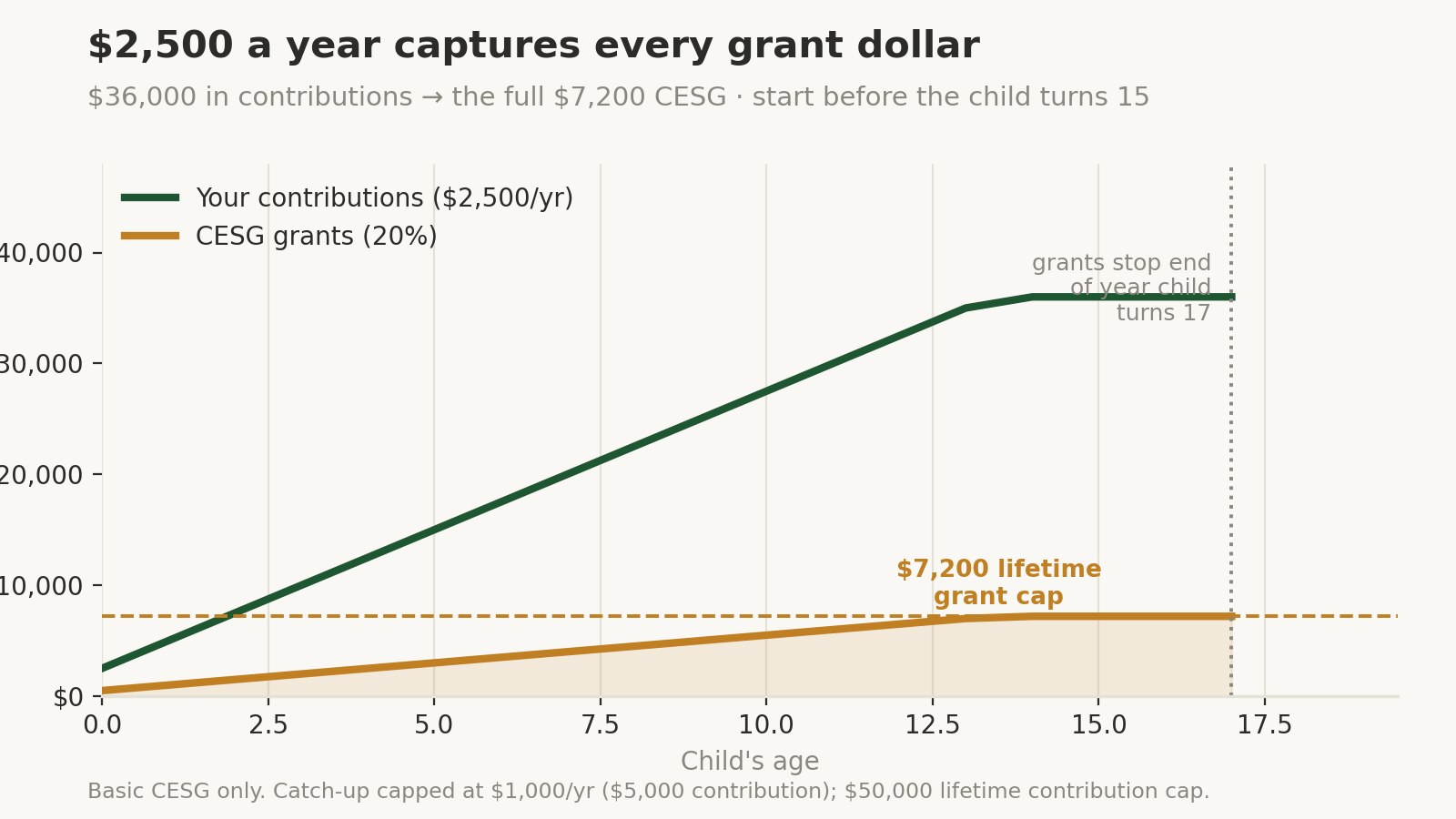
The verdict: The CESG matches 20% of your RESP contributions — $500 a year on $2,500 contributed, up to $7,200 lifetime per child — and grants stop at the end of the year the child turns 17, with catch-up capped at $1,000 a year.
Who this is for: Parents (and grandparents) saving for a child's education.
Your move: Contribute $2,500 per child per year to collect the full $500 grant, start before the child turns 15, and keep the $50,000 lifetime contribution cap in sight.
A Registered Education Savings Plan (RESP) is the only Canadian account where the government hands you free money just for contributing. The core of the deal: the Canada Education Savings Grant (CESG) matches 20% of what you put in. The catch is that every dollar of that match runs through specific annual caps, lifetime caps, and age deadlines — miss one, and the grant money evaporates. This guide covers the exact rules, with sources, and the contribution strategy that captures all of it.
| Rule | Amount | Source |
|---|---|---|
| Basic CESG match rate | 20% of annual contributions | https://www.canada.ca/en/revenue-agency/services/tax/individuals/topics/registered-education-savings-plans-resps/canada-education-savings-programs-cesp/canada-education-savings-grant-cesg.html |
| Annual CESG max (basic) | $500 per beneficiary (on $2,500 contributed) | https://www.canada.ca/en/revenue-agency/services/tax/individuals/topics/registered-education-savings-plans-resps/canada-education-savings-programs-cesp/canada-education-savings-grant-cesg.html |
| Annual CESG max (with catch-up) | $1,000 per beneficiary (on $5,000 contributed) | https://www.canada.ca/en/revenue-agency/services/tax/individuals/topics/registered-education-savings-plans-resps/canada-education-savings-programs-cesp/canada-education-savings-grant-cesg.html |
| Lifetime CESG max | $7,200 per beneficiary | https://www.canada.ca/en/employment-social-development/services/student-financial-aid/education-savings/resp/resp-promoters/user-guide/chapter-5.html |
| Lifetime contribution limit | $50,000 per beneficiary | https://www.canada.ca/en/employment-social-development/services/student-financial-aid/education-savings/resp/resp-promoters/infocapsules/withdrawals.html |
| Over-contribution penalty | 1% per month on the excess | https://www.canada.ca/en/employment-social-development/services/student-financial-aid/education-savings/resp/resp-promoters/infocapsules/withdrawals.html |
| CESG eligibility ends | End of the calendar year the child turns 17 | https://www.canada.ca/en/revenue-agency/services/tax/individuals/topics/registered-education-savings-plans-resps/canada-education-savings-programs-cesp/canada-education-savings-grant-cesg.html |
The Canada Education Savings Grant is a federal incentive paid by Employment and Social Development Canada (ESDC) into a child's RESP, based on contributions made to that RESP. No matter what your family income is, the basic CESG pays 20% of annual personal contributions across all eligible RESPs for a qualifying beneficiary, up to $500 per beneficiary per year, with a lifetime limit of $7,200 (https://www.canada.ca/en/revenue-agency/services/tax/individuals/topics/registered-education-savings-plans-resps/canada-education-savings-programs-cesp/canada-education-savings-grant-cesg.html).
To get the full $500 in a year, you must contribute at least $2,500 per beneficiary. Contribute less, and the grant is simply 20% of what you put in — $1,000 in contributions earns $100 in CESG. Contribute more than $2,500 in a year without any unused grant room from previous years, and the extra dollars earn no grant at all, though they still grow inside the RESP (https://www.Embark.ca/learning-centre/the-canada-education-savings-grant-cesg-unlock-its-benefits).
One thing the CESG is not: a tax deduction. RESP contributions are made with after-tax dollars and are not deductible from the subscriber's income (https://www.canada.ca/en/employment-social-development/services/student-financial-aid/education-savings/resp/resp-promoters/infocapsules/withdrawals.html). The payoff comes at withdrawal, not at contribution.
On top of the basic 20%, ESDC pays an additional CESG on the first $500 contributed each year, based on the adjusted family net income of the primary caregiver (https://www.canada.ca/en/revenue-agency/services/tax/individuals/topics/registered-education-savings-plans-resps/canada-education-savings-programs-cesp/canada-education-savings-grant-cesg.html):
| Adjusted family net income (most recently published — CRA labels this chart "for 2025") | Extra CESG on first $500 | Max total CESG/year |
|---|---|---|
| Less than $57,375 | Extra 20% = $100 | $600 |
| $57,375 – $114,750 | Extra 10% = $50 | $550 |
| More than $114,750 | Not eligible | $500 |
The additional CESG counts toward the same $7,200 lifetime maximum — it does not stack on top of it (https://www.canada.ca/en/employment-social-development/services/student-financial-aid/education-savings/resp/resp-promoters/user-guide/chapter-5.html). Thresholds are indexed and re-validated each calendar year against the most recent tax information on file (https://www.canada.ca/en/employment-social-development/services/student-financial-aid/education-savings/resp/resp-promoters/user-guide/chapter-5.html). Checked 2026-09-28: the CRA page (updated 2026-02-27) still labels this chart "for 2025" — 2026-labeled thresholds have not been published yet, so the figures above are the most recently published. Re-check the CRA page link before contributing, in case new thresholds post.
There is no annual contribution limit on RESPs — since 2007 you could legally deposit the full amount in a single year (https://www.canada.ca/en/revenue-agency/services/forms-publications/publications/ic93-3/ic93-3r2-registered-education-savings-plans.html). But the lifetime cap is strict: $50,000 in total contributions per beneficiary across all RESPs and all subscribers (https://www.canada.ca/en/employment-social-development/services/student-financial-aid/education-savings/resp/resp-promoters/infocapsules/withdrawals.html). Only subscriber contributions count toward it — grants and investment growth are excluded. CRA's IC93-3R2 is explicit: "Contributions made to an RESP for a beneficiary do not include amounts paid into the plan under the Canada Education Savings Act (CESA) or under a designated provincial program" (https://www.canada.ca/en/revenue-agency/services/forms-publications/publications/ic93-3/ic93-3r2-registered-education-savings-plans.html) — grants are deposited by ESDC, not by the subscriber, and investment earnings are not deposited amounts at all, so neither counts against the cap.
Cross the line and the cost is immediate: every subscriber is liable for a 1% per-month penalty tax on their share of the excess, until the over-contribution is withdrawn (https://www.canada.ca/en/employment-social-development/services/student-financial-aid/education-savings/resp/resp-promoters/infocapsules/withdrawals.html). This matters most when grandparents and parents are contributing to separate RESPs for the same child — nobody's individual contributions look excessive, but the combined total can breach the cap silently.
A contribution deadline most people never hit, but worth knowing: contributions must stop by the end of the 31st year following the year the plan was opened, and the plan itself must be terminated by December 31 of the 35th year (40th for a specified plan) (https://www.canada.ca/en/revenue-agency/services/forms-publications/publications/ic93-3/ic93-3r2-registered-education-savings-plans.html).
Unused CESG room carries forward from the child's birth — every child accumulates $500 of unused grant room per year (for 2007 and later years) (https://www.canada.ca/en/revenue-agency/services/tax/individuals/topics/registered-education-savings-plans-resps/canada-education-savings-programs-cesp/canada-education-savings-grant-cesg.html). But the catch-up rate is capped: you can collect CESG for the current year plus at most one prior year in any single calendar year. That makes the maximum CESG payable in one year $1,000 — which requires a $5,000 contribution (arithmetic: $1,000 ÷ 20% = $5,000; cap from https://www.canada.ca/en/revenue-agency/services/tax/individuals/topics/registered-education-savings-plans-resps/canada-education-savings-programs-cesp/canada-education-savings-grant-cesg.html).
In plain terms: if you open an RESP when your child is five and have never contributed, you cannot collect all five years of missed grants at once. You contribute $5,000 per year for five years, collecting $1,000 of CESG each year, and you're caught up. Each missed year beyond that requires another $5,000 year — and since CESG stops at the end of the year the child turns 17, starting late eventually means leaving grant money on the table (https://tawcan.com/maximizing-resp-front-loading-without-sacrificing-canada-education-savings-grant/).
Deadline 1: CESG ends at 17. The beneficiary qualifies for the grant on contributions made up to the end of the calendar year in which they turn 17 (https://www.canada.ca/en/revenue-agency/services/tax/individuals/topics/registered-education-savings-plans-resps/canada-education-savings-programs-cesp/canada-education-savings-grant-cesg.html).
Deadline 2: the age-16/17 gate. Because the CESG is designed to reward long-term saving, contributions made in the calendar years the child turns 16 and 17 only attract the CESG if at least one of the following was true before the end of the calendar year the child turned 15 (https://www.canada.ca/en/revenue-agency/services/tax/individuals/topics/registered-education-savings-plans-resps/canada-education-savings-programs-cesp/canada-education-savings-grant-cesg.html):
Translation: you must start contributing before the end of the year your child turns 15, or the last two years of grant eligibility are closed to you entirely.
The optimal contribution strategy depends on when you start. All scenarios below assume the basic CESG only and are arithmetic derived from the rules above.
Scenario A — Start at birth (the gold standard). Contribute $2,500 per year. Each year earns the full $500 CESG. After 14 years you've collected $7,000 in grants; one more year with a $1,000 contribution (earning $200) completes the $7,200 lifetime maximum. Total contributions needed to max the grants: $36,000 ($2,500 × 14 + $1,000). You've captured every grant dollar available while keeping the remaining $14,000 of lifetime contribution room for later top-ups that compound tax-free (https://www.wealthsimple.com/en-ca/learn/what-is-resp).
Scenario B — Front-load the full $50,000 early. The grant only ever sees one year's room: you collect $500 of CESG and permanently forfeit the other $6,700 of grant room ($7,200 − $500). On pure math, the lump sum still wins at ordinary returns — Tim Cestnick's analysis (Globe and Mail, June 2026) puts the $50,000 lump sum at $144,100 vs $98,700 for the grant-maximizing strategy at a 6% annual return: the forfeited $6,700 in grants (plus roughly $6,600 in grant growth) is dwarfed by 18 years of compounding on the extra principal (analysis: https://ourfamilyoffice.ca/wp-content/uploads/2026/06/The-right-education-savings-strategy-can-pay-for-any-degree.pdf). So why doesn't everyone do it? Liquidity: tying up $50,000 per child at birth is impossible for most families, and the money is locked into education use — if the child doesn't go to school, the grants go back and the growth faces the AIP tax (see below).
Scenario C — The practical middle path. Contribute $2,500 per year to lock in the full annual grant, then front-load whatever extra you can afford on top of that, up to the $50,000 lifetime limit. The extra dollars earn no additional CESG, but they do start compounding tax-free immediately. This is the strategy most high-savers actually follow (https://tawcan.com/planning-our-kids-financial-future-resp-housing-and-beyond/).
Scenario D — Started late (catch-up). For each missed year, add an extra $2,500 to that year's contribution, up to $5,000 total per year, collecting up to $1,000 of CESG. Note the hard ceiling: because of the $1,000-per-year cap, a child who starts at age 10 can still collect the full $7,200 ($5,000 × 7 years = $7,000 in grants, plus $200 on a $1,000 contribution at age 17), but anyone starting at 16 or 17 faces the gate rules in the previous section and may be locked out of those years' grants (illustrative schedule: https://tawcan.com/maximizing-resp-front-loading-without-sacrificing-canada-education-savings-grant/).
The priority order for every family: first, contribute $2,500 per beneficiary per year to capture the $500 CESG; second, if you have missed years, catch up at up to $5,000 per year; third, only after grant room is exhausted, front-load extra principal toward the $50,000 cap.
When the money comes out, it splits into two buckets with different tax treatment (https://www.canada.ca/en/revenue-agency/services/tax/individuals/topics/registered-education-savings-plans-resps/payments-resp.html):
This is the whole tax design of the RESP: the subscriber deducts nothing going in, but the growth and grants are taxed to the student, who typically has little other income and can offset it with tuition tax credits — often paying little or no tax (https://www.moneysense.ca/save/investing/resp/are-resp-contributions-tax-deductible/). Withdraw EAPs strategically in the student's low-income years to keep that tax bill at or near zero (https://www.moneysense.ca/save/investing/resp/are-resp-contributions-tax-deductible/).
One mechanical limit: in the first 13 consecutive weeks of a qualifying program, EAPs are capped at $8,000 for full-time students ($4,000 for a specified/part-time program). After 13 weeks, there is no limit as long as the student remains enrolled (https://www.canada.ca/en/revenue-agency/services/tax/individuals/topics/registered-education-savings-plans-resps/payments-resp.html).
The grants come with strings attached. If the beneficiary does not pursue post-secondary education, the CESG is returned to the government (https://www.canada.ca/en/revenue-agency/services/tax/individuals/topics/registered-education-savings-plans-resps/canada-education-savings-programs-cesp/canada-education-savings-grant-cesg.html). Your contributions still come back to you tax-free. The investment growth can be withdrawn by the subscriber as an Accumulated Income Payment (AIP), but only once plan conditions are met (generally after the year including the 9th anniversary with all beneficiaries 21+, or in the year of the 35th anniversary), and it is taxed at your regular rate plus an additional 20% tax (12% for Quebec residents) — though up to $50,000 can be transferred into your RRSP (or a spouse's) with available room to eliminate much of that tax (https://www.canada.ca/en/revenue-agency/services/tax/individuals/topics/registered-education-savings-plans-resps/payments-resp.html).
Lower-income families should also check the Canada Learning Bond: $500 for the first eligible year plus $100 for each subsequent eligible year until the child turns 15, up to $2,000 per child — with no personal contribution required (https://www.canada.ca/en/revenue-agency/services/tax/individuals/topics/registered-education-savings-plans-resps/canada-education-savings-programs-cesp/canada-learning-bond.html). The CLB is available for eligible children from low-income families born in 2004 or later.
The RESP game is simple arithmetic: $2,500 per child per year gets you $500 of free federal money per year, up to $7,200 total, until the child turns 17 — subject to the $50,000 lifetime contribution cap. Do that every year from birth and the strategy is essentially solved. Start late, and the $1,000-per-year catch-up cap becomes your binding constraint, so start contributing before the child turns 15 at the latest. Lump-sum the full $50,000 on day one wins on pure math at ordinary returns (about $144,100 vs $98,700 at 6% over 18 years), at the price of $6,700 in forfeited grants — but it ties up $50,000 per child for 18 years, which is the real reason almost nobody does it.
Refresh notes: evergreen — refresh annually to confirm CESG income thresholds (additional CESG) and check for any federal grant-rule changes. No expiring offers referenced (draft date 2026-09-28).