TFSA vs RRSP by Income Level: Where the Math Actually Flips
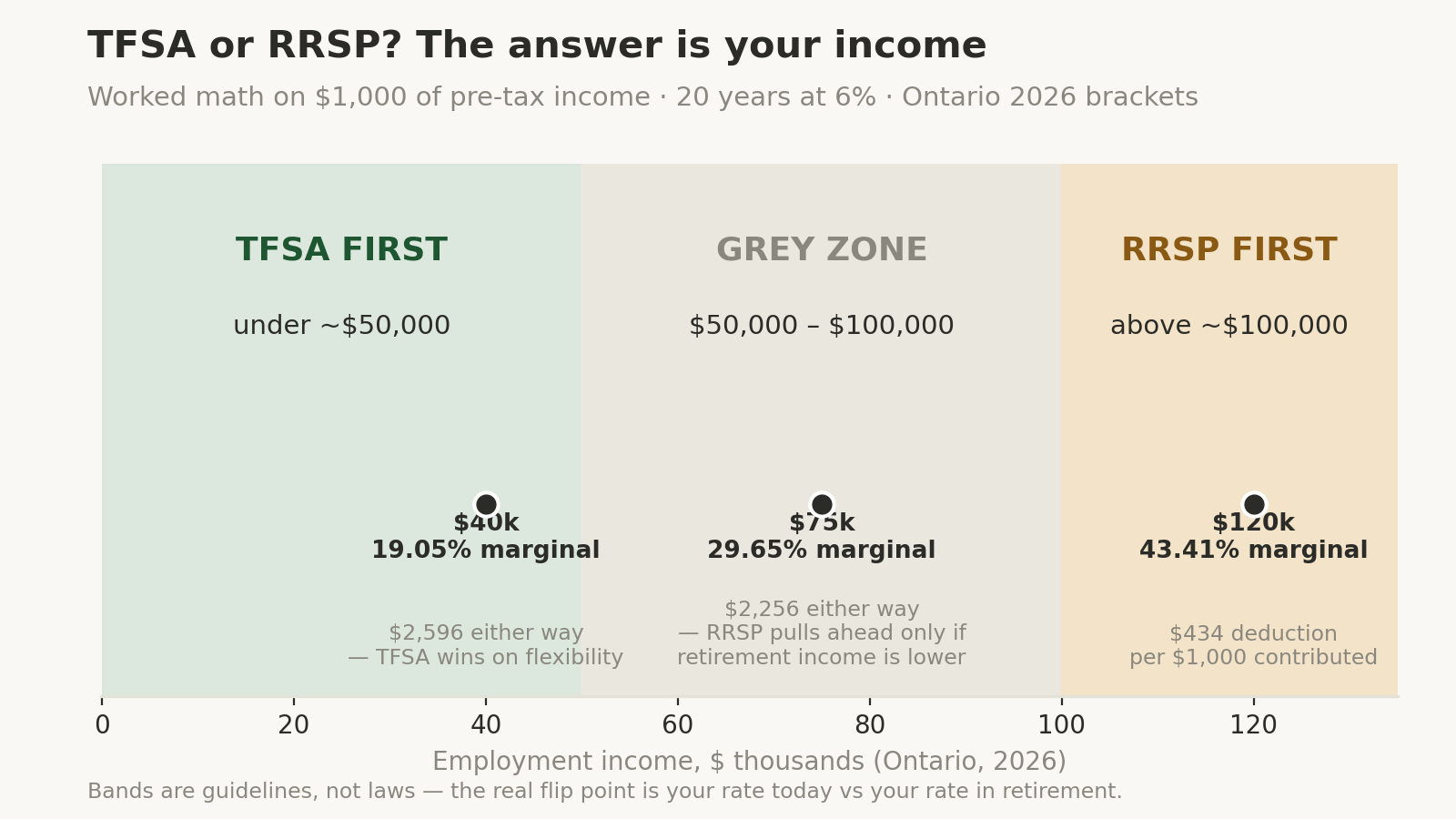
Zone chart of employment income from $0 to $135,000: TFSA first under about $50,000, a grey zone from $50,000 to $100,000, and RRSP first above about $100,000, with markers showing the worked examples at $40,000 (19.05% marginal rate, $2,596 either way), $75,000 (29.65%, $2,256 either way), and $120,000 (43.41%, $434 deduction per $1,000).

The verdict: Under ~$50,000 of income, the TFSA wins by default; above ~$100,000, the RRSP’s deduction (worth $434 per $1,000 contributed at $120k) wins — and in the $50k–$100k grey zone, the real question is whether your retirement income will be lower than today’s. Who this is for: Canadians choosing between the TFSA and RRSP … Read more
FHSA vs RRSP Home Buyers’ Plan for a Down Payment, Ranked by Math

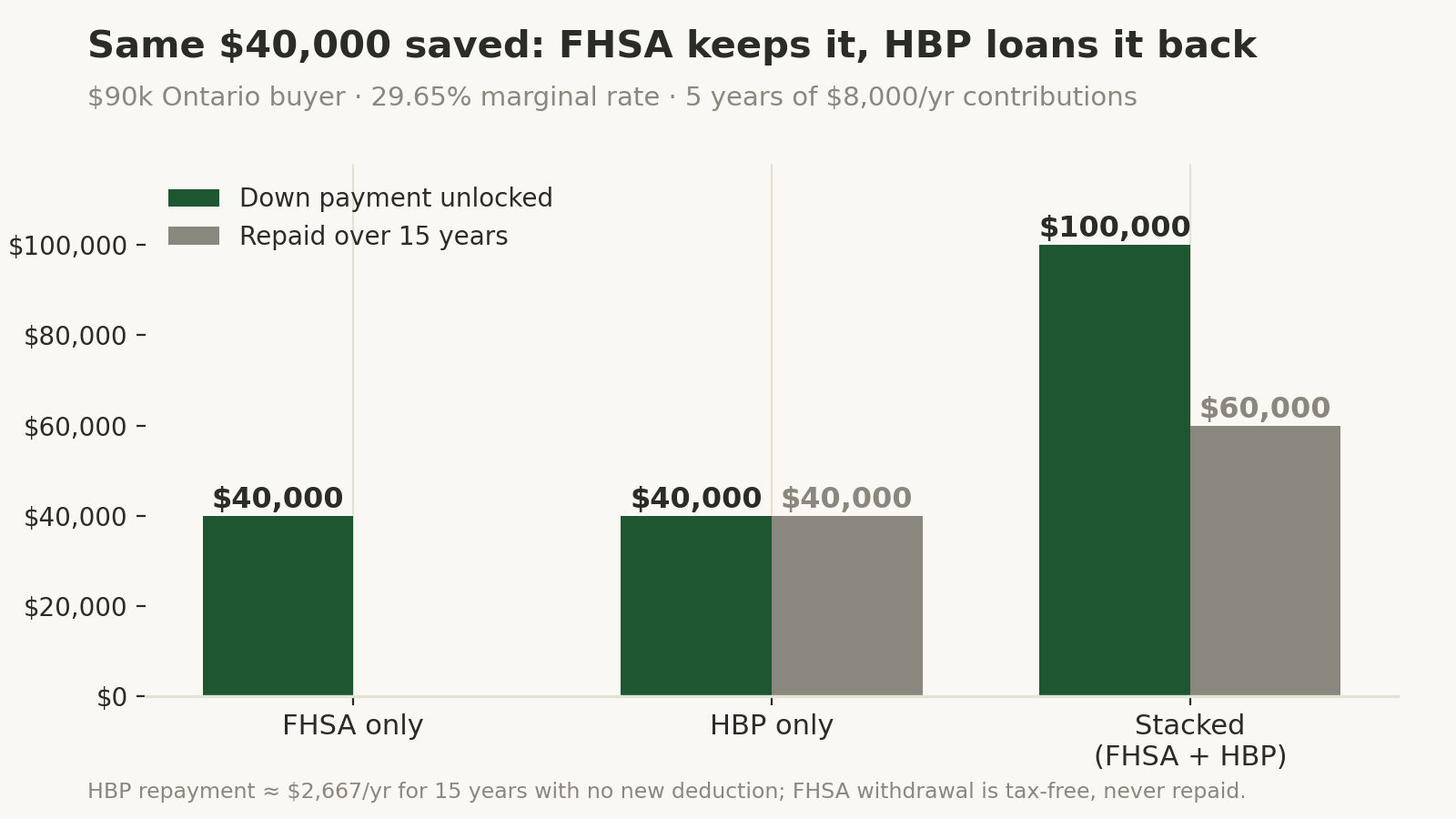
Paired bar chart comparing three down-payment paths for a $90,000 Ontario buyer: FHSA only unlocks $40,000 with $0 repaid; HBP only unlocks $40,000 with $40,000 repaid over 15 years; stacking FHSA plus HBP unlocks $100,000 with $60,000 repaid.

The verdict: For the same dollar saved, the FHSA beats the Home Buyers’ Plan — both give a tax deduction going in, but only the FHSA’s withdrawal is tax-free with nothing to repay, while the HBP must be repaid over 15 years. Stacked, one buyer frees up $100,000 of tax-advantaged down payment; a couple, $200,000 … Read more

The FHSA Complete Guide (2026)

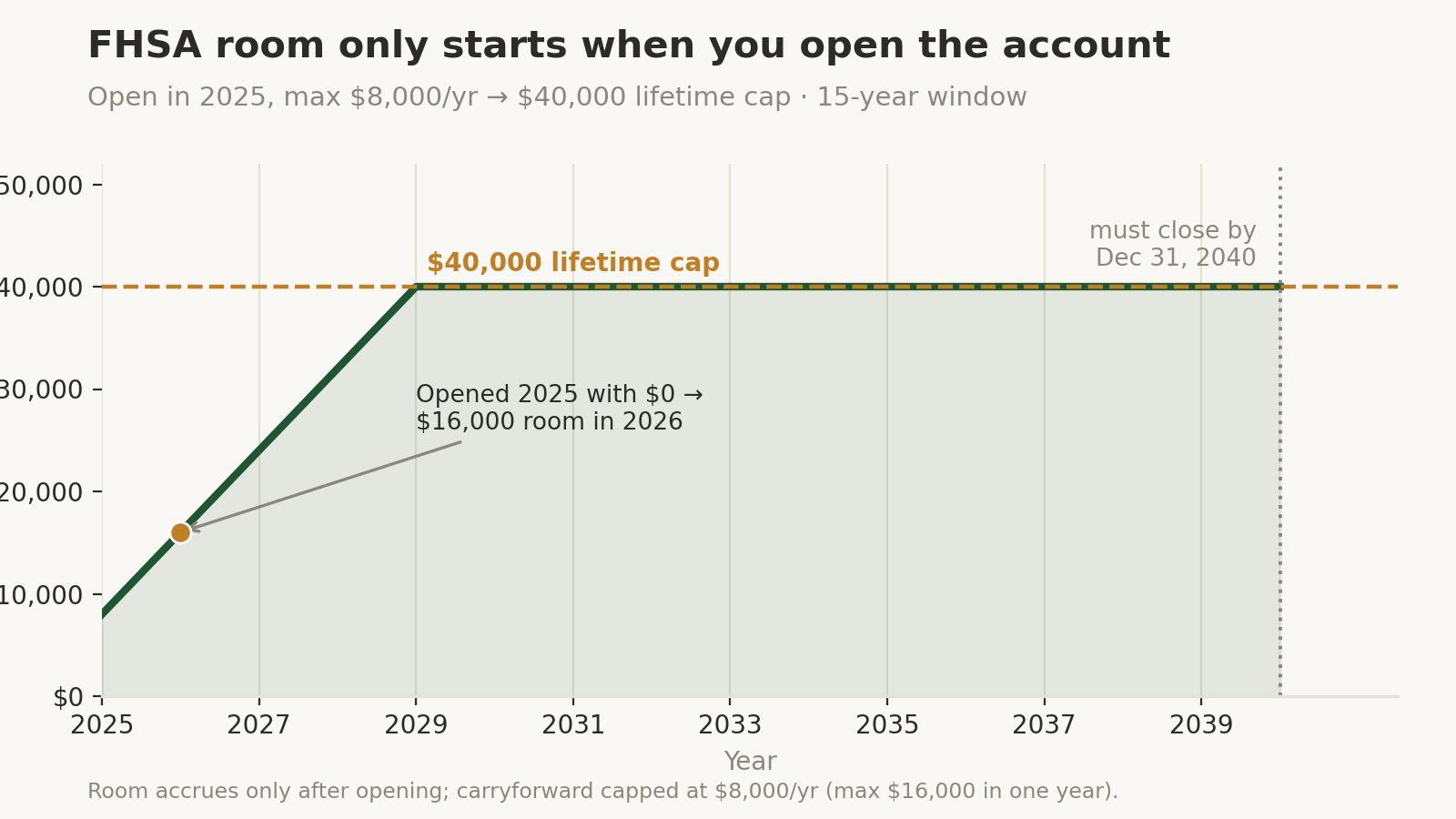
Line chart showing cumulative FHSA contributions from 2025 to 2040 for an account opened in 2025 and maxed at $8,000 per year: the line rises to the $40,000 lifetime cap by 2029 and stays flat, with a marker showing $16,000 of room in 2026 after opening with $0 in 2025, and a marker that the account must close by December 31, 2040.

The verdict: The FHSA gives you $8,000 a year ($40,000 lifetime) that’s tax-deductible going in and tax-free coming out for a first home — but room only starts accruing after you open the account, and it must close by December 31 of its 15th anniversary year. Who this is for: Canadians who are — or … Read more

Where Your Next Dollar Should Go (2026): HISA, FHSA, TFSA, RRSP, RESP — the Complete Funding Order

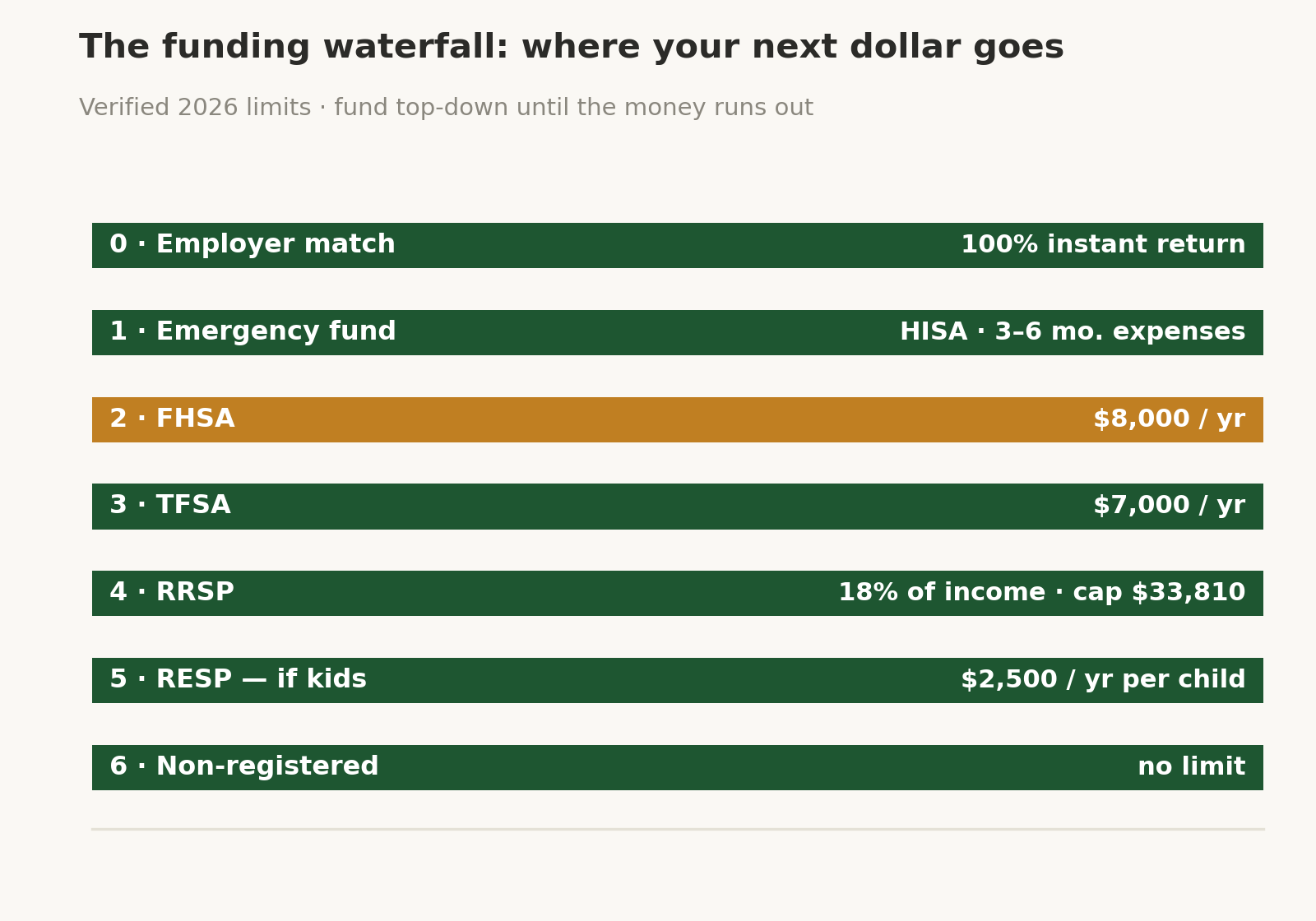
Horizontal step chart of the recommended funding order for 2026: step 0, employer match (100% instant return); step 1, emergency fund in a HISA (3-6 months expenses); step 2, FHSA at $8,000 per year, highlighted in amber; step 3, TFSA at $7,000 per year; step 4, RRSP at 18% of income capped at $33,810; step 5, RESP at $2,500 per year per child (conditional, families with kids); step 6, non-registered with no limit.

Numbers checked: September 28, 2026. The verdict: Fund in this order: capture any employer match (an instant 100% return), then park 3–6 months of essential expenses in a high-interest savings account emergency fund, then max the FHSA ($8,000/yr — deductible going in, tax-free coming out) if you’re a first-time buyer, then the TFSA ($7,000/yr for … Read more

Rogers Red World Elite: Three Cuts, Two Dates (What Changes Nov 18, 2026 and Jan 12, 2027)

The verdict: The Rogers Red World Elite is getting materially worse on November 18, 2026 — the 1.5× redemption bonus ends, trip cancellation/interruption/delay insurance disappears, and the Roam Like Home days become a narrower $75 credit in January 2027. If you hold the card, redeem banked points before November 18 and check whether your travel … Read more