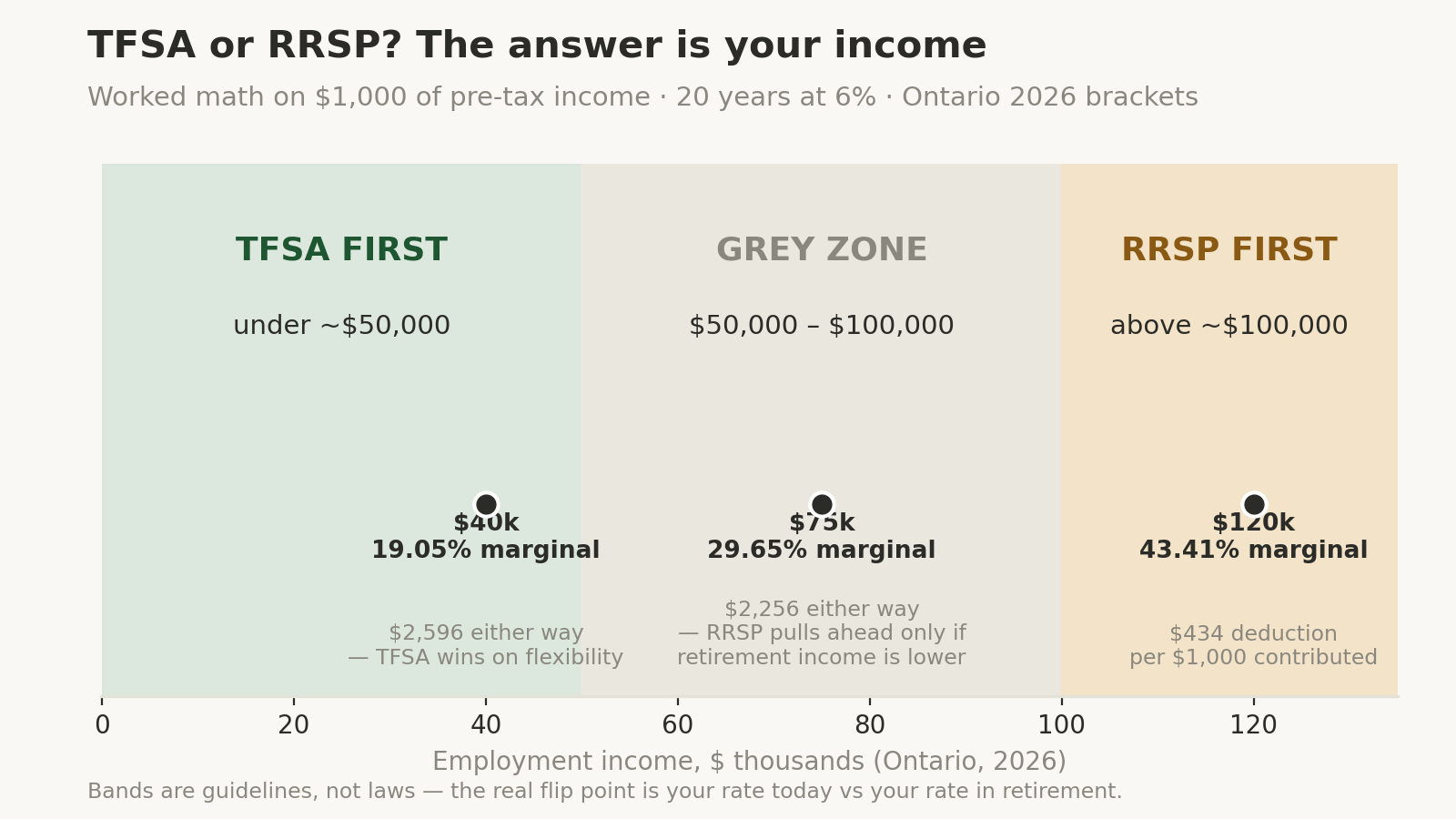
The verdict: Under ~$50,000 of income, the TFSA wins by default; above ~$100,000, the RRSP’s deduction (worth $434 per $1,000 contributed at $120k) wins — and in the $50k–$100k grey zone, the real question is whether your retirement income will be lower than today’s.
Who this is for: Canadians choosing between the TFSA and RRSP based on their income.
Your move: Take any employer match first, then fund the TFSA if you’re under ~$50k or still rising, and the RRSP if you’re above ~$100k and will retire on less — splitting the difference in the grey zone is fine.
Contents
- The short answer
- The one equation that decides everything
- The numbers: 2026 tax brackets (Ontario example)
- Worked examples: $1,000 of pre-tax income, three incomes
- The “$50,000 rule” — verified or myth?
- Edge cases that override the income rule
- The decision table
- Related reading
The short answer
- Under ~$50,000: TFSA first. The RRSP deduction is worth little at low marginal rates, and the TFSA’s flexibility is worth a lot.
- ~$50,000–$100,000: The grey zone. TFSA is the safe default; RRSP starts making sense if you’re confident your retirement income will be lower than today’s income.
- Above ~$100,000: RRSP first (after taking any employer match). At $100k the marginal rate is 31.48%, so the deduction is worth ~$315 per $1,000 contributed — rising to $434 per $1,000 at $120k (Table I3) — and most people withdraw in retirement at a lower rate.
Those income bands are guidelines, not laws. The decision actually rests on one comparison: your marginal tax rate today versus your marginal tax rate when you withdraw. Everything below shows the math.
The one equation that decides everything
An RRSP contribution gives you a tax deduction worth your marginal tax rate — the rate on your next dollar of income. Put $1,000 into an RRSP at a 30% marginal rate and your tax bill drops by $300 (illustrative rate — the worked examples below use sourced 2026 marginal rates).
A TFSA contribution gives you no deduction. But you never pay tax on the growth or the withdrawal — ever.
Here’s the part most articles bury: if your marginal tax rate is the same when you contribute and when you withdraw, TFSA and RRSP give you the exact same after-tax result. The worked examples below prove it. The RRSP only wins when you deduct at a high rate today and withdraw at a lower rate in retirement. The TFSA wins on flexibility regardless.
The numbers: 2026 tax brackets (Ontario example)
All the math in this article uses 2026 federal + Ontario tax brackets. Rates differ by province, so the exact flip points shift if you live elsewhere — the logic doesn’t. (Only Ontario is worked here; Quebec administers its own tax system separately.)
2026 federal brackets: 14% on the first $58,523 of taxable income; 20.5% on $58,523–$117,045; 26% on $117,045–$181,440; 29% on $181,440–$258,482; 33% above $258,482 . Note the lowest federal bracket dropped from 15% to 14% for 2026 — Bill C-4 cut it to 14.5% for 2025 and 14% for 2026 onward (Department of Finance report, June 2026).
2026 Ontario brackets: 5.05% to $53,891; 9.15% on $53,891–$107,785; 11.16% on $107,785–$150,000; 12.16% on $150,000–$220,000; 13.16% above $220,000 .
Combined marginal rates (what each extra dollar of income costs you) for an Ontario resident in 2026:
| Income | Federal | Ontario | Combined marginal rate |
|---|---|---|---|
| $40,000 | 14% | 5.05% | 19.05% (Table I3) |
| $75,000 | 20.5% | 9.15% | 29.65% |
| $120,000 | 26% | 11.16% + Ontario surtax | 43.41% (Table I3 marginal rates; the surtax adds 20% on provincial tax above $5,818 and 36% above $7,446) |
Every dollar of RRSP contribution saves you that combined marginal rate. That’s the lever.
Worked examples: $1,000 of pre-tax income, three incomes
Setup: you have $1,000 of pre-tax income. You either (a) contribute the full $1,000 to an RRSP — the deduction makes it cost you only $1,000 × (1 − marginal rate) out of pocket — or (b) pay tax first and contribute the remainder, $1,000 × (1 − marginal rate), to a TFSA. Same investment, same 6% annual return, 20 years (growth factor 1.06^20 = 3.2071 — arithmetic independently re-checked 2026-09-28; 6% and 20 years are illustrative assumptions, not predictions).
$40,000 income — TFSA by default
Marginal rate: 19.05%.
- RRSP route: contribute $1,000. Deduction saves $190.50 (Table I3). It grows to $3,207 over 20 years. Withdraw at a 19.05% rate → $2,596 after tax.
- TFSA route: contribute $809.50 after tax. It grows to $2,596, tax-free.
Same result. So why does every planner say TFSA at $40k? Because the tie is on math alone — and the TFSA wins on everything else: no RRSP withdrawal withholding (10% on withdrawals up to $5,000, 20% on $5,001–$15,000, 30% above $15,000 — source), no tax on withdrawal ever, and withdrawals don’t count as income against benefits. Plus, at this income your retirement income may well be similar or higher (pensions + CPP + OAS can match a $40k salary — source for the low-income TFSA argument). If you withdraw at a higher rate than you contributed, the RRSP actively loses.
Verdict at $40k: TFSA first. Your unused RRSP room doesn’t vanish — it carries forward indefinitely, so you can use it later when your income is higher .
$75,000 income — the genuine grey zone
Marginal rate: 29.65%.
- RRSP route: contribute $1,000. Deduction saves $296.50 . Grows to $3,207. Withdraw at 29.65% → $2,256 after tax.
- TFSA route: contribute $703.50 after tax. Grows to $2,256, tax-free.
Again a tie — at equal rates, the account type doesn’t matter mathematically. The $75k question is really: will your retirement income be lower than $75k? If yes, the RRSP pulls ahead. Say you retire on ~$50,000 of income (a 19.05% marginal rate — source: — Table I3): that $3,207 RRSP balance nets you $2,596 after tax versus $2,256 in the TFSA — about $340 more on a single $1,000 contribution (retirement income level is the drafter’s illustrative assumption; the 19.05% rate at ~$50k is the 2026 Ontario marginal rate).
Verdict at $75k: TFSA if you’re early-career with rising income ahead (save the deduction for later). RRSP if your income has plateaued and retirement income will clearly be lower. Splitting between both is reasonable, not indecisive — it’s what multiple planners recommend in this band .
$120,000 income — the RRSP earns its keep
Marginal rate: 43.41% (federal 26% + Ontario 11.16% + Ontario surtax — source).
- RRSP route: contribute $1,000. Deduction saves $434.10. Grows to $3,207. Even if you withdraw at the same 43.41% → $1,815. But if you retire at a ~29.65% marginal rate (income around $75k — source), you keep $2,256 — a 24% uplift purely from the rate difference (retirement income level is the drafter’s illustrative assumption).
- TFSA route: contribute $565.90 after tax. Grows to $1,815, tax-free.
The deduction alone — $434 back on every $1,000 — is the argument. At this income, deferring tax at 43.41% and paying it later at ~30% is one of the biggest guaranteed “returns” in Canadian personal finance.
Verdict at $120k: RRSP first for retirement savings (after the employer match — see below), TFSA for everything else.
The “$50,000 rule” — verified or myth?
You’ll see “$50,000” cited everywhere as the flip point. The Club checked what the sources actually say (all retrieved 2026-09-28):
- Wealthsimple’s RRSP vs TFSA guide: “Your income is less than $50,000” → prioritize TFSA .
- Wealthsimple’s other guide: “Your annual income is less than $57,375” → TFSA . Note: $57,375 was the 2025 federal bracket threshold; the 2026 equivalent is $58,523 (source: RCGT Table I3 2026).
- Educators Financial Group: “Making over $50K/year: choose an RRSP for long-term savings goals” .
- Gordon Pape via MoneySense argues the TFSA-first line is closer to $36,000 for lower earners whose retirement income (with government benefits) could exceed working income .
- One newcomer-focused 2026 guide splits it finer: under $57,375 TFSA first, $57,375–$114,750 split, above $114,750 RRSP first . Note: the guide’s brackets use the 2025 federal thresholds; the 2026 equivalents are $58,523 and $117,045 (source: RCGT Table I3 2026).
Honest verdict: $50,000 is a rule of thumb, not a law of physics. It roughly marks where the marginal rate climbs enough (into the 20.5% federal bracket, which starts at $58,523 in 2026 — source) that the deduction starts feeling meaningful. But the real flip point for you is personal: it’s the income level above which you’ll withdraw at a lower rate in retirement. If you earn $65k and will retire on $80k, the TFSA still wins. If you earn $65k and will retire on $45k, the RRSP wins. The number that matters is the difference between two rates, not one magic income.
Edge cases that override the income rule
Employer RRSP match: always take it first. A dollar-for-dollar match is an instant 100% return — no tax-timing argument beats it . Contribute up to the match limit before a single dollar goes to TFSA vs RRSP debates.
Low income + GIS: the TFSA is nearly mandatory. The Guaranteed Income Supplement is reduced by $1 for every $2 of other income — a 50-cent clawback that starts from the first dollar above the threshold . For a single senior, the income cutoff is $22,800 for Jul–Sep 2026, with amounts indexed quarterly (and the quarterly figures). RRSP and RRIF withdrawals count as income and can cost a low-income senior thousands in lost GIS. TFSA withdrawals never count as income. If there’s any chance you’ll rely on GIS in retirement, favour the TFSA now.
OAS clawback: the RRSP can cost you in your 70s. For the 2026 income year, OAS starts clawing back at $95,323 of net world income, at 15 cents per dollar (Jul–Sep 2026 ISP figures). RRSP/RRIF withdrawals count as income toward that threshold; TFSA withdrawals don’t . This doesn’t change the contribution decision much at $75k, but if you’re a high earner building a very large RRSP, mandatory RRIF withdrawals after 71 — you must convert your RRSP by the end of the year you turn 71 — can push you into clawback territory. Another reason the TFSA deserves a share of your savings.
RRSP room is 18% of earned income. Your 2026 RRSP contribution limit is 18% of your 2025 earned income, up to a maximum of $33,810 . The 2026 TFSA annual limit is $7,000 — confirmed directly against the CRA . At lower incomes, 18% of income may cap you below what you want to save — the TFSA has no such income-linked cap.
Expecting a big raise? Delay the RRSP deduction. Unused RRSP room carries forward indefinitely, and you can also contribute now and claim the deduction in a later, higher-income year (“you can contribute money to your RRSP now… choose to claim the deduction in a later year”; — “not all RRSP contributions must be deducted in the year they are made; you can choose to defer to a future year”). Contributing at $60k and deducting at $100k captures the bigger deduction without losing years of growth.
The decision table
| Your situation | First dollar goes to |
|---|---|
| Income under ~$50k | TFSA |
| Income $50k–$100k, income rising | TFSA now, save RRSP room for later |
| Income $50k–$100k, income plateaued, retirement income will be lower | RRSP (or split) |
| Income above ~$100k | RRSP |
| Any income + employer match available | Matched RRSP contributions first, always |
| Low income now, possible GIS reliance in retirement | TFSA |
| Saving for a non-retirement goal | TFSA (no withdrawal tax or withholding) |
Related reading
- Rogers Red World Elite: Three Cuts, Two Dates (What Changes Nov 18, 2026 and Jan 12, 2027) (verified 2026-09-28)
- Every Bank Account Bonus in Canada (October 2026) (verified 2026-09-28)