The verdict: Put $1 too much in your TFSA and the CRA charges 1% per month on the excess — no buffer, no grace period — and Canadians paid $166.2 million in these penalties in 2024 alone.
Who this is for: Anyone who contributes to a TFSA, especially if you ever withdraw and re-deposit in the same year.
Your move: Never re-contribute a withdrawal in the same calendar year (room only comes back January 1), and move TFSAs between institutions by direct transfer only.
Last checked against sources: 2026-09-28
Contents
- How TFSA contribution room works
- The penalty: 1% per month on the excess
- The timing trap: withdrawals come back next January, not today
- Direct transfers vs. do-it-yourself moves
- Three worked examples of how people trigger it
- How to fix an over-contribution if it happens
- How to check your room (and why the portal can mislead you)
The TFSA over-contribution penalty is the most expensive piece of TFSA mechanics in Canada, and the one people trigger by accident. It caught enough Canadians in 2024 that the CRA assessed $166.2 million in penalty taxes that year alone — up from $130.8 million in 2023, according to data obtained by Investment Executive and reported by Wealth Professional (October 2025), citing Financial Post reporting .
This is not a guide to clever loopholes. It is the mechanics of how the penalty works, when it triggers, and the exact arithmetic — so you never pay it.
How TFSA contribution room works
Your available room in any year is the sum of three things:
- This year’s annual dollar limit. For 2026, the TFSA dollar limit is $7,000 — the third consecutive year at that figure .
- Unused room carried forward from prior years. If you didn’t contribute the full limit in a past year, the remainder carries forward indefinitely . The CRA’s own worked examples build each year’s room from prior unused room .
- Withdrawals you made in prior calendar years. Every dollar withdrawn gets added back to your room — but only on January 1 of the following calendar year, not when you withdraw it .
Room accrues each calendar year you are 18 or older, a Canadian tax resident, and hold a valid SIN — whether or not you actually opened a TFSA . For someone eligible every year since the TFSA’s introduction in 2009 who never contributed, total room in 2026 is $109,000 .
Annual limits since 2009
| Year | Annual limit | Cumulative (eligible since 2009) |
|---|---|---|
| 2009–2012 | $5,000 | $20,000 |
| 2013–2014 | $5,500 | $31,000 |
| 2015 | $10,000 | $41,000 |
| 2016–2018 | $5,500 | $57,500 |
| 2019–2022 | $6,000 | $81,500 |
| 2023 | $6,500 | $88,000 |
| 2024–2026 | $7,000 | $109,000 |
The penalty: 1% per month on the excess
If, at any time in a month, you hold an excess TFSA amount, you are subject to a 1% tax on your highest excess TFSA amount in that month (CRA: “Any excess amount in your TFSA is taxable at a rate of 1% per month. This is calculated on the highest amount of excess in your account for each month it remains.”). The CRA puts it more plainly on its withdrawals page: “The excess amount in your TFSA is taxable at a rate of 1% per month for as long as the excess amount remains in your account” .
Three things to understand about that sentence:
- There is no buffer. RRSPs give you a $2,000 lifetime over-contribution buffer before penalties apply. TFSAs do not — “you get no buffer with TFSAs” — so the penalty starts at dollar one.
- It is per month, per highest excess. A $500 over-contribution left from November through December attracts $10 in penalty ($500 × 1% × 2 months) . The meter runs every calendar month the excess sits in the account. Note: the month you remove the excess still counts — over-contribute $2,000 in June and remove it in September, and you owe $20 for June, July, August and September .
- Accidents count. The penalty “is triggered automatically when excess contributions are made, even if the over-contribution was an accident” .
The timing trap: withdrawals come back next January, not today
This is the mechanism that generates most accidental penalties. When you take money out of a TFSA, it does not immediately create new available contribution room. The amount withdrawn is only added back as available room on January 1 of the next calendar year .
The CRA’s rule of thumb: “do not re-contribute funds in the same year you take them out” unless you have unused room still available . Money.ca names re-contributing a withdrawal in the same calendar year it was made as the most common cause of TFSA over-contributions .
The CRA publishes a textbook example: Twyla contributes the maximum each year since 2009, has $0 room at the end of 2024, contributes $7,000 (the 2025 limit) in 2025, then withdraws $3,000 for a trip and re-contributes the $3,000 when her plans change. Math: $0 room − $3,000 contribution = a $3,000 over-contribution — with no contribution room left in 2025, any contribution produces a taxable excess amount .
Direct transfers vs. do-it-yourself moves
To move funds from one TFSA to another institution, the CRA says to ask the receiving institution to do a direct transfer: “the funds you move will not affect your TFSA contribution room and you will avoid any tax implications” . Note that some institutions charge a fee for processing a transfer, and the amount varies by provider — check your institution’s fee schedule before initiating (notes “some providers charge a transfer-out fee”).
Do not withdraw the funds yourself and then contribute them to a different TFSA. The CRA calls this out explicitly: it is not a direct transfer, the contribution is treated as a new contribution, and if it exceeds your available room, the excess is subject to the 1% monthly tax . The CRA’s own example: Alexis contributes the maximum $95,000 (2009–2024) plus $7,000 for 2025, then withdraws $50,000 from her TFSA in April 2025 and deposits it at a new bank herself — a $50,000 over-contribution, at $500 per month in penalty until the excess is removed. The $50,000 of room created by the withdrawal would only be restored on January 1, 2026 .
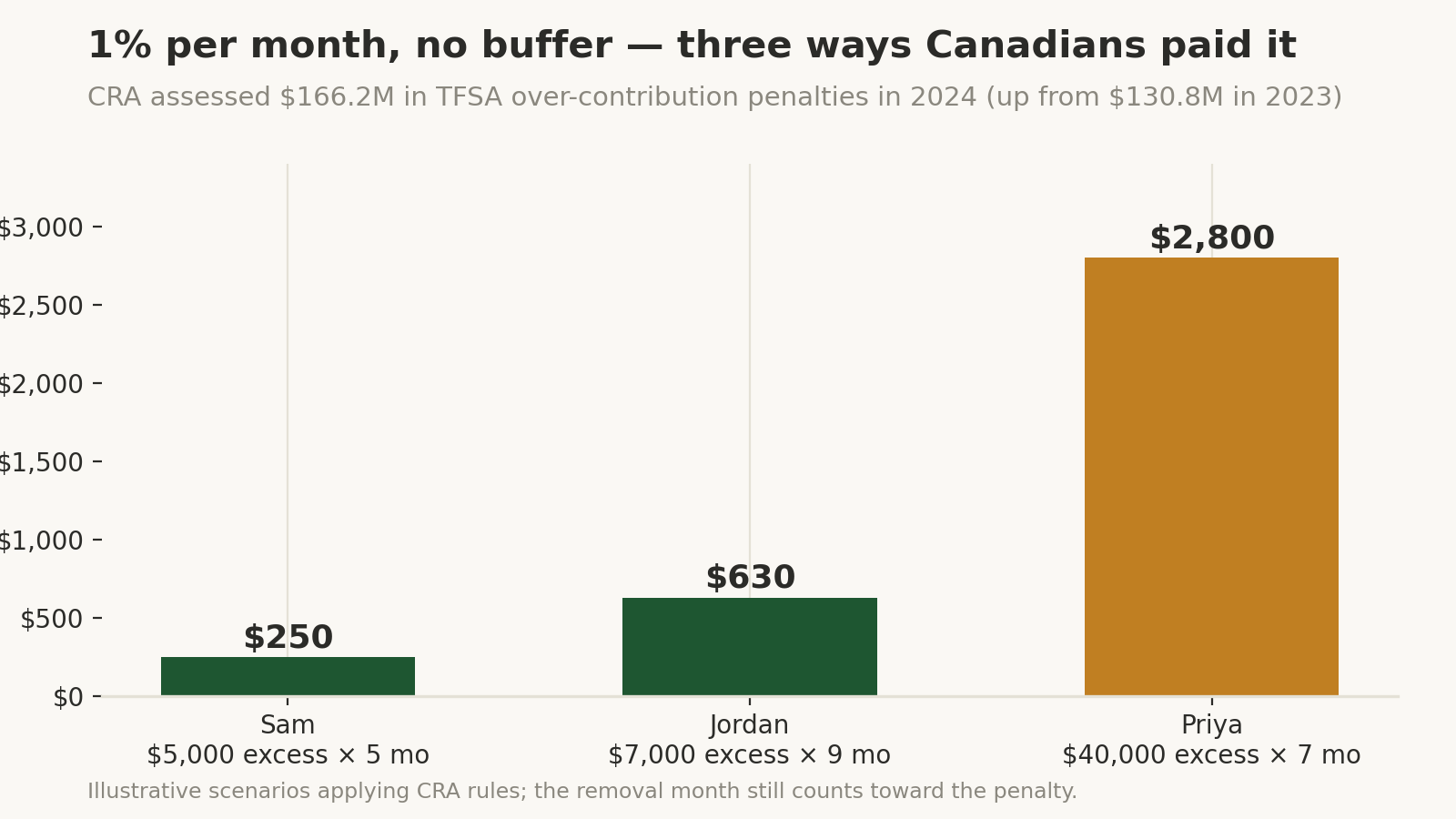
Three worked examples of how people trigger it
The arithmetic below is Cash Club’s own, applying the CRA rules cited above to hypothetical scenarios. Rules sourced from CRA; the scenarios and the people in them are illustrative, not real cases.
Example 1 — The same-year re-deposit (the classic trap)
Sam’s TFSA has been maxed since 2009, so at the start of 2026 his available room is exactly $7,000.
| Step | Room math |
|---|---|
| Jan 2026: contributes $7,000 (the 2026 limit) | $7,000 − $7,000 = $0 |
| May 2026: withdraws $5,000 for a home repair | $0 room (withdrawal does not restore room in 2026) |
| Aug 2026: re-deposits the $5,000 | $0 − $5,000 = $5,000 over-contribution |
Sam reads an article about the penalty in December, panics, and withdraws the $5,000 excess in December 2026.
Penalty: the $5,000 excess was in the account in August, September, October, November, and December — 5 months × 1% × $5,000 = 5 × $50 = $250.
If Sam had instead waited until January 2027 to re-deposit, the withdrawn $5,000 would have been restored as room and the penalty would have been $0.
Example 2 — Chasing a better rate, doing it yourself
Priya holds $60,000 in a TFSA at Bank A, with $0 available room. In March 2026 she sees a better rate at Bank B, withdraws $40,000 from Bank A, and deposits it at Bank B herself that same month.
Over-contribution: $40,000 (her room was $0; the withdrawal restores nothing until January 1, 2027). She leaves the excess in place until September 2026, when she withdraws it.
Penalty: March through September = 7 months × 1% × $40,000 = 7 × $400 = $2,800. (The removal month still counts — per the CRA’s own example, an excess removed in September is still taxed for September.)
Had she asked Bank B to do a direct transfer, the move would not have affected her contribution room at all, and the penalty would have been $0.
Example 3 — The “per account” myth
Jordan opened a TFSA at Bank A in 2024 and one at Bank B in 2025. He assumes the $7,000 annual limit is per account. In January 2026 he contributes $7,000 at Bank A; in March 2026 he contributes another $7,000 at Bank B.
The limit is shared across all your accounts — contributions to every TFSA count toward the one limit, not per account . Jordan’s available room for 2026 was $7,000 total, so the March contribution created a $7,000 excess. He holds both contributions until November 2026.
Penalty: March through November = 9 months × 1% × $7,000 = 9 × $70 = $630.
How to fix an over-contribution if it happens
- Withdraw the excess amount as soon as possible. This stops the 1% monthly penalty from accumulating — but it does not erase the months already accrued .
- File Form RC243 (the TFSA return) with Schedule A to report the excess and pay the tax owing. The return and payment are due by June 30 of the calendar year after the year the tax applies . The CRA monitors TFSA contributions on an annual basis from the data your financial institutions file, and typically notifies you through your CRA account or by mail in late spring if you have an excess amount .
- Confirm your room from your own records before contributing again. Contributions to every TFSA count toward one limit .
One relief valve exists: the CRA can waive or cancel the tax where it determines it is fair to do so — one factor the CRA reviews is whether the tax arose because of a “reasonable error” (per the waiver guidance in the CRA’s TFSA Return instructions) — and reporting notes the excess should be removed “without delay.” But the bar is strict: misunderstandings about your contribution room or simple carelessness do not meet the threshold for relief, according to the Financial Post’s reporting .
How to check your room (and why the portal can mislead you)
- CRA My Account shows your TFSA contribution room as of January 1 — but your current-year contributions and withdrawals are not reflected in real time, so keep your own records . Your financial institutions only report contributions and withdrawals to the CRA by the end of February of the next year — so early in the year, the portal is working with last year’s data. This data lag is a key driver of accidental over-contributions .
- Your own records. The CRA recommends you calculate your available room yourself using your own records — every contribution to every TFSA, every withdrawal .
The habit that prevents all three examples: never re-contribute a withdrawal in the same calendar year unless you have confirmed spare room, and never move TFSAs by hand — use the receiving institution’s direct transfer.