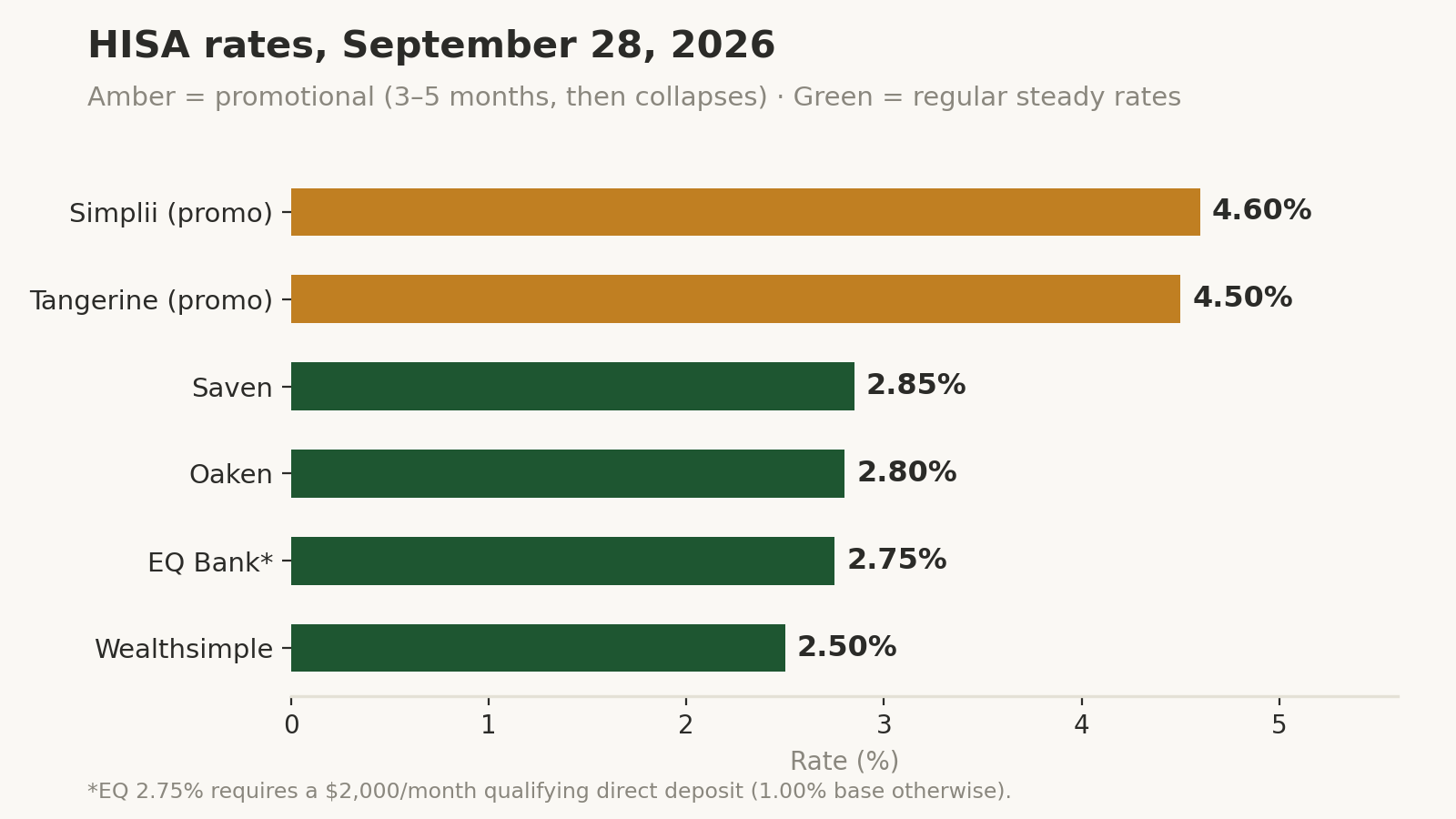
Rates checked: September 28, 2026. Cash rates move monthly — this guide is refreshed on that schedule (see Refresh notes at the bottom).
The verdict: Promo HISA rates (4.50%–4.60%) beat GICs for about five months, then collapse — for money parked a full year, a steady-rate HISA (~2.85%) or a 1-year GIC (~3.30%) wins, and for money with a known spending date, the longest GIC that ends before that date wins.
Who this is for: Canadians deciding where to keep cash they're not investing.
Your move: Emergency fund goes in a steady-rate HISA (Saven 2.85%), cash with a fixed date goes in a matching GIC — and hold either inside your TFSA if you have the room.
Cash feels safe. But "safe" isn't automatic — it depends on where the cash sits, whether the institution is insured, and whether the rate beats what you're giving up. The Club ran the numbers on the two main places Canadians park cash — high-interest savings accounts (HISAs) and guaranteed investment certificates (GICs) — and ranked them by math, not marketing.
The short version: promotional HISA rates (4.50%–4.60%) beat GICs for the first five months, then lose. For money you'll keep parked a full year or more with no set spending date, a steady-rate HISA (~2.75%–2.85%) or a 1-year GIC (~3.30%) usually wins. For money with a known spending date, the longest GIC term that ends before that date wins — certainty has a price, and it's called interest.
In this guide: The HISA table · The GIC table · The CDIC safety net · The math (three cases) · Cash inside a TFSA · The Club's ranking · Refresh notes
A HISA pays variable interest, calculated daily and paid monthly, with no lock-in. Rates can change at any time. Two kinds exist: promotional rates (high for 3–5 months, then collapse) and regular rates (lower, but stable).
| Account | Rate (Sept 28, 2026) | Type | Key terms | Source |
|---|---|---|---|---|
| Simplii Financial High Interest Savings Account | 4.60% for 153 days (~5 months) on eligible deposits up to $200,000; then tiered 0.30%–1.00% | Promo | New clients, or existing clients within their first 60 days. Offer ends October 31, 2026 — still live as of Sept 28, 2026 | https://www.simplii.com/en/special-offers/high-interest-savings-account.html |
| Tangerine Savings Account | 4.50% non-registered / 5.00% registered, for 153 days (5 months) on up to $1,000,000; then 0.30% | Promo | New clients only (client number created July 28–Nov 30, 2026). Offer window runs through November 30, 2026 — still live as of Sept 28, 2026 | https://tangerine.ca/en/offers/savings-account-promo |
| Saven Financial High Interest Savings Account | 2.85% regular | Regular | No account fees. Division of FirstOntario Credit Union; deposits protected by FSRA (Ontario) — up to $250,000 per depositor for non-registered accounts, unlimited coverage for registered accounts | https://www.moneysense.ca/save/best-high-interest-savings-accounts-canada/ (updated Sept 27, 2026) · https://savenfinancial.ca/en/on/filestore/DIRF_Brochure.pdf |
| Oaken Financial Savings Account | 2.80% regular — verified live on issuer page Sept 28, 2026 (rates in effect since Sept 21, 2026) | Regular | No fees, no minimum balance. Deposits issued through Home Bank and Home Trust Company, separate CDIC members | https://www.oaken.com/savings-account-rates/ |
| EQ Bank Personal Account | 2.75% with a qualifying $2,000/month direct deposit; 1.00% base rate otherwise | Regular | No monthly fees | https://www.eqbank.ca/personal-banking/personal-account |
| EQ Bank Notice Savings Account | 2.75% with 30 days' notice; 2.35% with 10 days' notice | Regular | Higher rate in exchange for advance notice on withdrawals; not available in Quebec | https://www.eqbank.ca/personal-banking/notice-savings-account |
| Wealthsimple Savings account | 2.50% — verified live on issuer page Sept 28, 2026 (same rate for everyone, no tiers; non-promotional) | Regular | Individual non-registered accounts only. Deposit protection: $1,000,000 CIPF, not CDIC — verified on issuer page | https://www.wealthsimple.com/en-ca/savings |
| Neo Savings Account | 2.00%–2.75% depending on membership | Regular | Issuer page not opened during verification; rate per MoneySense (updated Sept 27, 2026) | https://www.moneysense.ca/save/best-high-interest-savings-accounts-canada/ |
Context on what "high" means: the average standard savings rate at a major Canadian bank was a mere 0.06% in early 2026 (Bank of Canada data, via a published April 2026 comparison), and Canada's annual inflation rate was 3% in July — confirmed on money.ca's trade-war savings piece, opened Sept 28, 2026 — so cash earning less than that is quietly losing purchasing power (https://money.ca/banking/savings-accounts/trade-war-savings-cdic-insurance-cash).
A GIC locks cash away for a fixed term at a fixed rate. You can't touch it early (non-redeemable) or can only cash it at a lower rate. In exchange, the rate is guaranteed for the full term.
Representative rates, checked September 28, 2026 (all from EQ Bank's own rates page, where the identical ladder appears under the TFSA, RRSP, FHSA, and non-registered tables — EQ also lists a 27-month term at 3.70%, not shown):
| Term | Rate | Institution | Source |
|---|---|---|---|
| 1 year | 3.30% | EQ Bank | https://eqbank.ca/rates |
| 15 months | 3.40% | EQ Bank | https://eqbank.ca/rates |
| 2 years | 3.55% | EQ Bank | https://eqbank.ca/rates |
| 3 years | 3.65% | EQ Bank | https://eqbank.ca/rates |
| 4 years | 3.75% | EQ Bank | https://eqbank.ca/rates |
| 5 years | 4.00% | EQ Bank | https://eqbank.ca/rates |
Note: an aggregator panel showed an "EQ Bank 5-year non-registered 4.25%" rate, but EQ's own rates page lists 4.00% across all account types — the issuer's page wins, and the 4.25% figure was removed. No other institution's GIC rates could be verified live during this check, so only EQ's issuer-confirmed ladder ships in this table.
Every dollar above matters only if it's protected. CDIC — the Canada Deposit Insurance Corporation, a federal Crown corporation — automatically insures eligible deposits up to $100,000 per insured category, per member institution (principal and interest combined). Coverage is automatic and free; you don't apply (https://www.cdic.ca/what-happens-in-a-failure/resolution-of-small-and-medium-size-banks/reimbursement-of-insured-deposits/for-depositors/).
The category system is what multiplies your protection. CDIC recognizes separate categories including deposits in one name, joint deposits, and each of RRSP, RRIF, TFSA, RESP, RDSP, FHSA, and trust deposits — each with its own $100,000 limit (https://www.cdic.ca/what-happens-in-a-failure/resolution-of-small-and-medium-size-banks/reimbursement-of-insured-deposits/for-depositors/). So $100,000 in a personal HISA plus $100,000 in a TFSA GIC at the same bank = $200,000 fully insured.
Covered: savings and chequing accounts, GICs and term deposits, in Canadian or foreign currency. Not covered: mutual funds, stocks, bonds, or ETFs (https://www.cdic.ca/what-happens-in-a-failure/resolution-of-small-and-medium-size-banks/reimbursement-of-insured-deposits/for-depositors/).
Two wrinkles the table above already flagged: Wealthsimple's savings product is CIPF-protected (up to $1,000,000), not CDIC — it's an investment dealer product (confirmed on wealthsimple.com/en-ca/savings, Sept 28, 2026). And Saven Financial is a credit-union division insured by Ontario's FSRA, not CDIC — per Saven's own deposit-insurance brochure: up to $250,000 per depositor for non-registered accounts, unlimited coverage for registered accounts (https://savenfinancial.ca/en/on/filestore/DIRF_Brochure.pdf). Different backstop, same job.
(The CDIC rules above were re-verified against CDIC's own page on Sept 28, 2026 — $100,000 per depositor per insured category, interest and principal combined, coverage automatic with no claim needed.)
Rates are only half the story. The decision comes down to when you need the money.
An emergency fund must be withdrawable on a random Tuesday. A GIC can't do that — money locked in a 1-year GIC at 3.30% is useless when the furnace dies in month four.
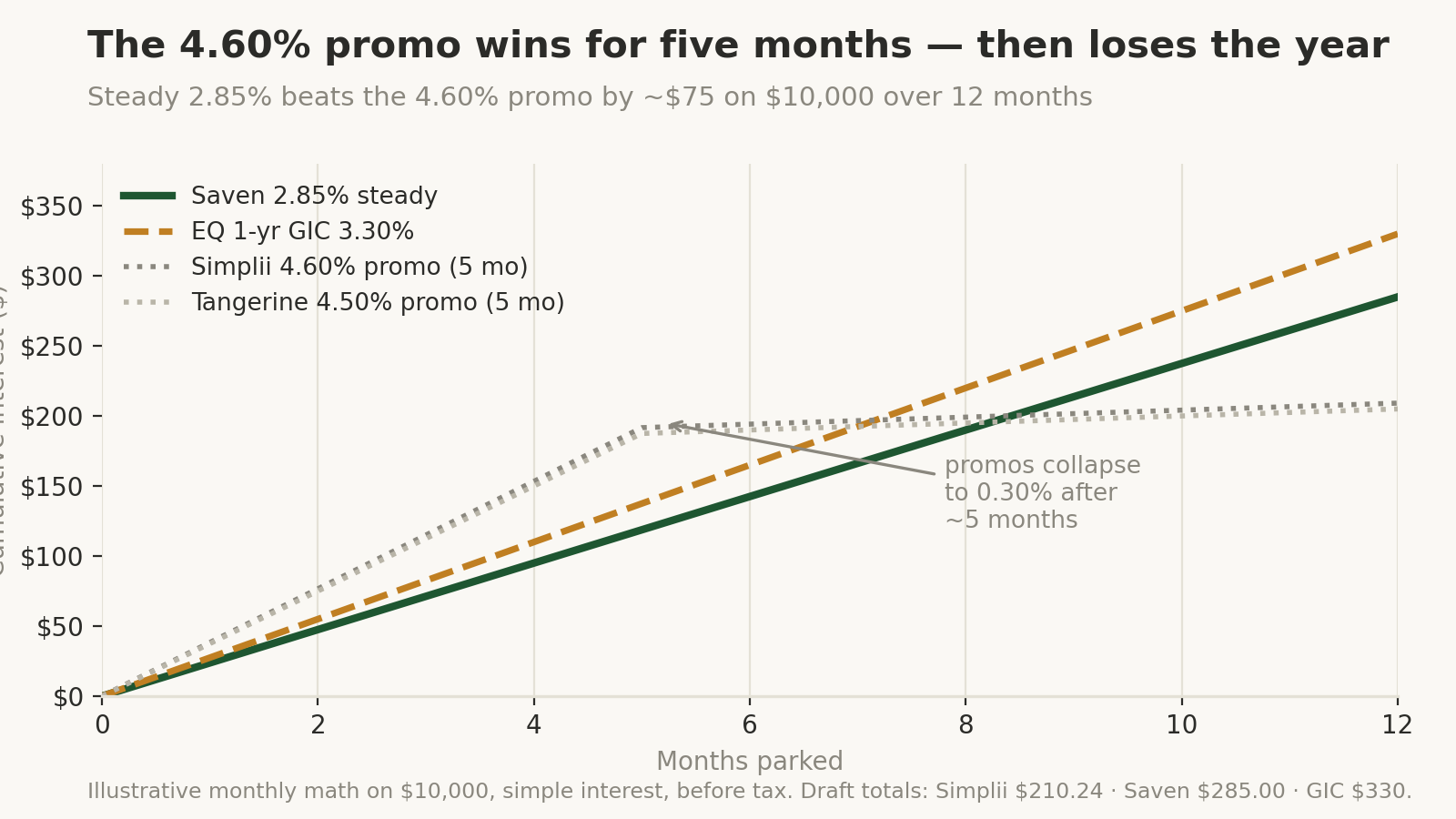
But here's the math most people miss: the promo HISA is not the best HISA for money that sits all year. Illustrative math on $10,000 (simple interest, before tax):
The steady 2.85% beats the 4.60% promo by about $75 on $10,000 over a full year, because the promo only lasts five months and the regular rate it falls back to is near zero. The promo is a great five-month deal and a bad twelve-month deal. The honest move for emergency funds: grab the promo, calendar the expiry, and move the money to the best regular rate when it ends. (Simplii's promo ends October 31, 2026; Tangerine's window for new clients runs through November 30, 2026 — both confirmed live on the issuers' own pages on Sept 28, 2026, not expiring yet.)
Verdict for emergency funds: HISA, always — and a steady-rate one (Saven 2.85%; Oaken 2.80%; EQ's 2.75% requires a $2,000/month direct deposit) for money that sits indefinitely. Promos are for money with a near-term job.
Property tax due in 12 months? Down payment in 2 years? Tuition in September? If the date is fixed and the money is definitely not needed before it, the GIC's guaranteed rate beats the HISA's variable rate in almost every current scenario:
The rule: pick the longest GIC term that matures before you need the money. A 2-year GIC for money needed in 18 months is a mistake; a 15-month GIC is the answer. Match the term to the date, not your ambition.
House down payment in "one to three years"? That's two buckets: the portion you might need in year one goes in a HISA; the portion you're confident you won't touch goes in a 1–2 year GIC. Laddering — staggering GIC maturities across terms — keeps cash freeing up on a regular schedule while capturing higher rates (https://money.ca/banking/savings-accounts/trade-war-savings-cdic-insurance-cash).
In a non-registered account, HISA and GIC interest are both fully taxable as income at your marginal rate — interest forms part of your total income and must be reported (CRA: bank interest reported even without a T5 slip; GIC interest reported as earned each investment year — https://www.canada.ca/en/revenue-agency/services/tax/individuals/topics/about-your-tax-return/tax-return/completing-a-tax-return/personal-income/line-12100-interest-other-investment-income.html, verified Sept 28, 2026). A 3.30% GIC at a 40% marginal rate nets about 1.98% after tax. Which is exactly why the TFSA question matters.
Often, yes — with one big caveat. Interest earned inside a TFSA is tax-free, and the 2026 TFSA dollar limit is $7,000, added to your room on January 1, 2026 (https://www.canada.ca/en/revenue-agency/services/tax/individuals/topics/tax-free-savings-account/contributing/calculate-room.html — verified on canada.ca, Sept 28, 2026). Both HISA cash and GICs can be held inside a TFSA, and CDIC treats TFSA deposits as their own $100,000 insured category.
The math: at a 40% marginal tax rate, a 2.85% HISA inside a TFSA is worth the same as a 4.75% HISA outside it (2.85% ÷ 0.60). The shelter is worth more than chasing an extra half-point of rate.
The caveat: TFSA room is precious and finite. Withdrawals regain room on January 1 of the following year (https://www.canada.ca/en/revenue-agency/services/tax/individuals/topics/tax-free-savings-account/contributing/calculate-room.html — verified on canada.ca, Sept 28, 2026) — so parking your emergency fund in a TFSA HISA is fine, but raiding it mid-year and re-contributing the same year can trigger over-contribution tax. (The Club's TFSA over-contribution guide covers the penalty math.) Rule of thumb: TFSA cash for planned spending and the tax shelter on interest; non-registered HISA for the true emergency fund you might touch any month.
Also note: not every institution's best rate is available in registered form. Tangerine's 5.00% registered promo is actually higher than its non-registered 4.50% — a rare case where the TFSA version wins twice (https://tangerine.ca/en/offers/savings-account-promo) (confirmed on Tangerine's own offer page, Sept 28, 2026).
This article needs monthly rate refreshes — recommend syncing with the weekly promo-tracker cron (a monthly pass over this article's two tables is enough; the promo rows change most). Specifically: