As of October 20, 2026.
The Bank of Canada decides on October 28. The policy rate sits at 2.25% today, and chartered-bank prime sits at 4.45%. A hike on October 28 does not raise the payment on a standard Canadian variable mortgage — its payment is fixed, and the hike lands on how much of that payment is interest, and on how long the mortgage takes to pay off. It does not move a fixed payment either. The choice between the two is a bet on how many hikes you can absorb, and on what it costs you to get out early. Here is the math.
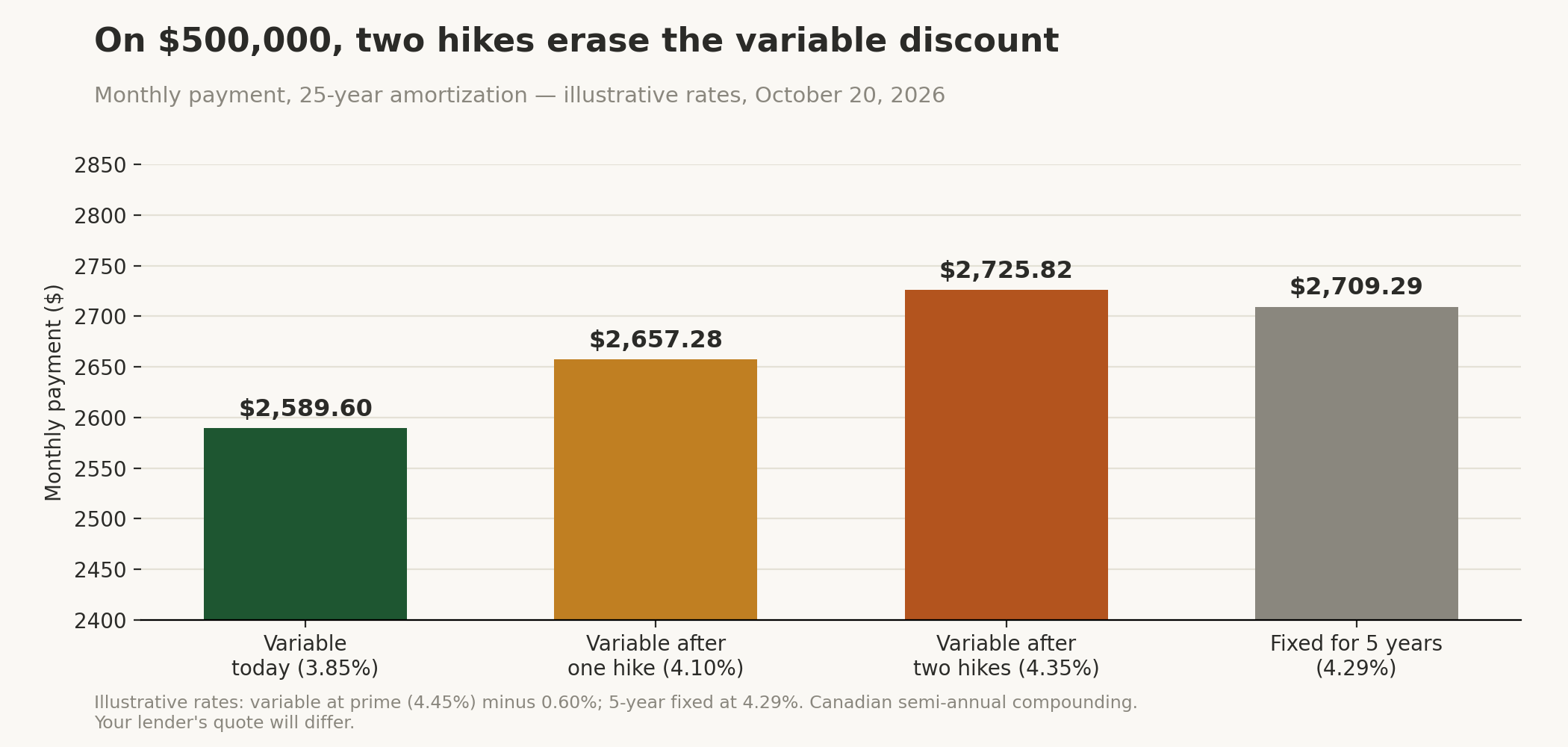
The verdict: On a $500,000 mortgage with a 25-year amortization (the years it would take to pay the mortgage off), the illustrative variable offer below costs $2,589.60 a month and the illustrative 5-year fixed costs $2,709.29 a month — a gap of $119.69 a month in the variable’s favour today. That $2,589.60 does not rise if the Bank hikes: on the standard variable mortgage the payment is fixed, so one 25-basis-point (0.25 percentage point) hike on October 28 instead stretches the amortization from 25 years to about 26 years 2 months, and two hikes stretch it to about 27 years 6 months. The monthly gap never closes — the payoff date moves instead. (On an adjustable-payment variable, the same hikes lift the payment to $2,657.28 and then $2,725.82, past the fixed. That path is tabled below, labelled.)
Who this is for: You are renewing, refinancing, or signing a new mortgage before the October 28 decision, and you need the dollar cost of each path, not a prediction.
Your move: Price both offers on your actual balance. Stress the variable at +50 and +100 basis points using the tables below — the payment if yours floats, the amortization if it does not. Then read the penalty section before you sign anything — the exit cost, not the starting rate, is where fixed and variable differ most.
Contents
- Two kinds of variable mortgage
- How the payments below are calculated
- The two offers, side by side
- What the hike path does to a variable mortgage
- The trigger rate, in plain English
- Breaking out: the penalty asymmetry
- Who should lock in, who should ride
- The middle option
- FAQ
- The Club’s take
Two kinds of variable mortgage
“Variable” covers two different products, and a hike hits them in different places:
- Variable-rate mortgage — the standard product: your payment is fixed for the term. When prime moves, the rate inside the payment changes: more or less of each payment goes to interest, and your amortization — the years it would take to pay the mortgage off — stretches or shrinks. The payment itself moves only if you reach your trigger rate (below), or at renewal. Most Canadian variable mortgages work this way, including the big banks’ standard variable product.
- Adjustable-rate mortgage: your payment floats. When prime moves, the payment is recalculated to keep you on your original amortization, so a hike reaches your bank account on the next payment cycle.
A HELOC is a separate case again: it charges interest only, on prime, so the interest cost of the balance you carry moves with every prime change. Know which product you hold before you use the math below — the hike tables split the two. Your contract says which one you have.
How the payments below are calculated
Canadian mortgages compound semi-annually, not monthly. The monthly rate is:
Monthly rate = (1 + annual rate ÷ 2)^(1/6) − 1
The monthly payment is then:
Payment = balance × r(1 + r)^n ÷ ((1 + r)^n − 1), where r is that monthly rate and n is 300 payments for a 25-year amortization.
Every payment figure in this post uses that formula. The amortization figures run it in reverse: the payment is held constant and the formula solves for the number of payments left. Payments are rounded to the nearest cent; changes are calculated before rounding, so a change may differ by $0.01 from the difference between two rounded payments shown. Amortizations are rounded to the nearest month.
The two offers, side by side
Both offers are worked examples, not quotes from a named lender. Prime is the live input: 4.45% on October 20, 2026, per the Bank of Canada. The discount off prime and the fixed rate are illustrative.
| Illustrative rates, October 20, 2026 — your lender’s quote will differ | Variable: prime − 0.60% | 5-year fixed |
|---|---|---|
| Rate today | 3.85% (prime 4.45% − 0.60%) | 4.29% |
| Rate after a +25 bp hike on October 28 | 4.10% (prime 4.70% − 0.60%) | 4.29% — locked for the term |
| Monthly payment on $500,000, 25-year amortization | $2,589.60 | $2,709.29 |
| Monthly payment after the +25 bp hike | $2,589.60 — unchanged. The standard variable payment is fixed; the hike lands on the amortization | $2,709.29 — unchanged |
| Amortization after the +25 bp hike | About 26 years 2 months, against 25 years today | 25 years — unchanged |
| Monthly payment after the hike, if your variable payment floats instead (adjustable-rate) | $2,657.28 | — |
Read the table this way:
- Today, the variable saves you $119.69 a month on $500,000.
- The payment gap never closes. $2,589.60 stays $2,589.60 whatever the Bank does, because the standard variable payment is fixed. Only a floating (adjustable-rate) payment gives the gap up: $2,657.28 after one hike, $2,725.82 after two — $16.53 a month more than the fixed.
- What closes is the payoff gap. In the first month, $998.15 of the variable payment reaches principal, against $937.56 of the fixed payment — the variable pays the mortgage down faster today, from a smaller payment. After one hike, $895.68 reaches principal: now the variable pays it down slower than the fixed. After two hikes, $793.31. The variable’s head start is 44 basis points of rate; on a fixed payment, hikes spend that head start as time, not as cash.
A fixed rate does not follow the Bank of Canada during its term. A variable rate may increase or decrease during the term, on both kinds of variable — what differs is whether your payment or your payoff date absorbs the move. For what the market expects on October 28, see the Bank of Canada rate tracker.
What the hike path does to a variable mortgage
Start with the standard product: the fixed-payment variable. Its payment never moves. What moves is the amortization — and how much of each payment is interest. Same illustrative example as above: a $500,000 balance, a payment set at 3.85% (prime − 0.60%) on a 25-year amortization.
| Rate move from 3.85% | New rate | Monthly payment on $500,000 | Amortization | Principal in the first payment at the new rate |
|---|---|---|---|---|
| No move | 3.85% | $2,589.60 | 25 years | $998.15 |
| +25 bp | 4.10% | $2,589.60 — unchanged | About 26 years 2 months (+14 months) | $895.68 |
| +50 bp | 4.35% | $2,589.60 — unchanged | About 27 years 6 months (+30 months) | $793.31 |
| +100 bp | 4.85% | $2,589.60 — unchanged | About 30 years 11 months (+71 months) | $588.89 |
The working rule for a fixed payment: near 4%, each 25-basis-point hike adds about 14 months to the amortization — about 30 months for two hikes, about 71 months for four. The stretch is roughly the same at any balance, because it is set by your rate and by your payment relative to your balance, not by the balance itself. And it is reversible: raise your payment by $13.53 a month per $100,000 after the first hike — $67.67 a month on $500,000 — and your original 25-year payoff date holds. Leave the payment alone, and each hike also walks your rate closer to the point where the payment stops covering interest at all. That point is the trigger rate, in the next section.
If your payment floats instead (adjustable-rate)
On an adjustable-rate mortgage the same hikes land on the payment, and the amortization never moves. This table starts from the same illustrative rate, 3.85%, on a 25-year amortization.
| Rate move from 3.85% | New rate | Payment on $100,000 | Change per month | Payment on $400,000 | Change per month |
|---|---|---|---|---|---|
| No move | 3.85% | $517.92 | — | $2,071.68 | — |
| +25 bp | 4.10% | $531.46 | +$13.53 | $2,125.82 | +$54.14 |
| +50 bp | 4.35% | $545.16 | +$27.24 | $2,180.66 | +$108.98 |
| +100 bp | 4.85% | $573.10 | +$55.18 | $2,292.38 | +$220.70 |
The working rule for a floating payment: near 4%, each 25-basis-point hike costs about $13.53 a month per $100,000 of balance. Scale it to your balance before October 28, not after. If +$220.70 a month on a $400,000 balance breaks your budget, you do not have room for a four-hike path, whatever you think the Bank will do.
The trigger rate, in plain English
The fixed payment has a built-in limit. As rates rise, more of each payment goes to interest and less goes to principal — the principal column in the table above. Keep going, and a payment eventually covers interest and nothing else; past that point, the balance grows instead of shrinking.
Two terms matter, and they are not the same:
- Trigger rate: the interest rate at which your payment covers interest only, and nothing goes to principal. Past it, your balance grows instead of shrinking. The Financial Consumer Agency of Canada defines it the same way: the trigger rate is the interest rate at which a mortgage only covers interest costs.
- Trigger point: the balance-growth limit in your contract. Hitting it means your mortgage balance has grown beyond the lender’s acceptable ratio for the amount of equity you need to hold vs. the purchase value of your home.
A worked illustration, using the example above: on a $500,000 balance with a fixed payment of $2,589.60, the payment covers interest only when the rate reaches about 6.30% — at the illustrative prime − 0.60% spread, prime at about 6.90%. The trigger rate is set by the ratio of your payment to your balance, so it is the same 6.30% on the $400,000 version of this example (payment $2,071.68). That figure is illustrative — it depends on your balance and your payment — and your contract’s trigger rate is the one that counts.
What happens at each point:
- At the trigger rate, your lender may require you to increase your payments, make additional payments to cover the excess interest, or switch to a fixed-rate mortgage.
- At the trigger point, you are required to adjust your payments, make a prepayment, or pay off the balance.
What you can do before either point:
- Raise your payment voluntarily, so more of it reaches principal. On the example above, $67.67 a month more after the first hike holds the original 25-year amortization outright.
- Make a lump-sum prepayment within your contract’s prepayment privileges, which lowers the balance the interest is charged on.
- Ask your lender, in writing, for your trigger rate and your trigger point. Your mortgage contract sets the exact limit — it differs by lender. No general article can give you your number.
Breaking out: the penalty asymmetry
This is the largest dollar difference between the two offers, and it has nothing to do with the rate.
For a closed mortgage, the prepayment penalty is usually the higher of an amount equal to 3 months’ interest on what you still owe, or the interest rate differential (IRD).
- Variable: on a closed variable mortgage, the penalty is typically 3 months’ interest, with no IRD leg to beat it. Your contract sets the formula — check the prepayment charge line before you rely on this.
- Fixed: the penalty is the greater of 3 months’ interest or the IRD. When the IRD leg wins, it wins by a lot.
Why the IRD gets so large at the big banks: the Financial Consumer Agency of Canada says a lender can build the IRD from two rates — the first can be the posted rate at the time you signed your contract or your contract (discounted) rate, and the second can be the current posted rate for a similar-length term, or that current posted rate minus the discount you were originally offered. The discount-adjusted comparison is the expensive one: it subtracts your full original discount from today’s posted rate for the remaining term, which can push the comparison rate far below your contract rate when posted rates have fallen since you signed. The worked example below uses that method — and pairs each rate consistently: your contract rate against the discount-adjusted comparison rate. (Pairing the two posted rates instead — posted at signing against current posted — gives the same differential, because the discount enters both sides once, not twice.)
Worked example — illustrative
Balance: $400,000. Three years left on the term. The scenario is a break after rates for the remaining term have fallen since signing — the situation the IRD exists for, since a lender typically uses the IRD when your contract rate is higher than the current rate. All rates below are illustrative, labelled where they appear, and your lender’s calculation will differ — the Financial Consumer Agency of Canada notes the way the penalty is calculated varies from lender to lender, and your lender must tell you how it calculates yours.
Variable at prime − 0.60% (3.85% today):
- 3 months’ interest = $400,000 × 3.85% × 3 ÷ 12 = $3,850.00
- Penalty: $3,850.00
Fixed at 4.29%, 3 months’ interest leg:
- 3 months’ interest = $400,000 × 4.29% × 3 ÷ 12 = $4,290.00
Fixed at 4.29%, IRD leg — posted-rate method (illustrative posted rates):
- Illustrative posted rate when you signed: 6.19%. Your contract rate is 4.29%, so your original discount was 1.90 percentage points.
- Illustrative current posted rate for a 3-year term: 4.05%. Less your 1.90-point original discount: a comparison rate of 2.15%.
- IRD = (4.29% − 2.15%) × $400,000 × 3 years remaining = 2.14% × $400,000 × 3 = $25,680.00
- Cross-check with the other consistent pairing — posted rate at signing against current posted rate: (6.19% − 4.05%) × $400,000 × 3 = 2.14% × $400,000 × 3 = $25,680.00. Same answer, because the discount is counted once either way.
- Penalty: $25,680.00 — the greater of $4,290.00 and $25,680.00. That is about 6.7× the variable penalty on the same balance.
Now the same break under a plain comparison, with no discount adjustment — your contract rate against the current posted rate itself: (4.29% − 4.05%) × $400,000 × 3 = $2,880.00. That is below the 3-months’ interest leg, so the penalty would be $4,290.00 instead. Same balance, same day, same contract rate — a $21,390 difference driven entirely by which IRD method your lender uses. In this illustration, the discount-adjusted method produces a penalty about 6.7× the variable penalty; the plain comparison produces one close to the variable penalty. Ask which method applies before you sign, and get the answer in writing.
Two ways to shrink any penalty, from the Financial Consumer Agency of Canada’s guidance: use your prepayment privileges first, so the penalty is charged on a lower balance; and consider porting the mortgage to a new home instead of breaking it, if your contract allows it.
Who should lock in, who should ride
The 5-year fixed at an illustrative 4.29%
Get this if you:
- A hike would hurt in the form it reaches you. On an adjustable-payment variable, a payment increase of $54.14 a month per $400,000 on the first hike — $220.70 in total at +100 bp — would strain your monthly budget. On a fixed-payment variable, you do not want the alternative either: an amortization that stretches about 14 months per hike, walking toward your trigger rate, unless you raise the payment yourself.
- You plan to stay in the home and keep this mortgage for the full term, so the IRD risk in the penalty section is unlikely to be triggered.
- You hold a fixed-payment variable now and your rate is closing on your trigger rate.
- Certainty itself is the product you want: $2,709.29 a month on $500,000, unchanged, for five years.
Skip it if you:
- There is a real chance you move, sell, or refinance inside the term. At a posted-rate lender, the illustrative IRD above is $25,680 on a $400,000 balance with three years left.
- You want the option to benefit if the Bank holds or cuts. A fixed rate does not move down when prime does.
- Your lender will not state, in writing, which IRD method it uses.
The variable at an illustrative prime − 0.60% (3.85% today)
Get this if you:
- You can absorb +100 bp without cutting essentials. On an adjustable-payment variable that is +$55.18 a month per $100,000. On a fixed-payment variable your payment never moves — the cost is about 71 extra months of amortization if you leave the payment alone, or voluntary increases totalling $55.18 a month per $100,000 across the four hikes to hold your payoff date.
- There is a real chance you break the term early. The exit cost is 3 months’ interest — $3,850.00 on $400,000 at 3.85% in the worked example.
- You accept that the $119.69 monthly advantage on $500,000 is a head start, not a guarantee. On a fixed-payment contract the payment edge itself survives every hike — what erodes is your principal. After two hikes you are paying the mortgage down slower than the fixed borrower, with an amortization about 30 months longer, unless you raise your payment.
Skip it if you:
- You hold an adjustable-payment variable and your payment is already at the edge of your budget at 3.85%. The first hike alone adds $67.67 a month on $500,000.
- You hold, or would be sold, a fixed-payment variable and you do not know your trigger rate. A flat payment that stops covering principal is not stability.
- Rate news will change your behaviour. If a hike headline would push you to lock in at whatever fixed rate is offered that week, the fixed rate today is the cheaper version of that decision.
While you decide, your savings do not have to sit idle — see where to park cash in Canada in 2026 and the current offers on the bank bonus tracker.
The middle option
Most lenders also offer a hybrid, or combination, mortgage: part of your balance sits on a fixed rate and part sits on a variable rate. The Financial Consumer Agency of Canada describes it the same way — the fixed portion gives you partial protection if rates go up, and the variable portion gives you partial benefit if rates fall. Each portion can carry its own term, which can make the mortgage harder to transfer to another lender. A hybrid splits your exposure; it does not remove it. Run the same +50 and +100 bp math on the variable portion only, and ask how the penalty is calculated on each portion before you sign.
FAQ
If the Bank hikes on October 28, when does my variable payment change?
Your rate is priced off prime, and prime follows the Bank’s policy rate. On a fixed-payment variable mortgage — the standard product — your payment does not change at all: more of it goes to interest, and your amortization stretches. On an adjustable-payment variable mortgage, your payment changes once your lender resets it after the prime change — the exact date is set by your lender and your payment schedule, so check your lender’s notice or your contract. The rate itself moves on both; only what it does to your payment differs.
Can I convert a variable mortgage to a fixed mortgage mid-term?
Many variable contracts let you convert to a fixed rate during the term without breaking the mortgage. Two limits apply everywhere: you get the fixed rate your lender offers on the day you convert, not today’s rate, and converting back to variable means breaking the fixed term. Conversion is a contract feature, not a legal right — confirm that your contract includes it, and what term lengths you can convert into, before you count on it.
What is a trigger rate?
The interest rate at which your fixed payment on a variable mortgage covers interest only, and none of your payment reduces your principal. Past it, your balance grows. It is different from the trigger point, which is the balance limit in your contract at which your lender can require a payment increase, a prepayment, or a payoff. Both definitions are covered in the trigger rate section above.
How much is the penalty to break a fixed mortgage?
Usually the greater of 3 months’ interest or the interest rate differential (IRD). On the illustrative numbers in this post — $400,000, three years left, 4.29% contract rate — the 3-months’ interest leg is $4,290.00, and an IRD calculated with the discount-adjusted posted-rate method in the worked example comes to $25,680.00. Your lender’s method decides which world you are in. Federally regulated lenders have a prepayment penalty calculator on their website, and your lender must tell you how your penalty is calculated.
Are fixed rates themselves about to rise?
A Bank of Canada hike does not raise a fixed rate you already hold — it stays the same for your whole term. New fixed offers are set by each lender and can move at any time, including before October 28, for reasons that have nothing to do with that day’s decision. If you are quoted a fixed rate you can live with, ask how long the lender will hold it in writing. Do not assume the quote survives the announcement.
The Club’s take
Who wins: Borrowers who run their own balance through the hike tables and choose based on the result. The variable wins on starting payment ($119.69 a month on $500,000) and on exit cost ($3,850.00 vs $25,680.00 on $400,000 in the illustrative examples). The fixed wins on certainty — its payment and its payoff date both hold still. The variable’s $119.69 payment edge never closes on a fixed-payment contract; instead, each hike moves the payoff date, to about 26 years 2 months after one hike and about 27 years 6 months after two on the example above. So the fixed also wins for any borrower who would not raise their own payment to stop that drift, and for any adjustable-payment budget that cannot absorb the first hike.
Who should skip: Anyone choosing on a rate prediction alone. The October 28 outcome is one move; you are signing a five-year contract with a penalty clause attached. If you have not read your lender’s IRD method, you have not finished comparing the two offers.
The catch: The two rates at the top of this post are illustrative. Prime — 4.45%, the input your variable rate is built on — is the live number, from the Bank of Canada. Your lender’s discount off prime, your fixed quote, your trigger rate, and your penalty method are all in your contract and nowhere else. Get each one in writing before October 28.