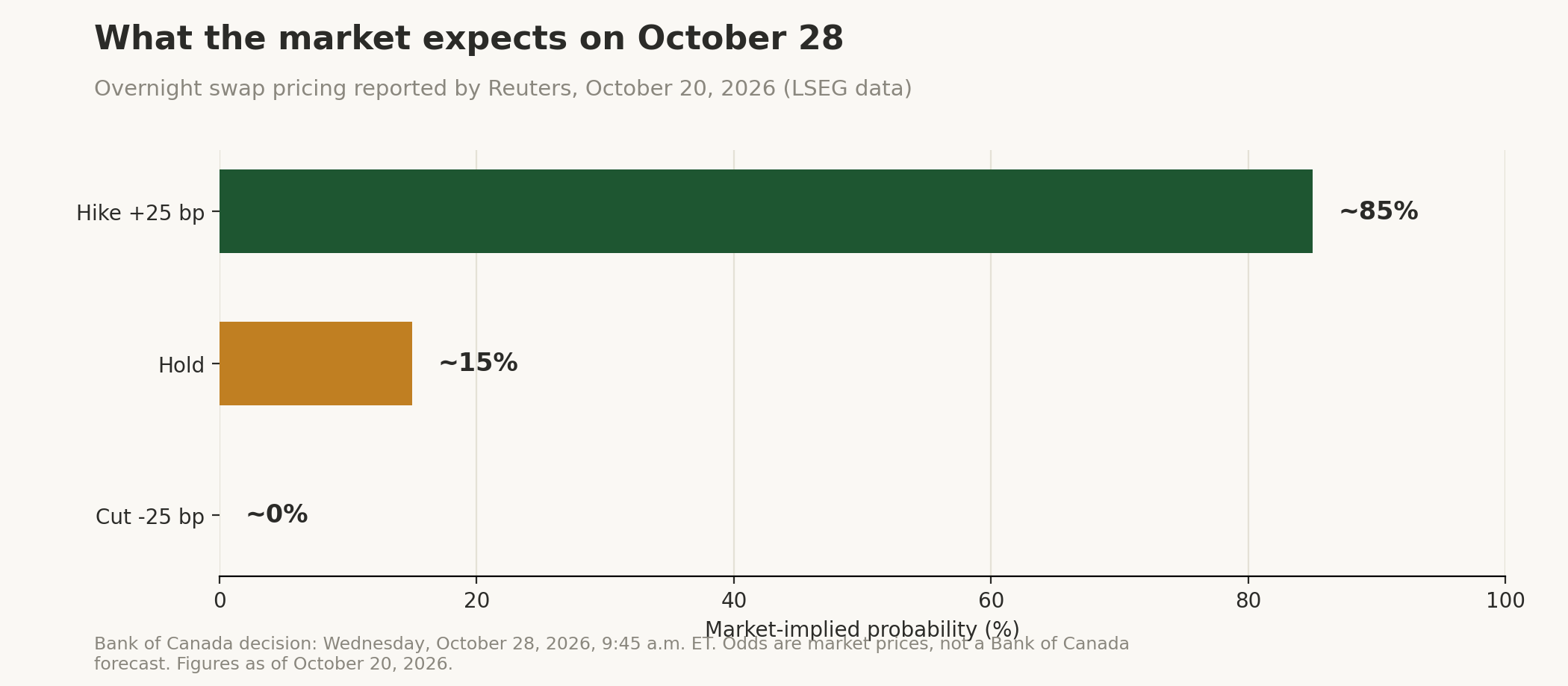
As of October 20, 2026.
The verdict: Traders price a ~85% chance of a +25 bp hike (25 basis points = 0.25 percentage points) on Wednesday, October 28 (overnight swap pricing reported by Reuters on October 20, 2026, based on LSEG data) — a move that would lift the policy rate from 2.25% to 2.50% and prime from 4.45% to 4.70%. If you carry a variable mortgage or a HELOC, the higher prime reaches you either way — as a higher interest bill on a HELOC right away, and, inside a standard variable mortgage, as a payment that stays the same while less of it pays down your balance.
Who this is for: Anyone with a variable-rate mortgage, a HELOC, a prime-linked loan, or cash sitting in a HISA or GIC that reprices soon.
Your move: Price the hike on what you actually hold. HELOC and adjustable-payment borrowers: run your payment at prime 4.70%, not 4.45%. Holders of the standard fixed-payment variable: your payment holds at prime 4.70% — what grows is your amortization, and what shrinks is your distance to your trigger rate. If either version breaks your budget or your payoff plan, talk to your lender about a fixed-rate conversion or a rate hold before October 28 — not after.
Current odds
Next decision: Wednesday, October 28, 2026, at 9:45 a.m. ET, with the quarterly Monetary Policy Report. Updated October 20, 2026.
Policy rate today: 2.25% (Bank Rate 2.50%, deposit rate 2.20%). Prime rate today: 4.45%.
| October 28 outcome | Market-implied odds |
|---|---|
| Hike +25 bp (to 2.50%) | ~85% |
| Hold (2.25%) | ~15% (the residual — no cut is priced) |
| Cut −25 bp (to 2.00%) | ~0% — no cut is priced |
Odds are overnight index swap (OIS) pricing reported by Reuters on October 20, 2026, based on LSEG data. They moved fast to get here: about 30% on Friday, October 16, roughly 70% early Monday, and 87% by mid-afternoon Monday.
The path beyond October: The next decision after this one is Wednesday, December 9, 2026. Money markets are also pricing a further 25 bp hike in December (Reuters, Oct 19, 2026), and at least one major forecaster, Manulife, expects back-to-back hikes in October and December (Bloomberg, Oct 20, 2026). Treat the December pricing as softer than the October number — it reprices the moment the October decision and the new Monetary Policy Report land.
Why the trackers disagree: Swap pricing says hike (~85%). A tracker based on CORRA futures (CORRA = Canadian Overnight Repo Rate Average, Canada’s overnight benchmark rate) said the opposite as of October 19: 78% hold, 22% hike. And a recent Bloomberg economist survey still pointed to a hold (Bloomberg, Oct 20, 2026), even as BMO, RBC Dominion Securities and Desjardins flipped their calls to a hike on Monday. Different instruments, different survey dates, different results. The swap market is the live price; the surveys are snapshots that can lag a weekend of central-bank comments by days.
What each outcome does to your money
Prime has historically moved with the policy rate: a 25 bp hike has meant a 25 bp prime increase announced the same day, and every prime-linked product reprices off that. That is the standard pattern, not a guarantee — each bank sets its own prime rate. The mortgage and HELOC columns below use the spreads in the column headers — your own spread is in your mortgage or credit agreement.
| Outcome | Policy rate after | Prime after | Variable mortgage (prime − 0.60%, illustrative) | HELOC (prime + 0.50%, illustrative) |
|---|---|---|---|---|
| Today, for reference | 2.25% | 4.45% | 3.85% | 4.95% |
| Hike +25 bp | 2.50% | 4.70% | 4.10% | 5.20% |
| Hold | 2.25% | 4.45% | 3.85% | 4.95% |
One thing the mortgage column does not show: those are rates, not payments. On the standard fixed-payment variable mortgage, your payment does not rise when the rate does — more of it goes to interest, your amortization stretches, and your rate walks closer to your trigger rate. Payments do rise on adjustable-rate mortgages, and a HELOC’s interest cost rises on whatever balance you carry.
If the Bank hikes: Savings rates get a tailwind. Posted variable HISA rates at banks that track prime typically follow it up, and new HISA promos have room to stay rich or improve — compare live offers on the HISA promo rate leaderboard before you renew anything. GIC pricing moves less on decision day: GIC rates follow bond yields, and yields already rose while the market priced this hike in, so expect GIC offers to hold firm rather than jump.
If the Bank holds: Nothing reprices on prime-linked products, and HISA promo pricing stays where it is — the current crop of promos remains the market. GIC rates could actually soften if bond yields give back some of the hike pricing, so a hold is the scenario where locking a GIC sooner beats waiting.
Deciding between riding a variable or locking in? The variable vs. fixed mortgage comparison works through the math, and where to park cash in Canada covers the HISA-versus-GIC choice.
Why the market flipped
Earlier this month, a hike was the long shot. September’s jobs report, released Friday, October 9, cut the odds to roughly 25%: the economy shed 68,000 jobs in September and unemployment rose to 6.5%. Then three things landed in quick succession.
Governor Macklem talked inflation up. Speaking to reporters in Bangkok on Saturday, October 17, Macklem said that if oil prices stay around $100, inflation is expected to gradually drift up from around 3%. He also said the forecasts released with the October 28 decision will show higher inflation in Canada (Reuters, Oct 19, 2026). Swap odds jumped from about 30% on Friday to about 80% on Monday as those comments landed (Reuters, October 19, 2026), and Bloomberg put them at 87% by Monday afternoon, after the CPI print and the Bank’s surveys were out.
September CPI printed hot on the headline, soft underneath. Headline inflation rose to 3.1% year over year in September, up from 3.0% in August — back above the top of the Bank’s 1–3% control range, though a tick below the 3.2% forecast. Gasoline did the damage: +27.8% year over year, with energy overall up 19.0%. Strip gasoline out and inflation slowed to 2.2%, from 2.4%. The Bank’s core measures all eased: CPI-median 1.9%, CPI-trim 1.8%, CPI-common 2.4%. Grocery inflation slowed to 1.7%, the smallest yearly increase since May 2024. On the CPI alone, there was no rush to hike.
The Bank’s own surveys pointed the other way. The Business Outlook Survey and the Canadian Survey of Consumer Expectations, both released Monday, October 19, found consumers’ longer-term inflation expectations rising, and roughly half of firms said they plan to pass some or all of their higher oil-price and tariff costs on to customers (Bloomberg, Oct 20, 2026). That combination — a Governor warning about the forecast, expectations drifting up, firms ready to pass costs through — is what turned a 25% long shot into an 85% favourite. Three big-bank desks (BMO, RBC Dominion Securities, Desjardins) flipped their calls to a hike on Monday; Scotiabank firmed up its hike call, and Manulife held its back-to-back call (Bloomberg, Oct 20, 2026).
The counterweight is real: 68,000 jobs lost in September, core inflation under 2% on two of three measures, and headline inflation driven by a global oil price the Bank cannot control. That is why the consensus in a recent Bloomberg economist survey still points to a hold while the swap market says hike.
The 2026–27 decision calendar
The Bank announces on eight fixed dates a year, at 9:45 a.m. ET. The remaining 2026 dates and the full 2027 schedule come from the Bank of Canada’s published announcement schedule (2027 schedule published July 27, 2026).
| Date | Monetary Policy Report? |
|---|---|
| Wednesday, October 28, 2026 | Yes |
| Wednesday, December 9, 2026 | No |
| Wednesday, January 27, 2027 | Yes |
| Wednesday, March 3, 2027 | No |
| Wednesday, April 28, 2027 | Yes |
| Wednesday, June 2, 2027 | No |
| Wednesday, July 21, 2027 | Yes |
| Wednesday, September 8, 2027 | No |
| Wednesday, October 27, 2027 | Yes |
| Wednesday, December 8, 2027 | No |
Decisions with a Monetary Policy Report carry the Bank’s updated growth and inflation forecasts — the October 28 report is the one Macklem has already said will show higher inflation.
How to read market odds
Market odds are prices, not predictions from the Bank. They come from overnight index swap (OIS) trading: the rate traders agree to in swap contracts implies a probability for each decision, and financial data firms publish that implied probability. The Bank of Canada does not publish, endorse, or follow these odds. They move with every CPI print, jobs report, and speech — this month they swung from about 25% to about 85% in under two weeks. Read them as the market’s current bet, sized so traders lose money when they are wrong, and expect them to be wrong sometimes.
FAQ
When is the next Bank of Canada decision?
Wednesday, October 28, 2026, at 9:45 a.m. ET. It comes with the quarterly Monetary Policy Report. The last decision of 2026 follows on Wednesday, December 9.
What is the policy rate right now?
2.25%. The Bank has held it there since October 2025, through seven straight decisions. The Bank Rate is 2.50% and the deposit rate is 2.20%.
What happens to prime if the Bank hikes?
Prime has historically moved in lockstep with the policy rate: a +25 bp hike points to prime rising from 4.45% to 4.70%, typically announced by the banks the same day. That is the standard pattern, not a guarantee. Every variable mortgage, HELOC, and prime-linked loan reprices off the new prime.
Does a hike change a fixed mortgage payment?
No. Your fixed payment and rate stay put until renewal. What changes is the renewal offer you’ll get: fixed rates follow Government of Canada bond yields, which have already risen as markets priced in hikes — so renewal pricing can move even on days the Bank does nothing.
What does this mean for savings rates?
A hike supports higher HISA rates and richer promos; a hold keeps today’s offers in place. Either way, the spread between the best promo HISA and a big-bank posted savings rate is worth more than one 25 bp move — compare before you settle, and check the bank bonus tracker if you’re moving money anyway.
Should I lock in a fixed rate before October 28?
Only if the hike breaks your budget in the form it reaches you: a higher payment at prime 4.70% on an adjustable-rate mortgage or a HELOC, or — on the standard fixed-payment variable — a longer amortization and a thinner cushion before your trigger rate. Fixed offers already carry much of the expected hike in their pricing, because bond yields moved first. If you can absorb one or two hikes, the variable discount still pays you to wait; if you can’t, certainty is the product you’re buying.
The Club’s take
Who wins: Savers, if the hike lands — HISA and short-term GIC pricing gets support at exactly the moment borrowers pay more. Variable borrowers who locked in deep prime-minus discounts also win relative to anyone renewing into today’s fixed rates.
Who should act: Anyone with no room for the hike in the form it reaches them — a payment at prime 4.70% on an adjustable-rate mortgage or a HELOC, or years more amortization and a step closer to the trigger rate on a fixed-payment variable — or for a second hike after that. Get the conversion and rate-hold conversation done before October 28, while it’s still a choice instead of a reaction.
The catch: The market has been wrong-footed twice this month — about 25% after the October 9 jobs report, about 85% after a weekend speech and Monday’s data. The core inflation numbers (median 1.9%, trim 1.8%) argue for patience, and the Bank has surprised a confident market before. Plan for the hike; don’t bet the house on it.