As of October 21, 2026.
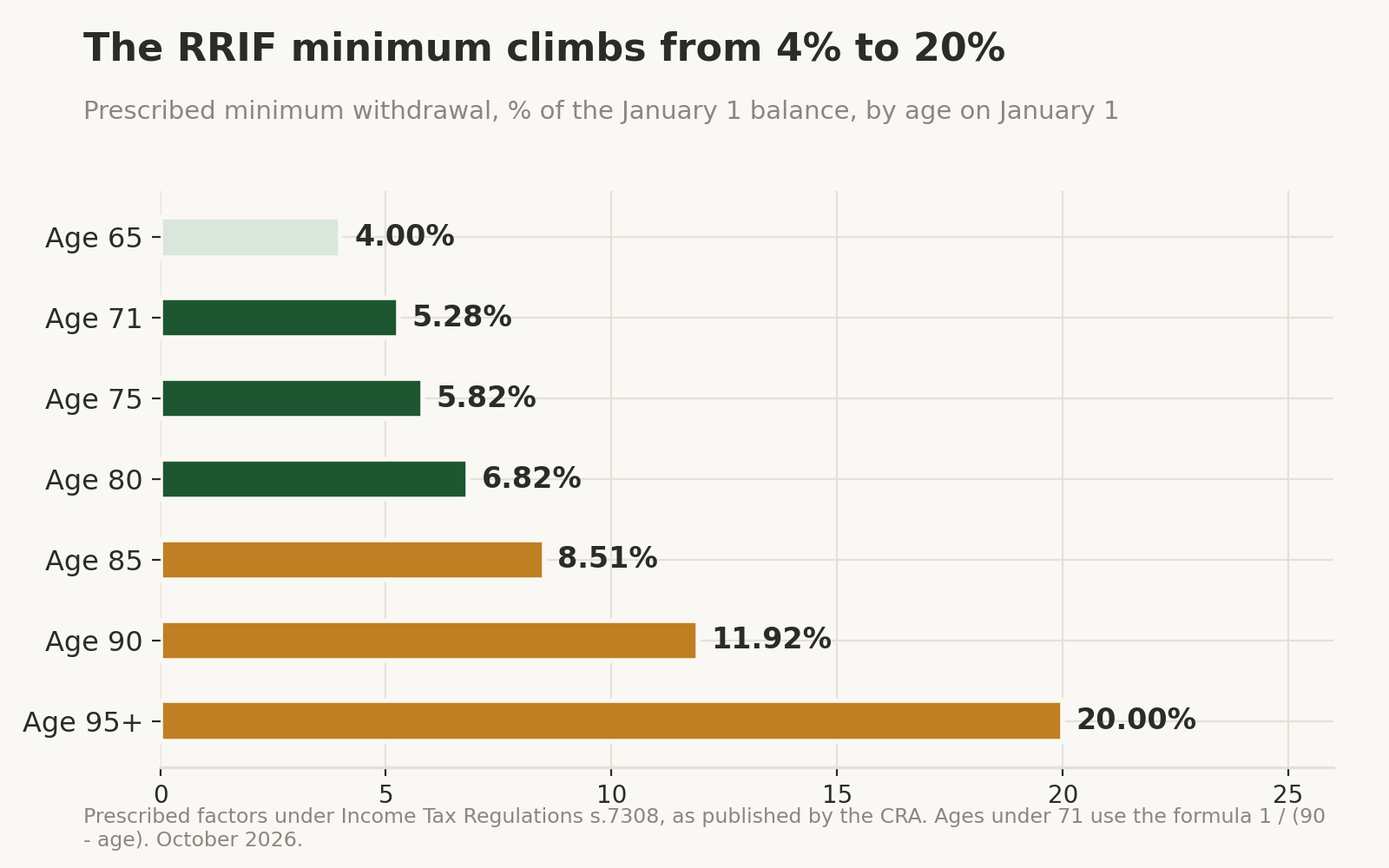
The short answer: Your RRSP has a hard expiry date. By December 31 of the year you turn 71, it must be withdrawn, moved to a RRIF, or used to buy an annuity. Most people pick the RRIF. From the year after the RRIF opens, you must withdraw a minimum amount every year. The minimum is your RRIF’s value on January 1 multiplied by a set percentage for your age that day. At 71 the percentage is 5.28%. At 95 and older it is 20%.
Who this is for: You are in your 60s, or you turn 71 soon, and you want the mechanics before you make timing decisions.
Your move: Decide two things early. First, whether converting some money before 71 lowers your lifetime tax. Second, if you have a younger spouse or common-law partner, whether to base your minimums on their age. That second choice closes before your first RRIF payment.
Contents
- The December 31 deadline and your three options
- What changes when your RRSP becomes a RRIF
- How the RRIF minimum amount actually works
- The full minimum percentage table
- The younger spouse’s-age election
- Withholding tax: the minimum vs the excess amount
- Four timing moves, and their limits
- Worked examples
- The Club take
- FAQ
This piece is general information about how the rules work. It is not personal tax or financial advice for your situation.
The December 31 deadline and your three options
An RRSP does not run forever. In the year you turn 71, you have to pick one of three options for your RRSPs, as set out on the CRA’s page on your options for your RRSPs at 71:
- Withdraw the money. The whole amount counts as income in that one year. Your issuer withholds tax at source. On a large RRSP, one year of income at that size usually means a very high tax rate on the top dollars.
- Transfer it to a RRIF. A RRIF is a Registered Retirement Income Fund. It is the payout version of your RRSP. Your investments move over and keep growing tax-sheltered. You pay tax as money comes out, not on the transfer itself.
- Buy an annuity. You hand the money to an insurer. The insurer pays you a set income. Each payment is taxed when you receive it.
You can mix the options. Part can go to a RRIF and part to an annuity, for example. The deadline is the same either way: the end of the year you turn 71. That date, December 31, is also your last chance to contribute to your own RRSP.
One point saves a lot of stress. The transfer itself is not taxed. The CRA confirms your issuer does not withhold tax on amounts transferred directly to a RRIF or used to buy an annuity. Tax starts when payments come out.
What changes when your RRSP becomes a RRIF
Three things change. Everything else mostly stays the same.
- No new contributions. You cannot contribute fresh money to a RRIF. Money gets in only by direct transfer from another registered plan, such as your RRSP. The CRA spells this out on its page on transferring to your RRIF.
- A forced yearly withdrawal starts. You must take out at least the minimum amount every year, starting the year after the RRIF is set up. There is no minimum in the year you open it. There is also no maximum. You can always take out more.
- Every dollar out is taxable income. RRIF payments are taxed in the year you receive them, just like RRSP withdrawals were.
You do not have to wait until 71. You can convert to a RRIF at any age. Earlier conversion is a planning choice, covered below.
A RRIF is not quite a one-way door, but the door has a closing date. Before the end of the year you turn 71, amounts can be transferred from a RRIF back to an RRSP. After that deadline, there is no RRSP left to transfer back to, because RRSPs themselves must mature that year. Once RRIF minimums have started, they cannot be paused.
How the RRIF minimum amount actually works
The RRIF minimum amount is the smallest amount you must withdraw in a year. The CRA sets it with one multiplication:
Minimum amount = fair market value of the RRIF on January 1 × prescribed percentage for your age on January 1.
Four details matter:
- The balance is frozen on January 1. A market drop in March does not lower this year’s minimum. A strong year raises next year’s.
- The age is your age on January 1. If you turn 72 in June, this year still uses the age-71 percentage.
- Under 71, there is no table. The percentage is a formula: 1 ÷ (90 − your age). At 65 that is 1 ÷ 25, or 4.00%. At 70 it is 1 ÷ 20, or 5.00%.
- From 71, a fixed table applies. The percentages below are the post-2015 prescribed factors for a standard RRIF. They have not changed since 2015.
The full minimum percentage table
Age is your age on January 1. The dollar column shows the minimum on a $500,000 RRIF on January 1, so you can scale it to your own balance.
| Age on January 1 | Prescribed percentage | Minimum on $500,000 |
|---|---|---|
| 65 (formula: 1 ÷ 25) | 4.00% | $20,000 |
| 70 (formula: 1 ÷ 20) | 5.00% | $25,000 |
| 71 | 5.28% | $26,400 |
| 72 | 5.40% | $27,000 |
| 73 | 5.53% | $27,650 |
| 74 | 5.67% | $28,350 |
| 75 | 5.82% | $29,100 |
| 76 | 5.98% | $29,900 |
| 77 | 6.17% | $30,850 |
| 78 | 6.36% | $31,800 |
| 79 | 6.58% | $32,900 |
| 80 | 6.82% | $34,100 |
| 81 | 7.08% | $35,400 |
| 82 | 7.38% | $36,900 |
| 83 | 7.71% | $38,550 |
| 84 | 8.08% | $40,400 |
| 85 | 8.51% | $42,550 |
| 86 | 8.99% | $44,950 |
| 87 | 9.55% | $47,750 |
| 88 | 10.21% | $51,050 |
| 89 | 10.99% | $54,950 |
| 90 | 11.92% | $59,600 |
| 91 | 13.06% | $65,300 |
| 92 | 14.49% | $72,450 |
| 93 | 16.34% | $81,700 |
| 94 | 18.79% | $93,950 |
| 95 and older | 20.00% | $100,000 |
Read the shape of the table, not just your row. The percentage roughly doubles between 71 and 90. At 95 and older, one fifth of whatever is left on January 1 must come out every year.
The younger spouse’s-age election
Your minimums do not have to run off your own age. When you set up the RRIF, you can elect to base the minimum amount on your spouse’s or common-law partner’s age instead. If your partner is younger, their percentage is lower. Less is forced out each year. More stays tax-sheltered.
The mechanics are strict:
- The election is made when the RRIF is set up.
- It must be in place before you receive the first payment from that RRIF.
- It cannot be changed later for that RRIF.
Example. You are 71 on January 1 and your partner is 65. On a $500,000 RRIF, your own age gives a minimum of $500,000 × 5.28% = $26,400. Your partner’s age gives $500,000 × 4.00% = $20,000. The election keeps $6,400 a year from being forced out and taxed, in the first year alone.
The catch is timing. Decide before the RRIF pays you anything. If you miss the window, that RRIF keeps your own age for life.
Withholding tax: the minimum vs the excess amount
Withholding tax is tax your financial institution takes off a payment and sends to the CRA before the money reaches you. It is a prepayment. It is not your final tax bill. Your final tax is worked out on your return, from your total income for the year. Any extra withheld comes back as a refund. Any shortfall is due when you file.
For RRIFs, the rule splits in two:
- The minimum amount: no withholding. Nothing is taken off the minimum. It is still fully taxable income. The tax on it is simply collected later, on your return.
- The excess amount: withholding applies. The excess amount is anything you withdraw above the minimum in that year. It is treated as a lump-sum payment for withholding. One rate applies to the whole excess, based on its size.
| Excess amount (above the minimum) | Federal withholding, rest of Canada | Federal withholding, Quebec |
|---|---|---|
| $5,000 or less | 10% | 5% |
| $5,001 to $15,000 | 20% | 10% |
| Above $15,000 | 30% | 15% |
These are the CRA’s lump-sum withholding tiers, shown on the CRA’s page on lump-sum payment withholding rates. The same tiers apply to a lump-sum withdrawal straight from an RRSP. In Quebec, the federal rate drops to the 5% / 10% / 15% column, and Quebec provincial withholding is charged on top of the federal amount. The combined Quebec total is therefore higher than the federal-only column suggests.
Two practical points:
- The rate applies to the whole excess, not in slices. An excess of $5,000 has $500 withheld at 10%. An excess of $5,001 falls in the 20% tier, so about $1,000 is withheld on the entire amount. One extra dollar can mean less cash in hand today.
- Splitting withdrawals does not change your tax. Taking two smaller withdrawals to land in a lower withholding tier only changes how much cash is held back now. Your income for the year is the same. Your tax on the return is the same. Withholding is timing, not savings. Note that where separate requests look like one withdrawal split up to reduce withholding, the CRA’s position is to rate them together.
Because nothing is withheld on the minimum, plan for the tax bill. A $26,400 minimum arrives whole. The tax on it does not. Set money aside, or ask your institution to withhold voluntarily.
Four timing moves, and their limits
1. Draw some RRSP money in low-income years, before 71
The mechanism is bracket management. Tax rates rise in steps as income rises. A year with little other income has room in the low brackets. Withdrawing some RRSP money in that year fills the low brackets at a low rate. It also shrinks the RRSP that later becomes forced RRIF income.
The natural window is after you stop working and before Canada Pension Plan (CPP) and Old Age Security (OAS) start, and before RRIF minimums begin. You can do this with direct RRSP withdrawals, or by converting part of the RRSP to a RRIF early and taking payments.
The limits are real. Withdrawn RRSP money cannot go back in unless you have RRSP contribution room, and a withdrawal does not create new room. Money taken out also leaves the tax shelter for good. This move only helps if your tax rate in the low years is actually lower than the rate you expect later.
2. Convert at 65 to unlock pension income treatment
Here the account type matters, not just the amount. A plain RRSP withdrawal is not eligible pension income. RRIF payments are different. The CRA’s page on eligible pension income lists RRIF payments as eligible when the person receiving them is 65 or older at the end of the year.
Eligible pension income does two things:
- It supports the pension income amount. You can claim up to $2,000 of eligible pension income on line 31400. The claim is the lesser of $2,000 and your eligible pension income.
- It can be split with a spouse or common-law partner. Pension income splitting means you and your partner jointly elect, on Form T1032, to move up to 50% of your eligible pension income onto your partner’s return. If your partner is in a lower bracket, the household pays less tax on the same income. The CRA’s income tax folio on pension benefits confirms the one-half cap.
So converting even a small part of an RRSP to a RRIF at 65 can create eligible pension income that an RRSP withdrawal cannot. The limit: payments before 65 do not qualify on this basis, apart from narrow cases such as payments received because a spouse or partner died. And once that RRIF exists, its yearly minimums apply from the following year.
If you are still deciding where retirement savings belong in the first place, see TFSA vs RRSP by income level and the complete funding order for your next dollar.
3. Use the younger spouse’s age to shrink the minimums
This is the election covered above, used as a strategy. The mechanism is simple. A younger age means a smaller percentage every year, for the life of the RRIF. Less income is forced onto your return. More money keeps compounding inside the shelter.
It helps most when you do not need the RRIF income to live on, and when the age gap is wide. The limits: the election must be made before the first payment, it cannot be undone for that RRIF, and a smaller minimum today means a larger RRIF later. The money is taxed eventually, either as you withdraw it or on your final return.
4. Understand what waiting until 71 actually does
Waiting is a decision too. If you never draw from the RRSP before 71, the full balance converts at the deadline. Your first minimum then runs off the largest possible balance. That forced income stacks on top of CPP, OAS, and any other pension income in the same years.
The result is concentration. Income you could have spread across low-income years in your 60s lands in your 70s and 80s instead, where the minimum percentage is higher and rising. For a small RRSP, the difference may be minor. For a large one, it can push you into a higher bracket every year, with no way to pause the minimums once they start.
Worked examples
Example 1: the first minimum at 71. Your RRIF holds $500,000 on January 1 and you are 71 on that date. The prescribed percentage is 5.28%.
$500,000 × 5.28% = $26,400
That $26,400 must come out during the year. No tax is withheld from it. It is added to your income for the year.
Example 2: the same habit, nine years later. You are 80 on January 1 and your RRIF holds $400,000 that day. The percentage at 80 is 6.82%.
$400,000 × 6.82% = $27,280
The balance is $100,000 smaller than in Example 1. The minimum is still larger. The rising percentage outweighs the falling balance.
Example 3: an excess withdrawal. Your minimum for the year is $26,400. You withdraw $46,400 in total. The excess amount is $46,400 − $26,400 = $20,000. Outside Quebec, the excess is above $15,000, so 30% is withheld from the excess:
$20,000 × 30% = $6,000 withheld
You receive the $26,400 minimum in full, plus $14,000 of the excess. Your taxable income for the year is still the full $46,400. The $6,000 is a prepayment credited on your return.
The Club take
Who wins: Anyone in their 60s with a gap between stopping work and starting CPP and OAS. Those low-income years are a one-time chance to pull RRSP income forward at low rates, and converting at 65 adds the pension income amount and pension splitting that RRSP withdrawals cannot give you.
Who should skip the early moves: Anyone whose income is already high in their 60s, or whose RRSP is small enough that the forced minimums at 71 will sit comfortably in a low bracket anyway. Early withdrawals solve a concentration problem. If you do not have one, there is nothing to fix.
The catch: Two decisions are hard to reverse. The spouse’s-age election closes before your first payment. And RRSP money withdrawn early cannot go back without contribution room. Get both decisions right before the RRIF starts paying, not after.
FAQ
What happens if I do nothing by the end of the year I turn 71?
Your RRSP still has to mature. If you do not choose an option, the plan is treated as cashed out and its value counts as income in that year. Pick the RRIF or annuity transfer yourself instead, so the income is spread over future years.
Can I contribute to a RRIF?
No. You cannot contribute new money to a RRIF. Money enters only by direct transfer from another registered plan, such as an RRSP, a PRPP, or another RRIF.
Do I have to withdraw in the year I open my RRIF?
No. There is no minimum amount in the year the RRIF is set up. The first required minimum is in the following year, based on the January 1 value and your age on that January 1.
Is the RRIF minimum tax-free because nothing is withheld?
No. No withholding is not the same as no tax. The minimum is fully taxable income. Nothing is taken off at source, so the tax is settled on your return instead.
Can I split RRIF income with my spouse before 65?
Generally no. RRIF payments count as eligible pension income for splitting when you are 65 or older at the end of the year. A narrow exception covers payments received because a spouse or common-law partner died.
Can RRIF minimums be paused in a bad market year?
No. The minimum is set from the January 1 value and must be withdrawn that year. A market drop after January 1 does not reduce it. Next year’s minimum uses the new, lower January 1 value.