As of: October 3, 2026
Offer ends: November 1, 2026 — 29 days left
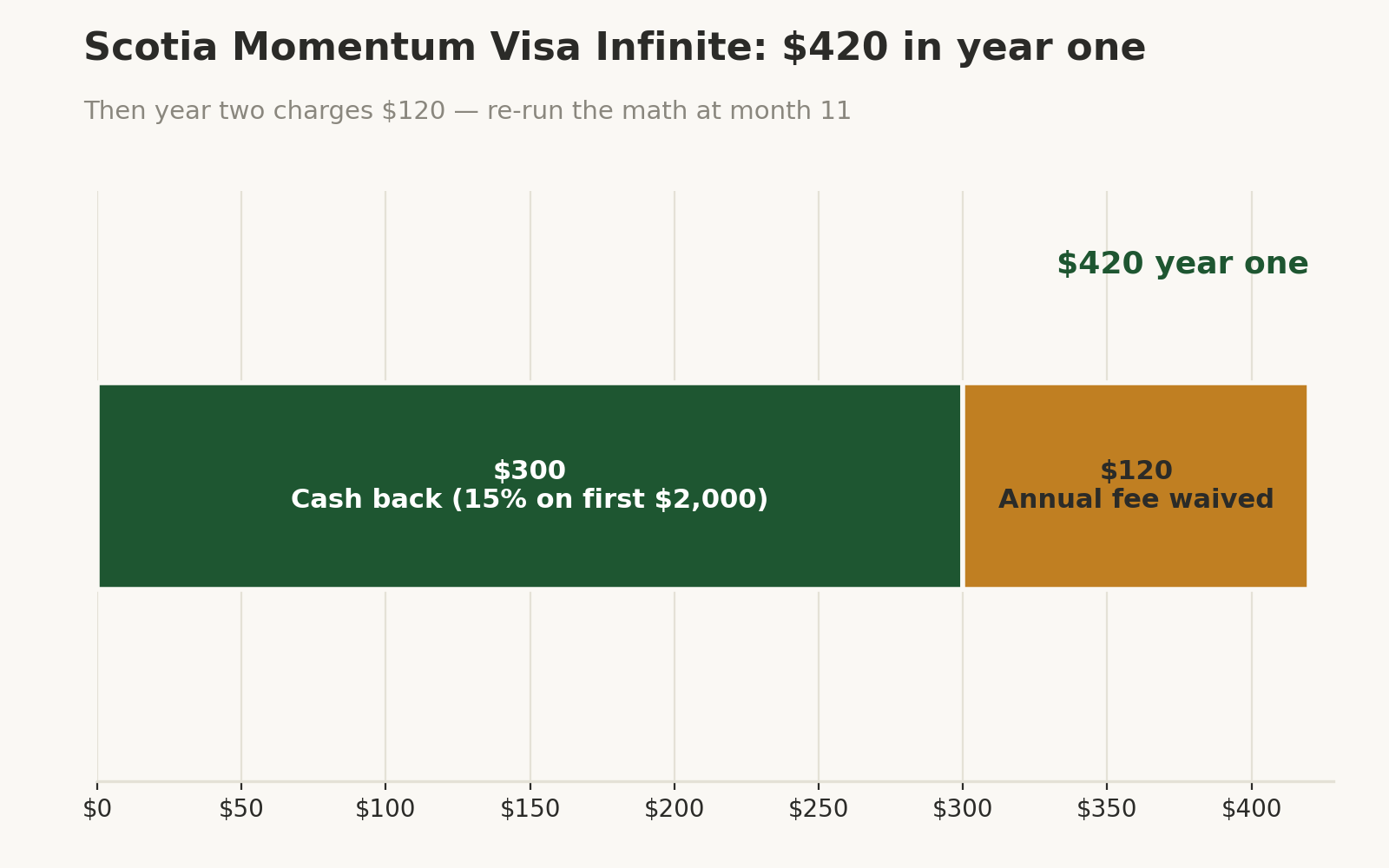
The verdict: The issuer offer is a clean, no-tricks $420 in year one — $300 cash back (15% on your first $2,000 in 3 months) plus a waived $120 annual fee. Then year two charges you $120, and this card only deserves a second year if your grocery and recurring-bill spend clears roughly $3,000 a year. If it doesn’t, churn it or downgrade. That’s the honest version.
Who this is for: Households putting real money through groceries and recurring bills who don’t already hold a Scotiabank card, and who can park $2,000 of spend in the first 3 months. Not for you if you’ve held a Scotiabank personal card in the last 2 years — you’re excluded from the offer.
Your move: Apply before November 1, run $2,000 of planned spend through it in 90 days, then set a calendar reminder for month 11 to re-run the year-two math below.
On this page
- The year-one math
- Three honest catches in the fine print
- The year-two question
- The comparison that matters
- What to do
The year-one math: $420 from Scotiabank, $570 if you stack the rebate
Scotiabank’s current offer on the Scotia Momentum Visa Infinite is two pieces, all ending November 1, 2026 (Scotiabank’s card page):
| Piece | Value |
|---|---|
| 15% cash back on your first $2,000 in eligible purchases within 3 months of opening | $300 |
| Annual fee waived for the first year (primary + additional cards) | $120 |
| Issuer-offer total | $420 |
There’s also a stackable $150 FlyerFunds rebate from Frugal Flyer — their rebate page: you get $150 paid via PayPal if you apply through their rebate page and are approved. That’s a third-party rebate, not Scotiabank money, and it has strings: you must apply through their page, accept cookies, and disable ad blockers, or they may not be able to fulfill the offer. Stacked total: $420 + $150 = $570.
To be clear about what this is: the $300 requires $2,000 of eligible purchases in the first 3 months — not sign-up, actual spend. Eligible purchases exclude payments, cash advances (including balance transfers and cash-like transactions), interest, fees, and other charges.
Three honest catches Scotiabank buries in the fine print
- The bonus portion arrives late. The 15% is really your normal earn rate (1–4% depending on category) plus a top-up bonus. The bonus portion is only available to redeem approximately 5 months after your account opens. Regular cash back redeems anytime from $25 — the bonus waits.
- Past cardholders are locked out. Anyone currently or previously a primary or secondary holder of a Scotiabank personal credit card in the past 2 years is not eligible for the offer. This is stricter than many bank offers.
- There’s no category sweet spot in the 15%. The 15% tops up your normal earn rate, and the top-up is bigger where the base rate is smaller (14 points on 1% categories, 11 points on 4% categories) — but the total is $300 on $2,000 either way. What changes is the split: spend in 1% categories and $20 lands as regular cash back while $280 sits in the bonus portion that only unlocks about 5 months in (catch 1). Spend in 4% categories and $80 is regular cash back — above the $25 redemption minimum on its own — with $220 delayed. Same $300; the 4% route puts more of it in your hands sooner. Don’t reroute planned spending into 1% categories to squeeze out a bigger bonus — there isn’t one.
The year-two question: does it survive the $120 fee?
Ongoing earn rates, straight from Scotiabank’s terms:
- 4% on groceries and recurring bill payments — up to $25,000/year
- 2% on gas, EV charging, transit, rideshare, and food delivery — up to $25,000/year
- 1% on everything else
- Annual fee: $120 ($50 for additional cards)
Here’s the breakeven table at three spend levels — all assuming you already pocketed the year-one bonus:
| Annual spend profile | 4% categories | 2% categories | 1% categories | Cash back | − $120 fee | Net |
|---|---|---|---|---|---|---|
| Heavy ($21,600) | $12,000 → $480 | $3,600 → $72 | $6,000 → $60 | $612 | −$120 | +$492 |
| Moderate ($12,000) | $7,200 → $288 | $1,800 → $36 | $3,000 → $30 | $354 | −$120 | +$234 |
| Light ($6,200) | $3,000 → $120 | $1,200 → $24 | $2,000 → $20 | $164 | −$120 | +$44 |
The rule of thumb: $3,000 a year in 4% categories alone covers the fee ($3,000 × 4% = $120). That’s $250/month in groceries and bills — most households clear it. But if your grocery/recurring spend sits below ~$2,500/year and the rest is 1% spending, the card earns less than a good no-fee alternative and you’re paying $120 for the privilege. In that case, year two’s correct answer is churn or downgrade, not loyalty.
The comparison that matters
No-fee cash back cards in Canada typically pay 0.5–1% base. The Momentum Infinite beats them only where its multipliers hit. A household charging $7,200/year in groceries and bills earns $288 at 4% versus ~$72 at 1% — a $216 edge that more than covers the $120 fee. A single person with $1,200/month total spend mostly on dining and transit earns maybe $100–150 in bonuses over a no-fee card — roughly break-even, not a win. Rank your own spending before you rank the card.
What to do
- Before November 1: If you’re eligible (no Scotia card in the past 2 years) and meet the income bar — Scotiabank states it as ranges, not a single cutoff: $60,000–$80,000 individual, $100,000–$150,000 household, or $250,000–$300,000 in assets under management (meet any one of the three) — apply through Scotiabank’s card page, or through Frugal Flyer’s rebate page to stack the $150 (apply through their page, cookies on, ad blocker off).
- Months 1–3: Route $2,000 of planned spend through the card — the $300 pays the same in every category, so use the spend you already have planned rather than rerouting it. Pay in full — the purchase rate is 20.99%, and carrying a balance torches the bonus in weeks.
- Month 11: Pull your actual grocery/recurring spend. If it’s under ~$3,000/year, call to downgrade to the no-fee Scotia Momentum Visa instead of paying $120.
- Ignore the 0% balance transfer pitch for this decision. The card also offers 0% on balance transfers for 12 months with a 2% fee ($5 minimum) — fine if you need it, irrelevant to the cash back math.