The verdict: On a $24,000/year spending profile, the BMO CashBack World Elite wins year one at ≈$1,039 in net value — but it falls to last place ongoing (≈$420), where the Amex Cobalt’s 5x on food leads at ≈$515 net and the no-fee Rogers Red World Elite pays a flat $480.
Who this is for: Canadians picking a cash-back card who want the ranking done by dollars, not vibes.
Your move: Chase BMO’s year-one bonus only if you can reliably spend $2,000/month — otherwise take the Cobalt for food-heavy spend, or the Rogers card for a no-fee flat rate.
How Cash Club works
Every rate, fee, and date on this page comes from the issuer’s own page (October 7, 2026; BMO’s terms as of October 8).
Rankings are set by the math: first-year and ongoing cash value minus fees, on a fixed spending profile.
Cash Club is a small team, not a person. That’s why there are no bylines. The numbers carry the authority, not a name.
Contents
- The spending profile (all math flows from this)
- Head-to-head: the numbers
- The ranking: first-year net value
- The ranking: ongoing value (year two and beyond)
- The Rogers devaluation: what actually changed
- Which card for which reader
- What this comparison assumes (and where it breaks)
Most “best credit card” lists rank by vibes, sponsored placements, or headline earn rates that collapse the moment you read the fine print. This one ranks by dollars: a defined spending profile, the cards’ actual earn structures, and net value after fees — first year and ongoing.
The spending profile (all math flows from this)
Annual spend: $24,000 ($2,000/month), split as:
- Groceries: $600/mo ($7,200/yr)
- Dining / food delivery: $300/mo ($3,600/yr)
- Gas and EV charging: $150/mo ($1,800/yr)
- Transit: $80/mo ($960/yr)
- Streaming and recurring bills: $120/mo ($1,440/yr — about $30/mo streaming, $90/mo other recurring bills)
- Everything else: $750/mo ($9,000/yr)
Balances paid in full every month (interest charges would swamp any rewards on all of these cards). For the Rogers card, the math assumes you’re a Rogers, Fido, or Shaw customer, since that’s where the card’s value lives.
Head-to-head: the numbers
| Card | Earn rates (ongoing) | Annual fee | Income requirement | Welcome offer (as of 2026-09-28) | Foreign transaction fee |
|---|---|---|---|---|---|
| American Express Cobalt | 5x eats & drinks (groceries, dining, food delivery); 3x streaming; 2x gas, transit & rideshare; 1x everything else (Amex benefits) | $15.99/mo = $191.88/yr (Amex; MoneySense) | None specified — Amex publishes no income requirement for this card (MoneySense) | Up to 15,000 MR points (1,250/month × 12 months at $750/mo spend), no published end date (Amex) | 2.5% (not disclosed on issuer pages retrieved; Frugal Flyer) |
| Rogers Red World Elite | 3% USD purchases; 2% everything else with an eligible Rogers, Fido or Shaw service (1.5% without); from Nov 18, 2026: 5% on eligible Rogers purchases (Rogers Bank calculator; Rogers Bank change notice) | $0 (Rogers Bank; milesopedia) | $80,000 personal / $150,000 household (Rogers Bank) | No current welcome offer (milesopedia, September 2026) | 2.5% (Rogers Bank calculator) |
| Wealthsimple Visa Infinite+ | 2% unlimited on everything (Wealthsimple) | $240/yr ($20/mo; $240 charged annually in QC), waived with $100,000+ in Wealthsimple assets or $4,000+/mo direct deposits (Wealthsimple) | $80,000 personal / $150,000 household; Canadian resident, age of majority, active Wealthsimple chequing account (Wealthsimple) | Up to 5% back for new clients’ first 30 days (Wealthsimple); third parties report a $500 cap (first $10,000 in purchases) and a 180-day clawback (milesopedia) | 0% (Wealthsimple) |
| CIBC Dividend Visa Infinite | 4% gas, EV charging, groceries; 2% transportation, dining, recurring payments, CIBC by Expedia; 1% everything else (CIBC) | $120, first year rebated; $50 each for up to 3 additional cards (raised from $30 on Aug 1, 2026, per The Points Standard) (CIBC) | $60,000 personal / $100,000 household (CIBC) | Up to $350 in value (CIBC’s headline; its listed components add to $370): 10% cash back up to $200 (net purchases up to $2,000, first 4 statements) + $50 pre-authorized-payment bonus + $120 first-year fee rebate; no published end date (The Points Standard, reviewed 2026-09-28) | 2.5% (milesopedia; not on retrieved issuer page) |
| BMO CashBack World Elite | 5% groceries (first $500/cycle); 4% ground transit (first $300); 3% gas/EV (first $300); 2% recurring bills (first $500); 1% thereafter & everything else (BMO terms) | $139 ($50 additional cards); first year waived (BMO terms for fees; milesopedia for first-year waiver) | $80,000 personal / $150,000 household (BMO product page) | $40 cash back each month you spend ≥$2,000 net in each of the first 12 billing cycles (up to $480) + first-year fee waiver; apply by Nov 30, 2026 (BMO terms) | 2.5% (money.ca, milesopedia; not on retrieved issuer pages) |
The ranking: first-year net value
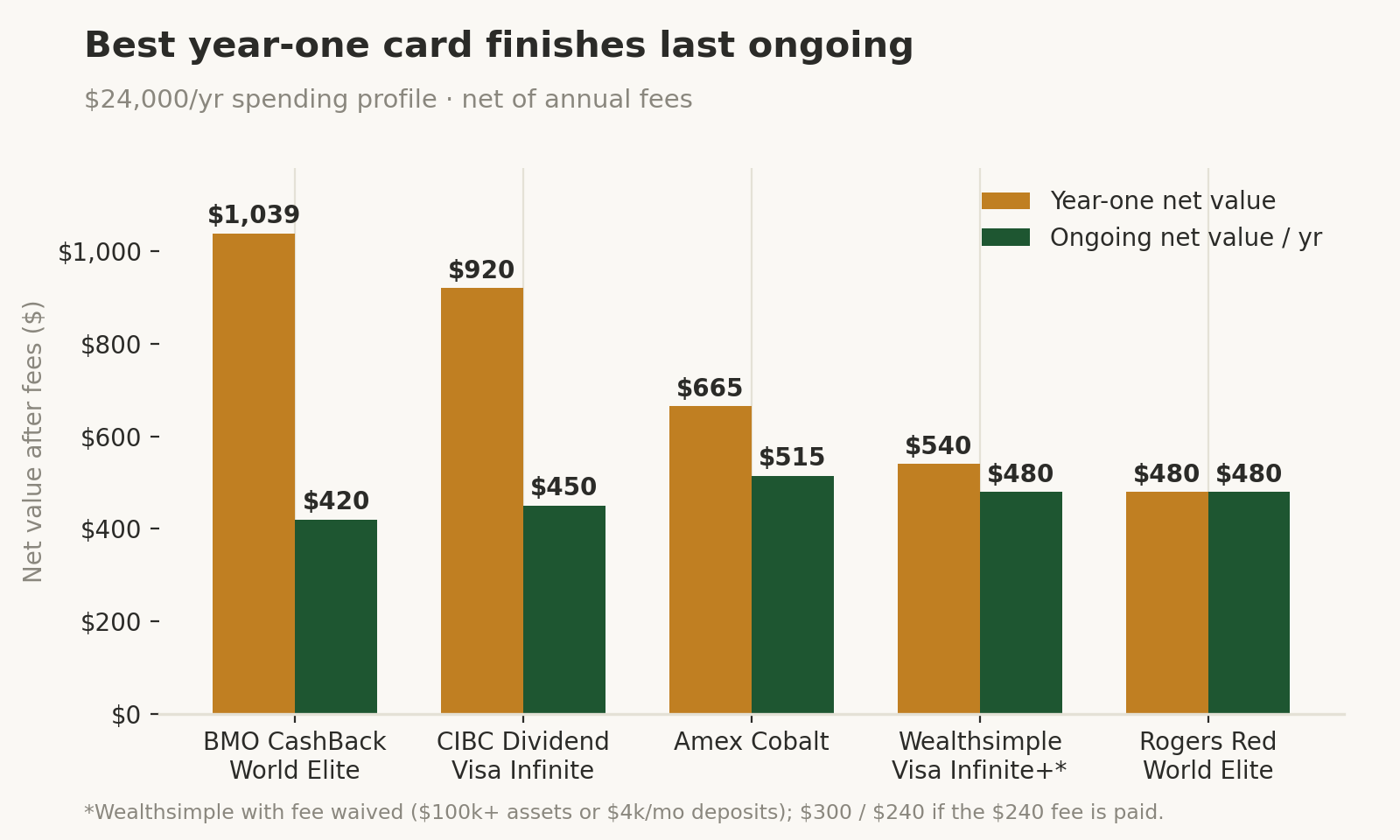
- BMO CashBack World Elite — ≈$1,039. Ongoing earn on the profile: groceries 5% on $6,000 ($300) + 1% on the remaining $1,200 ($12) = $312; gas $1,800 × 3% = $54; transit $960 × 4% = $38.40; recurring bills $1,440 × 2% = $28.80; everything else ($3,600 dining + $9,000 general) × 1% = $126. Total ≈ $559, all from the issuer’s earn terms (BMO terms). Add the $480 bonus (requires $2,000/month in net purchases — the profile spends exactly $2,000/month, so assume it’s achievable, but a leaner month breaks a $40 payment) with the $139 fee waived in year one: $559 + $480 = ≈$1,039 in year-one value. Note the bonus is demanding: miss the $2,000 in any billing cycle and that month’s $40 is gone. (BMO terms)
- CIBC Dividend Visa Infinite — ≈$920. Ongoing: groceries $7,200 × 4% = $288; gas $1,800 × 4% = $72; transit, dining, recurring ($960 + $3,600 + $1,440) × 2% = $120; everything else $9,000 × 1% = $90. Total $570, all from the issuer’s earn page (CIBC). Year one adds the advertised up to $350 in offer value ($200 at 10% on the first $2,000 of net purchases over 4 statements, $50 pre-authorized payment bonus, $120 fee rebate — the components actually sum to $370; we run the math on CIBC’s advertised $350): $570 + $350 = $920 (The Points Standard). CIBC notes the offer is digital-exclusive and excludes anyone who opened, transferred or cancelled another Dividend card in the last 12 months (milesopedia).
- Amex Cobalt — ≈$857 gross / $665 net. Points on the profile: eats & drinks ($7,200 groceries + $3,600 dining) × 5 = 54,000; streaming ($360) × 3 = 1,080; gas + transit ($2,760) × 2 = 5,520; everything else ($10,080) × 1 = 10,080. Total 70,680 points. At 1¢ per point (the statement-credit redemption rate — 1,000 points = $10, per Amex benefits; MoneySense notes higher value possible via 1:1 airline transfers), that’s ≈$707 in year-one ongoing value, minus the $191.88 fee = ≈$515 net. Add the welcome offer of up to 15,000 points (≈$150 at 1¢; new cardmembers only — current or former Cobalt cardholders are excluded) and year-one net ≈ $665. Note: the 5x food category carries a $2,500/month combined spending cap (Amex benefits) — the profile’s $900/month is well under it.
- Wealthsimple Visa Infinite+ — ≈$540 net (fee waived) / ≈$300 net (fee paid). Flat 2% × $24,000 = $480 (Wealthsimple). Minus the $240 annual fee = $240 net if you pay the fee; $480 if you qualify for the waiver ($100k+ assets or $4k/month deposits). Year one adds the welcome boost (up to 5% back for the first 30 days for new clients, confirmed by the issuer); at ~$2,000 of first-month spend that’s roughly $100 total (≈$60 above the regular 2%). The boost mechanics — a $500 cap on the first $10,000 and a 180-day clawback — are reported by milesopedia (third-party; Wealthsimple’s promo T&Cs weren’t retrieved), and The Points Standard notes the card has been invite-limited at times, so treat the $60 as upside rather than guaranteed. The card’s real edge is 0% foreign transaction fees — the only card here with no FX fee (Wealthsimple).
- Rogers Red World Elite — ≈$480. No welcome offer is currently published (milesopedia, September 2026), so year one equals ongoing: 2% × $24,000 = $480 for a Rogers/Fido/Shaw customer, $0 fee (Rogers Bank calculator). From November 18, 2026, cardholders also earn 5% on eligible Rogers purchases (e.g., a Rogers/Fido/Shaw postpaid mobile bill), per Rogers Bank’s own change notice (Rogers Bank change notice). Note: the same notice ends the 1.5x redemption multiplier on November 18, 2026 — after that, all redemptions are a flat 1¢ per point (Rogers Bank change notice). If you’re not a Rogers/Fido/Shaw customer, the rate drops to 1.5% ($360) and this card falls out of contention.
The ranking: ongoing value (year two and beyond)
- Amex Cobalt — ≈$515 net. ≈$707 in points value minus $191.88. Wins for anyone who spends heavily on food: the 5x on groceries and dining is the highest sustained earn rate in this comparison. Caveats: the $191.88 fee is steep (only Wealthsimple’s $240 is higher), Amex acceptance is narrower than Visa/Mastercard, and the 2.5% FX fee (Frugal Flyer) makes it a poor travel-spend card.
- Rogers Red World Elite — $480. A flat 2% with no fee and no category tracking is hard to beat for simplicity — if you’re a Rogers, Fido, or Shaw customer and spend under the $61,000/year annual cap on the accelerated rate (Rogers Bank change notice). Post-November 18, the 5% rate on eligible Rogers purchases adds a meaningful boost for telecom bills (Rogers Bank change notice). Non-Rogers customers: $360, which changes the ranking below.
- Wealthsimple Visa Infinite+ — $480 net (waived) / $240 net (paid). Same $480 gross as Rogers, but the value is fee-dependent: at the full $240 fee it would fall to last place, below BMO, at $240 net; at the waived fee this ranking uses (realistic for its target audience of $100k+ Wealthsimple clients) it ties Rogers — with 0% FX fees as the tiebreaker for anyone who spends in foreign currency (Wealthsimple).
- CIBC Dividend Visa Infinite — $450 net. $570 gross minus the $120 fee (CIBC). The 4% on groceries and gas makes it the strongest pick for households with high grocery spend that shop outside BMO’s $500/month grocery cap.
- BMO CashBack World Elite — ≈$420 net. ≈$559 gross minus the $139 fee (BMO terms). The best year-one card collapses to last place ongoing — the $139 fee plus capped categories mean the welcome bonus was doing all the work. Worth keeping past year one only if your grocery spend fits neatly under the $500/month cap and you value the included roadside assistance (valued at $75/year, BMO terms).
The Rogers devaluation: what actually changed
The ranking above uses the post-November 18, 2026 Rogers earn structure, because that’s the card you’ll hold for most of any year. Per Rogers Bank’s own change notice (Rogers Bank change notice): the 1.5x redemption bonus on eligible Rogers purchases ends November 18, 2026 (no grandfathering — all redemptions become a flat 1¢ per point), and earn on eligible Rogers purchases rises to 5% from the same date, subject to the card’s annual limits. Trip cancellation, trip interruption, and trip delay insurance are also removed November 18, 2026, and the 5 annual Roam Like Home days become a $75 roaming credit on January 12, 2027. Until November 18, the card still earns 2% (Rogers/Fido/Shaw customers) / 1.5% on CAD purchases and 3% on USD purchases, with a 2.5% foreign transaction fee (Rogers Bank calculator). Net effect for a pure cash-back user: the card stays a strong 2% no-fee flat card, and gets better if you pay a Rogers-family mobile bill with it.
Which card for which reader
- Amex Cobalt — Get this if you: spend heavily on groceries and dining (5x is the best ongoing food rate here) and can live with the places that don’t take Amex. Skip it if you: won’t earn back the $191.88 annual fee in extra rewards, or do most of your spending where Amex isn’t accepted.
- Rogers Red World Elite — Get this if you: are a Rogers, Fido, or Shaw customer (that’s what unlocks the 2% tier) and want a no-fee flat rate. Skip it if you: aren’t a Rogers customer — without the 2% tier, Wealthsimple (fee waived) or CIBC win.
- Wealthsimple Visa Infinite+ — Get this if you: can waive the $240 fee ($100K in assets or $4K monthly direct deposit) and spend in foreign currency (0% FX fee). Skip it if you: won’t hit the waiver — the $240 fee halves its value.
- CIBC Dividend Visa Infinite — Get this if you: spend big on groceries and gas (4% on both) and clear the $60,000 personal / $100,000 household bar. Skip it if you: spend little on groceries and gas — the 4% categories are where this card’s value lives.
- BMO CashBack World Elite — Get this if you: can reliably spend $2,000/month (that’s what unlocks the $40/month bonus) and apply by November 30, 2026. Skip it if you: spend unevenly — one thin month costs you $40 — or won’t reassess at renewal, when the fee kicks in and this card falls to last place ongoing.
What this comparison assumes (and where it breaks)
- Amex points valued at 1¢ each — the statement-credit rate (1,000 points = $10, Amex benefits); MoneySense notes ~1.5¢ average via Fixed Points Travel, up to 2¢ via airline transfers. If you transfer to Aeroplan and redeem well, the Cobalt’s lead grows; if you redeem at Amazon’s Shop with Points rates, it shrinks.
- Rogers customer assumption — the 2% tier requires an eligible Rogers, Fido or Shaw service in good standing (Rogers Bank calculator).
- BMO’s $40/month bonus requires $2,000 in net purchases every billing cycle (BMO terms); the profile spends exactly that, so one thin month costs $40.
- Wealthsimple’s boost exists per the issuer (Wealthsimple); its cap ($500 on the first $10,000) and 180-day clawback are third-party reported (milesopedia), and availability has been invite-limited at times per The Points Standard — the $60 year-one boost value is upside, not guaranteed.
- Foreign spending is excluded from the profile; if you spend heavily in foreign currency, Wealthsimple’s 0% FX fee (Wealthsimple) changes the math materially, and the Rogers card’s 3%-on-USD-minus-2.5%-FX nets only ~0.5%.