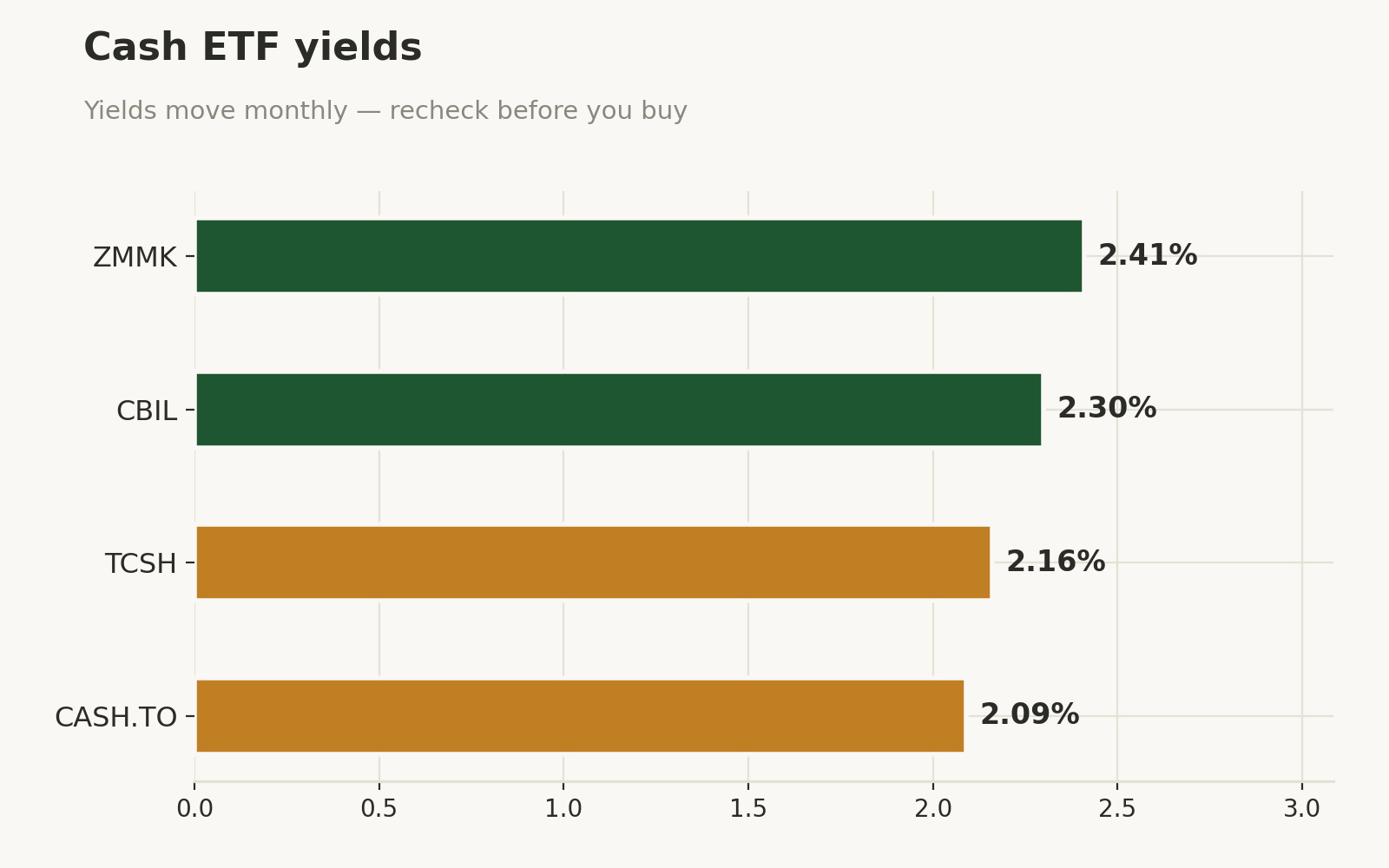
Yields on cash ETFs move every month — every yield in this guide is shown with its date. Recheck before you buy.
- The verdict: There is no single Canadian SGOV. There are three families of cash ETFs, and the right one depends on your account type and your tax situation — not on the yield alone.
- Who this is for: Anyone sitting on cash in a Canadian brokerage account who keeps seeing r/PersonalFinanceCanada threads asking “what’s the Canadian SGOV?” and wants the actual answer with numbers.
- Your move: Taxable account and a high marginal rate? HSAV’s no-distribution structure means your return accrues in the share price and is taxed as a capital gain when you sell. Registered account where tax doesn’t matter? Buy the cheapest monthly distributors — right now that’s a tie between CASH.TO and CBIL, both at a 0.11% MER. Want the literal “Canadian SGOV” — a fund that holds Canadian T-bills? That’s CBIL.
Contents
- Why Reddit keeps asking for a Canadian SGOV
- The three families, with numbers
- The safety question: CDIC vs. not
- The tax question: distributions vs. NAV compounding
- Why the yields move: the Bank of Canada context
- Which one should you actually buy
Why Reddit keeps asking for a Canadian SGOV
SGOV is the iShares 0-3 Month Treasury Bond ETF — a U.S.-listed fund that holds American Treasury bills maturing in three months or less, priced in USD, with monthly distributions.
Canadians want the same thing in Canadian dollars: a dead-simple parking spot for cash that tracks short-term government rates. The closest domestic answer is CBIL, the Global X 0-3 Month T-Bill ETF, which holds Government of Canada T-bills maturing in under three months, pays monthly distributions, and currently yields 2.30% annualized as at October 1, 2026.
But CBIL is only one of three answers. The other two families — HISA ETFs and the corporate-class maximizer — do the same job with different plumbing, and the plumbing changes the tax bill.
One note on names before the numbers: everything that used to be called Horizons is now Global X. Horizons ETFs Management (Canada) Inc. completed its rebrand to Global X Investments Canada Inc. effective May 1, 2024, with tickers unchanged. (Global X rebrand press release) So if a thread mentions “the Horizons HISA ETF,” it means CASH.TO.
The three families, with numbers
Family 1: HISA and cash ETFs — CASH.TO, TCSH, ZMMK
These hold cash or near-cash instruments and pay you monthly.
- CASH.TO (Global X High Interest Savings ETF) parks almost all of its assets in high-interest deposit accounts at Canadian chartered banks — as of September 30, 2026, roughly half at National Bank, with the rest at Scotiabank, CIBC and CIBC Mellon. Annualized distribution yield: 2.09% as at October 1, 2026; 12-month trailing yield 2.04%. Management fee 0.10% plus tax, MER 0.11% as at June 30, 2026. Monthly distributions, ~$6.6 billion in net assets.
- TCSH (TD Cash Management ETF) is TD Asset Management’s actively managed cash ETF. It benchmarks the FTSE Canada 91 Day T-Bill Index and holds a mix of high-quality money-market and short-term fixed-income securities (177 holdings, average term to maturity 148 days as of late September 2026). Last distribution yield: 2.16% (monthly), management fee 0.15%, MER 0.17%, ~$1.35 billion in assets, as of September 24, 2026.
- ZMMK (BMO Money Market Fund, ETF Series) holds high-quality Canadian money-market instruments — T-bills, bankers’ acceptances and commercial paper — with maturities under 365 days and an average term under 90 days. Annualized distribution yield: 2.41% as of August 31, 2026; maximum management fee 0.12%, MER 0.13%; monthly distributions; ~$5.6 billion in net assets.
All three pay monthly cash. All three distributions arrive as interest income in a taxable account.
Family 2: The corporate-class maximizer — HSAV
HSAV (Global X Cash Maximizer Corporate Class ETF) holds the same kind of assets as CASH — high-interest deposit accounts at Canadian banks (National Bank 61%, CIBC Mellon 27%, CIBC 12% as of September 30, 2026) — but its objective is “modest capital growth,” and it is not currently expected to make any regular distributions. Your return compounds inside the share price instead of landing in your account as cash.
The numbers: management fee 0.18% plus tax, MER 0.20% as at June 30, 2026 — roughly double CASH’s. And the higher fee shows up in results: HSAV’s 1-year total return was 1.85% as at September 30, 2026, trailing CASH’s 2.04% trailing distribution yield over a similar period. You are paying for the tax structure, not a higher yield.
One reassurance and one real catch, both from the issuer’s own sheet. First, the reassurance: HSAV is alive and well — the October 1, 2026 product sheet shows $1.93 billion in net assets. The catch: new subscriptions have been suspended since February 3, 2022, after the fund hit roughly $2 billion. You can still buy and sell it on the exchange, but with no creation mechanism to keep the price glued to NAV, watch for a premium or discount before you trade.
Family 3: The T-bill ETF — CBIL
CBIL (Global X 0-3 Month T-Bill ETF) holds 100% Government of Canada Treasury bills — “backed by the full faith and credit of the Canadian Government,” in the issuer’s words. Annualized distribution yield: 2.30% as at October 1, 2026, paid monthly (the September 2026 distribution was $0.096 per unit). Management fee 0.10% plus tax, MER 0.11% as at June 30, 2026.
This is the literal “Canadian SGOV”: same structure, Canadian government paper, Canadian dollars. (Global X also lists a CBIL.L accumulating-unit variant for investors who want the capital-gains treatment on T-bill returns.)
The comparison table
| CASH.TO | TCSH | ZMMK | HSAV | CBIL | |
|---|---|---|---|---|---|
| Issuer | Global X | TD Asset Mgmt | BMO | Global X | Global X |
| What it holds | Bank deposit accounts | Money-market / short-term debt | T-bills, BAs, commercial paper | Bank deposit accounts | GoC T-bills ≤3 months |
| Yield (as of) | 2.09% (Oct 1, 2026) | 2.16% (Sep 24, 2026) | 2.41% (Aug 31, 2026) | 1.85% 1-yr total return (Sep 30, 2026) — pays no distributions | 2.30% (Oct 1, 2026) |
| MER (as of) | 0.11% (Jun 30, 2026) | 0.17% | 0.13% | 0.20% (Jun 30, 2026) | 0.11% (Jun 30, 2026) |
| Distributions | Monthly cash | Monthly cash | Monthly cash | None expected | Monthly cash |
| Tax (taxable account) | Interest income | Interest income | Interest income | Capital gain on sale | Interest income |
| CDIC insured | No | No | No | No | No |
For the full picture of where cash ETFs sit next to plain bank HISAs and GICs, see our guide to where to park cash in Canada in 2026.
The safety question: CDIC vs. not
A high-interest savings account at a CDIC member bank is deposit insurance: up to $100,000 per insured category, per institution, if the bank fails.
A HISA ETF is not a deposit. It is a security — units of a fund — and Global X’s own product sheets state it plainly: “The Global X Money Market Funds are not covered by the Canada Deposit Insurance Corporation, the Federal Deposit Insurance Corporation, or any other government deposit insurer.”
Does that make HISA ETFs unsafe? Be precise about the risk. The cash inside CASH.TO sits in deposit accounts at National Bank, Scotiabank and CIBC — real banks, real accounts. What you have given up is the insurance wrapper: if one of those banks failed, CDIC would not make you whole the way it would for your own savings account. You are also exposed to a second, smaller risk — the ETF wrapper itself can trade at a slight premium or discount to its net asset value around distribution dates. In practice, these funds hold their ~$50 unit price tightly because the assets are overnight bank deposits.
The honest framing: a HISA ETF replaces a tiny slice of bank-failure insurance with intraday liquidity and (usually) a better rate. For emergency-fund money, many investors prefer the insured account. For brokerage cash waiting to be deployed, the ETF is the standard tool.
The tax question: distributions vs. NAV compounding
This is where the families actually differ, and it’s the part most Reddit threads get wrong.
CASH, TCSH, ZMMK and CBIL pay monthly cash. In a non-registered (taxable) account, those distributions are interest income — fully taxable at your marginal rate in the year you receive them.
HSAV pays nothing. The interest it earns compounds into the share price. When you sell, the difference between your sale price and your adjusted cost base is a capital gain — and capital gains get the 50% inclusion rate in Canada, meaning only half the gain enters your taxable income. (The proposed increase to 66.67% was cancelled by the federal government on March 21, 2025.)
The math, on $10,000 earning roughly 2% for a year in a taxable account:
- CASH at 2.09%: ~$209 of interest, all of it taxable. At a 40% marginal rate, that’s ~$84 of tax, ~$125 kept.
- HSAV at ~1.85% (its actual 1-year return): ~$185 of NAV appreciation. On sale, half is included: ~$92.50 taxable. At a 40% marginal rate, ~$37 of tax, ~$148 kept.
Lower yield, higher after-tax result. That’s the entire point of the corporate-class structure — it is a tax-form play, not a yield play. The advantage shrinks or vanishes if you’re in a low bracket, and it disappears entirely inside an RRSP or TFSA, where distributions and gains are both sheltered and the only thing that matters is the MER.
Caveats: tax rules change (the inclusion-rate saga of 2024–25 is proof), and HSAV’s suspended subscriptions mean you should check the premium/discount before trading. This is not tax advice — if the dollars are large, confirm the treatment with your accountant.
Why the yields move: the Bank of Canada context
Cash-ETF yields are not set by the ETF. They are set by the overnight market, and the overnight market follows the Bank of Canada.
As of its September 2, 2026 decision, the Bank is holding its target for the overnight rate at 2.25% — unchanged since its last cut on October 29, 2025, with the Bank Rate at 2.5% and the deposit rate at 2.20%. (Bank of Canada rate decision, September 2, 2026) The next scheduled decision is October 28, 2026.
That is why every yield in the table above starts with a “2.” Bank deposit rates track the overnight rate; T-bill yields track it too; and because these ETFs reset their portfolios constantly, their distributions ratchet down (or up) within weeks of a Bank move. If the Bank hikes on October 28, expect the November distributions to tick up. If it holds, expect more of the same.
Which one should you actually buy
Conclusion first, in one paragraph: In a taxable account at a high marginal rate, HSAV’s capital-gains structure usually wins after tax despite its higher MER — check the premium/discount first. In an RRSP or TFSA, buy the cheapest monthly distributor — CASH.TO and CBIL tie at 0.11% MER. If you specifically want the “Canadian SGOV” — Canadian T-bills, nothing else — buy CBIL. ZMMK is a fine alternative if its money-market yield stays on top, but its 2.41% is August-dated — check it against October distributions before relying on it.
The evidence, briefly: The table above is the evidence — the four monthly distributors’ yields within ~30 basis points of each other (HSAV’s 1.85% is a 1-year total return, not a distribution yield — it pays none), MERs between 0.11% and 0.20%, and the tax treatment as the real differentiator. On a $10,000 balance, the MER gap between CASH (0.11%) and HSAV (0.20%) is $9 a year; the tax gap on the distributions can be $40+ a year at a 40% marginal rate. Taxes dominate fees here.
The action, step by step:
- Decide the account. Taxable → weigh HSAV. Registered → cheapest distributor.
- Recheck the yield. Every figure above carries its date; yields reset monthly. Open the issuer’s product page and confirm the current annualized distribution yield before you trade.
- Check the price. These ETFs trade around $50 per unit and dip slightly on ex-distribution dates — that’s normal, not a loss. For HSAV specifically, confirm it isn’t trading at a premium to NAV, since subscriptions are suspended.
- Count the trading costs. A $9.95 commission to buy and another to sell wipes out the yield advantage on small balances held briefly. For small or short-term amounts, a no-fee bank HISA wins — see our where-to-park-cash guide for current HISA rates.
- Remember what these are not. Not CDIC-insured. Not GICs. Not a place for money you cannot afford to see fluctuate by a few cents.